
In 1986 a proposal to substantially redevelop St Kilda harbour prompted Professor Mike Cullen of Monash University to visit the Breakwater.
The St Kilda Council had offered to commission Mike to provide a report on the penguins. He declined the offer but embarked on a long-term study of the colony.
Between 1986 and 1998 Mike conducted fortnightly trips to St Kilda Breakwater often finishing well after midnight. Always there to help, was Neil Blake from St Kilda council.
The Penguin study was the catalyst for the formation of Earthcare St Kilda.
Earthcare members, many students, local residents, and international visitors were inspired by Mike’s commitment and belief that the best solutions are based on good science. The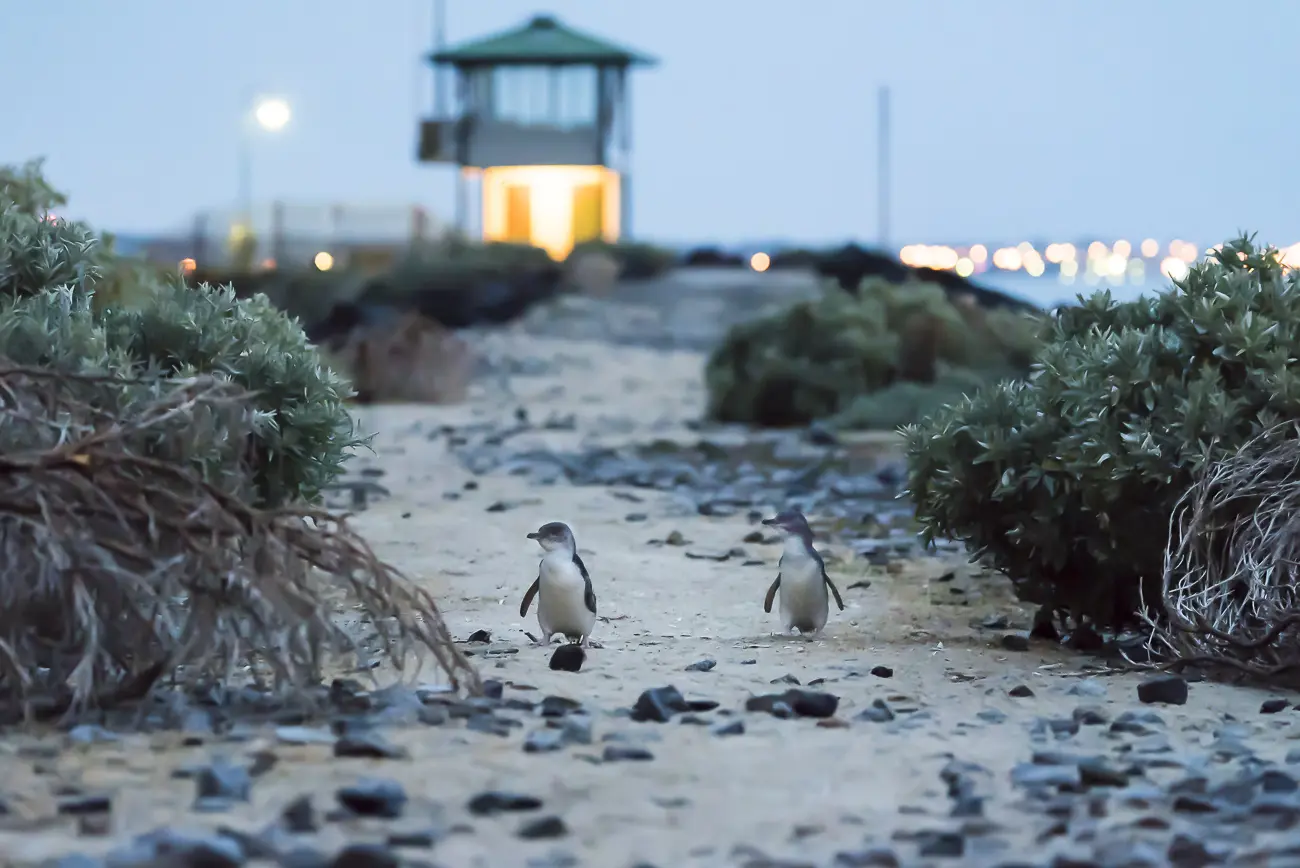 importance of collecting data to support this was paramount.
The study has continued since Mike passed away in 2001 and is coordinated by Earthcare St Kilda.
The work of Mike Cullen, Neil Blake and Earthcare St Kilda has had a major influence on the management of the breakwater and the neighbouring foreshore.
How the St Kilda Breakwater Became a Home for Little Penguins
The story of the St Kilda penguins is one of the most unusual urban wildlife success stories in Australia. A colony of Eudyptula minor – the little penguin, the smallest of the world’s seventeen penguin species – has made its home on a human-built rock wall just seven kilometres from the centre of Melbourne. It is the only mainland breeding colony of little penguins in Victoria that sits inside a major city, and it exists almost entirely because of a coincidence of engineering.
The breakwater that protects St Kilda Harbour was not built for wildlife. It was constructed in 1955 as part of the upgrade to St Kilda Pier, replacing an older timber breakwater with a heavy rubble-stone structure built from bluestone, urban rubble, sand and fill. The motive was practical: to provide calmer water for the sailing clubs that used the harbour and to protect the pier itself from the south-westerly swells that sweep across Port Phillip Bay. Nobody involved in the design work expected the structure to become one of the most watched wildlife sites in Melbourne.
The First Penguins Arrive
Little penguins almost certainly used the southern shores of Port Phillip Bay long before Europeans arrived, but recorded observations of penguins at the new breakwater only began to appear in the 1970s. The first documented nesting at the St Kilda rocks was recorded in 1974, when birds were seen entering and leaving gaps in the rubble at dusk. By 1989 researchers had identified around 100 individuals living among the stones – a modest colony, but an extraordinary one given its location.
What made the breakwater attractive was precisely what made it useful as coastal engineering. The jagged voids between the basalt and bluestone boulders created hundreds of cool, dark, predator-resistant cavities that mimicked the burrows penguins dig on offshore islands such as Phillip Island and Gabo Island. There was also no fox or cat population able to penetrate deep into the rock pile, and the bay itself offered reliable access to the small schooling fish – mostly pilchards, anchovies and barracouta – that little penguins rely on to feed themselves and their chicks.
The Research Era: Mike Cullen and the First Long-Term Study
Scientific interest in the colony began almost as soon as concern for it did. In 1986 the St Kilda Council raised plans to redevelop parts of the harbour, and Professor Mike Cullen of Monash University was invited to assess what impact this might have on the young colony. Professor Cullen declined a formal commission but chose instead to begin what would become one of the longest-running little penguin studies on mainland Australia.
For more than a decade, from 1986 to 1998, Cullen made fortnightly visits to the breakwater, often working long past midnight under the glow of a head torch. Birds were weighed, banded and measured, breeding success was tracked season by season, and foraging ranges were inferred from morphological changes between visits. He was consistently supported by Neil Blake from the St Kilda Council, who would become a central figure in the colony’s later protection. The routine was modest but disciplined, and it established a baseline of scientific knowledge that still underpins management decisions today.
The work became the intellectual foundation for the community group that grew up around it. Earthcare St Kilda was established in 1989 as a not-for-profit local volunteer organisation, originally focused on protecting and studying the colony before expanding into broader marine conservation and education. The volunteer researchers and guides that Earthcare trained over subsequent decades learned their methods directly from Cullen’s long-term dataset.
Formal Protection: The 1992 Wildlife Management Declaration
By the early 1990s it had become clear that the breakwater colony was nationally significant, not a curiosity. A community campaign driven largely by Earthcare and local residents argued that an urban colony needed the same legal standing as more remote breeding sites. The campaign succeeded. In 1992 the St Kilda Breakwater was formally declared a Wildlife Management Cooperative Area under Victorian legislation – a designation that obliged the managing authorities to consider the penguins in every decision affecting the structure.
The declaration arrived just in time. Less than a decade later the breakwater itself would need major engineering work, and without legal protection the penguins would have had little standing in the design process.
The 1998 Refurbishment: Rebuilding the Home Without Losing the Residents
Between 1998 and the early 2000s the breakwater was comprehensively refurbished – a project that moved approximately 22,000 tonnes of rock over roughly four years. From a penguin’s perspective this was potentially catastrophic. Thousands of nesting cavities could have been lost or sealed, birds could have been crushed during stone placement, and the disturbance of nightly construction lighting could have disrupted decades of breeding behaviour.
Neil Blake and the Earthcare volunteers, armed with Cullen’s dataset, worked closely with the engineers to stage the work around breeding seasons and to design the new rock arrangement with penguin-friendly voids deliberately built in. The result was unusual in Australian coastal engineering: a hard-infrastructure project that was adjusted around the needs of the wildlife already living on it. Mike Cullen passed away in 2001 before the work was complete, but the study he began continued under Earthcare’s coordination and has now been running continuously since 1986.
Growth of the Colony and the Rise of the Penguin Guides
In the decades since protection was granted, the colony has grown from around 100 observed individuals in 1989 to a current estimate of roughly 1,400 penguins, of which about 400 are actively breeding. As the population grew, so did the number of people who wanted to see them. By the late 1990s Earthcare had begun training volunteer “penguin guides” – local residents given formal instruction in penguin behaviour, viewing etiquette and colony research protocols. At its peak the program supported around 180 guides and 30 research volunteers, and by the late 2010s the breakwater was attracting international visitors year-round.
The guides also became the colony’s most effective defence. On any given evening they would intercept visitors using flash photography, prevent people climbing on the rocks, rescue penguins that had wandered onto nearby paths, and quietly enforce the three-metre viewing distance that the penguins need to move freely between the water and their nests.
The 2024 Pier Reopening and the Colony Today
In 2017 the ageing St Kilda Pier was declared at the end of its design life, and in 2022 construction began on a full replacement. Designed by Jackson Clements Burroughs, the new pier was angled south and finished with a curved end to improve wave dynamics around the breakwater. The project temporarily closed penguin guiding for the first time in decades, and Earthcare worked with Parks Victoria and Phillip Island Nature Parks to minimise impact on the colony during the construction period.
The new pier was officially opened on 7 November 2024, and penguin viewing resumed along an upgraded boardwalk that now provides safer sightlines without bringing people closer to the nesting rocks. Phillip Island Nature Parks – the organisation that manages Victoria’s best-known little penguin colony at the Summerland Peninsula – now provides operational support at St Kilda, complementing Earthcare’s volunteer base. The day-to-day research, tagging and monitoring work, however, remains in the hands of the community group that began it in 1986.
Why This History Matters
The St Kilda colony is often described as an accident of history – a few dozen penguins that stumbled onto a 1950s breakwater and never left. That framing undersells what the colony actually represents. It is a living demonstration that a wild population of an iconic Australian species can not only tolerate an urban harbour but thrive in it, provided the community around the site chooses to treat its wildlife as permanent residents rather than seasonal visitors. The same principles that have sustained the St Kilda colony for nearly four decades – legally binding protection, unbroken long-term research, trained volunteer guides, and engineering projects adjusted around the needs of the birds – are now cited internationally as a template for urban seabird conservation.
The little penguins at St Kilda have lived through a harbour redevelopment, a four-year breakwater rebuild, the loss of the scientist who first studied them, two pier reconstructions and a pandemic-era closure. They are still there, coming ashore at dusk, nesting in the same rock voids their great-grandparents used, and continuing to write one of the most unlikely urban wildlife stories in Australia.