
Stand quietly near the breakwater on a mild November evening and you’ll sometimes hear it before you see anything: a short, urgent, wheezy call coming from somewhere down in the rocks, repeated, almost impatient. That’s a chick begging for food. Its parent has just come ashore after a full day at sea and is about to do something worth understanding properly, because little penguin chick feeding is one of the more physically demanding things a small seabird does anywhere in the world.
We’ve watched this exchange play out on the St Kilda breakwater for years now, and it never quite loses its punch. A one-kilogram bird, barely 30 centimetres tall, spends the day out in Port Phillip Bay chasing small fish, then comes home under cover of darkness and delivers a stomach-load of half-digested seafood straight into the mouth of a chick that, within about eight weeks, will need to be big enough and strong enough to do the exact same job itself.
What little penguin chick feeding actually looks like
Little penguins don’t carry fish home in their beaks the way some seabirds do. Both parents forage independently through the day, sometimes travelling a fair distance from the colony, and what they catch gets partially digested and stored before they return to the nest. Feeding is by regurgitation: the chick pushes its bill into the parent’s throat and the parent brings up a slurry of anchovy, pilchard, sprat or whatever’s been running well in the bay that week. It looks a bit undignified from the outside, honestly, but it’s an efficient way to transfer a lot of energy quickly to a chick that can’t yet regulate its own body temperature or leave the nest to feed itself.
In the first couple of weeks after hatching, one adult stays at the nest with the chicks almost constantly while the other forages, a period researchers call the guard phase. Chicks are covered in soft grey-brown down at this stage and can’t hold their own body heat well, so a parent left alone at sea too long would risk the chick chilling. Once chicks are a bit more robust, usually a few weeks in, both parents start heading out to forage on the same day, coming back after dusk loaded up and ready to feed. That’s also roughly when demand peaks, because a growing chick’s appetite scales up fast.
If you’ve read our piece on why little penguins only ever come ashore after dark, you’ll know this nightly return isn’t casual timing. It’s a hard-wired predator-avoidance strategy, and it applies just as much during chick-rearing as at any other point in the season. Parents with hungry chicks waiting don’t get to cut corners on that caution, even when they’re clearly keen to get back and unload a full crop.
Two eggs, but not always two survivors
Little penguins typically lay a clutch of two, and both eggs are incubated for around five weeks by the two parents taking turns. We’ve covered that incubation stretch in detail in our piece on what happens inside the nest, but it’s worth restating here because feeding pressure is really where clutch size starts to matter. Two chicks hatching close together means double the demand on the parents at exactly the point when foraging trips are longest and most energetically costly.
In good years, with plenty of small pelagic fish available in the bay, both chicks can be raised through to fledging. In leaner years, the second-hatched or weaker chick sometimes doesn’t make it, simply outcompeted at the nest by a sibling that’s marginally bigger and pushier. It’s not pleasant to watch and volunteers don’t sugarcoat it when it happens, but it’s a completely normal feature of seabird breeding biology rather than a sign that something’s gone wrong at the colony. Food availability tracks water conditions in Port Phillip Bay pretty closely, which is a topic our article on water quality and penguin foraging goes into if you want the fuller picture.
The growth spurt that changes everything
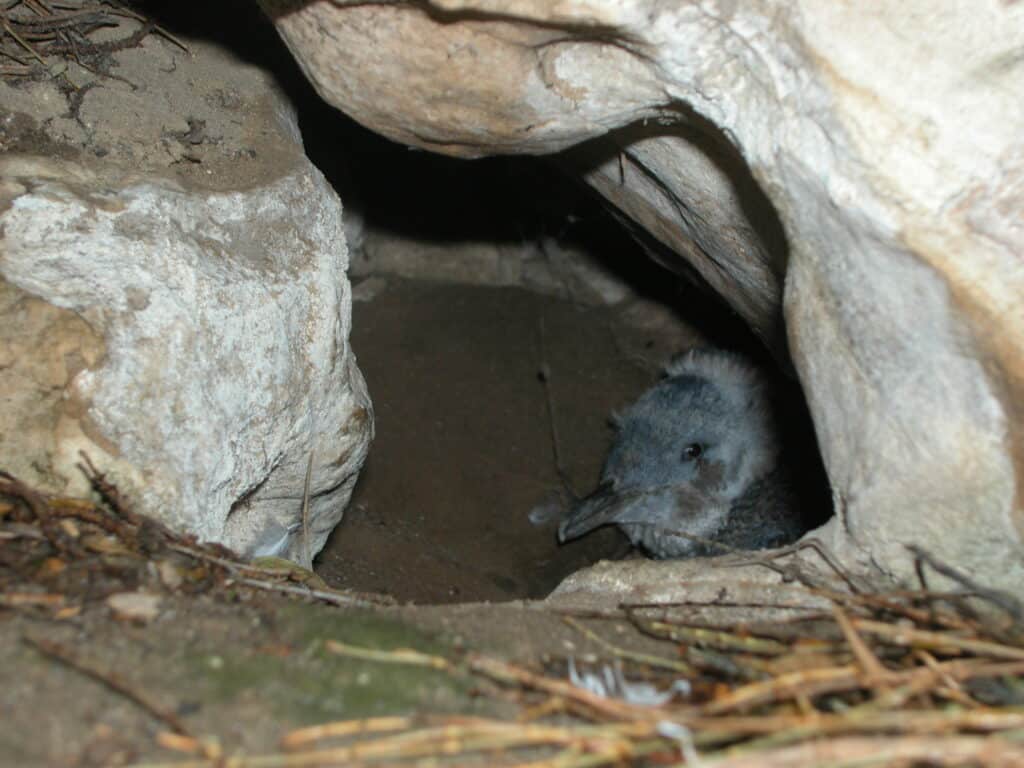
By around three to four weeks old, chicks have shed most of their natal down for a thicker, woollier grey coat and have grown enough to be left alone at the nest while both parents forage. This is when you notice the real size jump. A chick that started as a fist-sized ball of fluff is, within a month, nearly as bulky as an adult, though still without the sleek waterproof plumage it needs to actually go to sea.
That waterproof plumage doesn’t come cheap, biologically speaking. Building it takes weeks of steady, high-volume feeding, and it’s the main reason fledging isn’t a single clean event across the colony. Chicks from early-laid clutches might be ready to leave in November, while chicks from a re-laid or delayed clutch could still be at the nest well into January. Anyone expecting a tidy, calendar-perfect fledging season at St Kilda will be disappointed; the breakwater doesn’t work that way, and I’d argue that’s actually one of the more interesting things about this colony rather than a flaw in it.
Getting ready to fledge
The lead-up to fledging is visible if you know what to look for, though we’d always caution casual visitors against going hunting for it themselves, given how easily disturbance can set a chick back at exactly the wrong moment. Volunteers doing routine monitoring notice chicks starting to lose their downy grey coat in patches, revealing the smart, waterproof black-and-white plumage underneath. They’ll also see chicks venturing right to the mouth of the nest cavity, sometimes flapping their flippers experimentally, effectively practising the motion they’ll need once they hit open water.
Parents don’t accompany chicks on that first trip to sea. Once a chick fledges, it’s on its own, expected to find food and avoid predators without any further hands-on parenting. That’s a genuinely tough transition and it’s part of why juvenile survival in the first year is lower than adult survival across little penguin populations generally, a pattern documented in long-term Australian seabird research going back decades. It’s also worth remembering the historical monitoring context here. Professor Mike Cullen’s fortnightly night trips through the late 1980s and 1990s, assisted by Neil Blake from St Kilda Council, built the foundation for understanding these breeding and fledging patterns at this specific colony, and the volunteer monitoring that continues today is a direct continuation of that same long-term dataset.
Why timing varies so much bird to bird
People often ask our volunteers during evening viewing sessions why one nest seems to have fledged already while a neighbouring pair is still feeding a half-grown chick in the same week. The honest answer is that breeding at St Kilda, like most little penguin colonies, is staggered rather than synchronised. Courtship and nest re-forming starts anywhere from late July through October, eggs get laid from August into early November, and that spread alone guarantees chicks will be at wildly different stages by summer.
Add in the fact that roughly 18 to 50 percent of young penguins end up switching mates after an unsuccessful first pairing, and you get even more variation, because a bird re-pairing partway through a season is starting its breeding clock later than a settled, long-term pair reusing the same cavity. We’ve written separately about why some St Kilda penguins sit out a breeding season entirely, which is the other end of the same story: not every adult breeds every year, and that too adds to the scattergun timing you see across the colony each summer.
What this means for evening visitors
If you’re planning a visit hoping to see a feeding event, patience matters more than any particular calendar date, something we go into at length in our guide on patience versus timing at the breakwater. Feeding happens at the nest, mostly out of sight in the rock cavities, not out in the open where torches and cameras could easily disrupt it. That’s precisely why flash photography and handheld torches are such a problem here, and why volunteers are firm about asking visitors not to use them; a startled adult delaying its return, or aborting a feeding visit because of a light flare, has real costs for a chick that needs regular, uninterrupted feeds to make its fledging weight in time.
The practical upshot for anyone coming down for an evening is that you’re far more likely to see adults arriving from the water after dusk, moving across the rocks toward their nest cavities, than you are to see an actual feed. That arrival itself is worth the trip. Knowing what’s happening just out of view, underneath the rubble stone, makes it land differently.
One thing I’ll say plainly, because I think it gets glossed over in a lot of general penguin content: chick-rearing season is genuinely stressful for this colony, physically and logistically, and it’s the period where careless human behaviour does the most damage. An off-leash dog on the rocks, a boat running too close inshore, a bright phone torch pointed at the wrong moment – any of it lands harder on a bird mid-feeding-cycle than at other times of year. If you take one thing away from an evening at the breakwater during summer, let it be that the quiet, unremarkable-looking rock wall in front of you is doing an enormous amount of biological work right under the surface.