
Half past eight on a clear evening, and along the viewing boardwalk at the end of St Kilda Pier there’s a row of people checking their phones every ninety seconds, convinced they’ve missed something. They haven’t. This is, we reckon, the single most common misunderstanding about visiting the colony: people treat it like a scheduled show with a curtain time, when really it’s the opposite. Your session has a start and a finish, but the penguins don’t. Waiting for them to come ashore is not a countdown. It’s a watch-and-wait exercise that rewards the person who stops checking the time.
Across every month of the year, the birds have never once read the guidebook. Some nights the first porpoising shape appears in the shallows the moment the sky goes properly dark. Other nights most of the session goes by before anything shows, and you start wondering if tonight’s the night nobody comes in at all (they always do, eventually, but the doubt creeps in). Patience isn’t a nice-to-have for this. It is the actual skill required.
Why waiting for penguins to come ashore beats chasing a “best time”
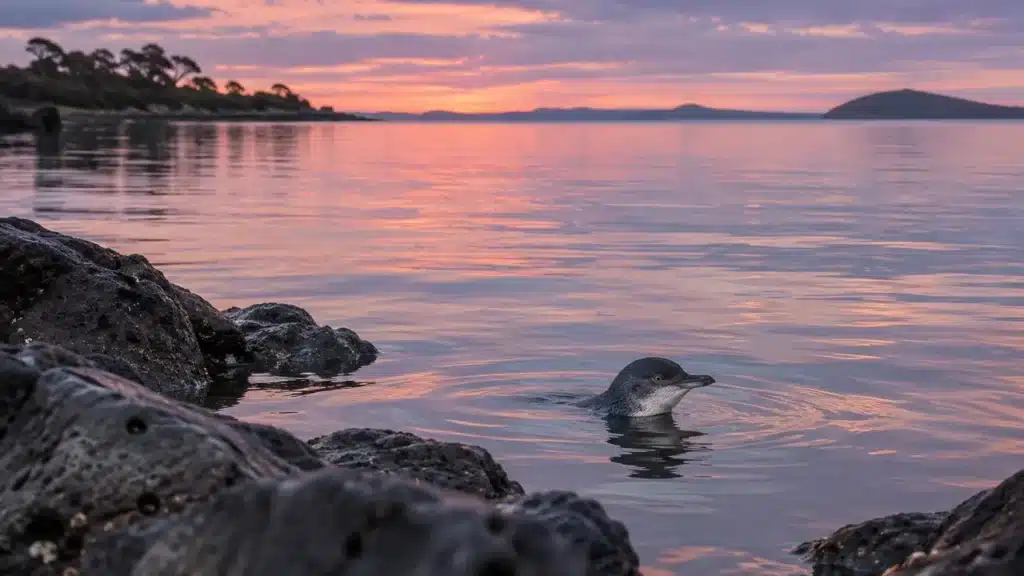
Little penguins spend the entire day out foraging in Port Phillip Bay and only return to the breakwater after dusk, under cover of darkness. That much is predictable. What isn’t predictable is the precise minute, because it depends on how far they travelled, how good the fishing was, sea conditions, and frankly a bit of individual bird temperament. Some birds are early. Some dawdle offshore for ages, apparently working up the nerve, before finally waddling up over the rocks.
This is why we’d steer you away from treating a session like a “peak time” that guarantees instant results. Public viewing now runs as nightly free but ticketed one-hour sessions on the 150-metre elevated boardwalk, operated by Phillip Island Nature Parks, with one session at sunset and one after dark, each limited to 150 people and with bookings essential. Session times shift with sunset through the year. The sensible approach is to choose the session that suits you, find a spot at the railing and treat the whole hour as your window rather than a single moment. The guides on the boardwalk will tell you the same thing, because the birds arrive in trickles and clusters, not on a timer.
What’s actually happening while you wait
The wait isn’t dead time, even when nothing is visibly happening on the rocks below. Underneath the surface, penguins are often gathering in small rafts just offshore, working up the courage to make the dash across open water and exposed rock where they’re vulnerable to boat traffic and, historically, to predation risk. That instinct to bunch up before committing to land is well documented and it’s one reason a single penguin rarely comes ashore alone if there are others nearby.
While you’re at the railing in the dark listening to the water slap against the rubble stone, it’s worth remembering this breakwater wasn’t built for them at all. It went up in 1955 as part of upgrade works to St Kilda Pier, and the colony that lives in its cavities today formed entirely on its own, uninvited and unplanned. That accident of engineering is, if you think about it, a fairly remarkable thing to be standing above on a quiet Tuesday night.
Reading the signs instead of the clock
Long-term observation of the colony, going back to the fortnightly monitoring trips Professor Mike Cullen of Monash University ran from 1986 with help from Neil Blake at St Kilda Council, has given researchers a decent sense of the rhythms here, even if the exact arrival time on any given night stays stubbornly unpredictable. What you can read, standing there in the dark, is noise. The breakwater gets genuinely loud after dusk once birds start calling to their partners and to chicks in nearby cavities, and that swell of calling is usually your best signal that arrivals are picking up, better than any watch-check.
Wind matters too. On a rough, blustery night the birds can take longer to time their approach through the swell breaking over the rocks, and choppy conditions change the whole viewing experience, sometimes delaying things, sometimes compressing a slow trickle into a sudden rush once conditions ease. It’s tempting to assume a calm bay means an easy, early night. It doesn’t always work that way, and plenty of visitors have been proven wrong on that front.
The etiquette that makes the wait worthwhile
None of this patience pays off if the conditions you’re waiting in aren’t right for the birds too. Torches and flash photography genuinely disrupt a penguin’s night vision and its confidence to cross open rock, and the effect of artificial light on returning penguins is one of the best-documented disturbances at this site. It’s why the boardwalk uses wildlife-friendly lighting, and why the guides present at each session will gently remind people to keep phones down and watch from behind the railings, not to police for the sake of it. Dogs are another consideration: they’re allowed on the pier on a lead, but not on the breakwater at any time, and a loose dog near the colony is a serious problem. Given the colony sits right beside a busy harbour with regular boat traffic, a startled bird bolting back into the water isn’t a small thing.
Standing still, staying quiet, and resisting the urge to lean over the railing or shuffle about for “a better angle” isn’t just etiquette, it’s the actual mechanism by which the wait produces a sighting. Birds that sense movement or light will simply hold offshore longer. The less you do, the sooner something happens. That’s a strange thing to tell people who’ve driven across town for an evening out, but it’s true and we’d rather say it plainly than have visitors leave disappointed and blaming bad luck.
What to bring so the wait doesn’t wear you down
A big part of managing your own patience is simply being dressed and equipped for it. Port Phillip Bay throws a cold wind off the water even in the warmer months, and standing still for a full session is a different experience to walking. A proper layer and sensible shoes make the difference between an evening you’d repeat and one you’d rather forget. Torches aren’t permitted at the viewing area, so leave the phone flashlight alone entirely; if you carry a small torch for the walk back to the car or the tram stop afterwards, keep it switched off near the colony.
If you’re bringing children, the wait is genuinely part of the experience worth managing rather than rushing. A calm approach with kids tends to produce better sightings anyway, since a fidgety, loud group is more likely to keep birds offshore than a quiet one.
Timing still counts for something
None of this is an argument that timing is irrelevant, only that it’s the wrong thing to obsess over minute-to-minute. Season matters more than clock time. Winter dusk falls earlier and the sessions shift with it, so the birds tend to come ashore at a more civilised hour for visitors, which is one reason winter evenings are often recommended over midsummer for people who don’t want a late after-dark session. Breeding season, from around late July through into summer, also brings more activity and calling as pairs re-form and feed chicks, which can make for a livelier, noisier wait even if the birds themselves aren’t arriving any faster.
Some visitors get the sequence backwards. They pick a date based on their own calendar convenience, arrive expecting results on cue, and then feel cheated when nothing happens in the first ten minutes. Flip that around, pick a season that suits the behaviour, book the session that fits it, then give yourself an unhurried hour once you’re there, and the whole evening reads completely differently.
An evening that rewards sticking around
The breakwater sits about 7km from Melbourne’s CBD, which is part of what makes this colony so unusual, it’s the only mainland little penguin breeding colony in Victoria inside a major city. That proximity means people often think of it as a quick stop on a bigger night out, ducking down for ten minutes before dinner. We’d gently push back on that plan, and in any case a booked session doesn’t really work that way. If you can, make the penguins the actual destination rather than a side errand, and pair the wait with a proper wander along the pier and foreshore either side of it.
The birds will come in. They always have, night after night, for decades of recorded observation and probably long before anyone was counting. Your job isn’t to catch the exact moment. It’s to be there, settled, quiet and reasonably patient, when it happens.