
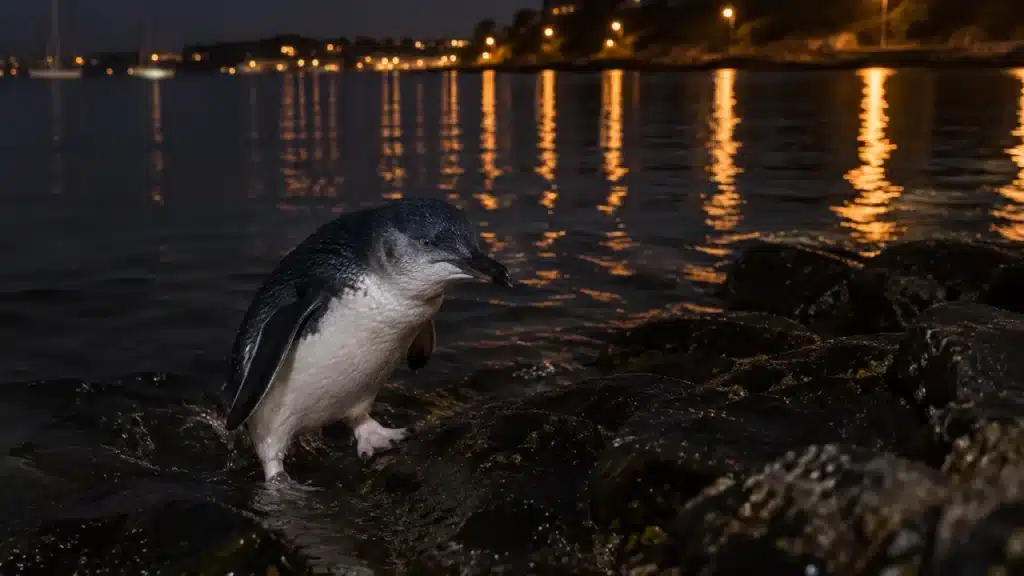
Stand on the St Kilda breakwater about twenty minutes after sunset and you’ll notice something odd: the birds are out there, you can sometimes hear them, but they won’t come in. They bob in the dark water off the rocks, sit low, wait. A stretch of harsh light spilling across the landing zone is often enough to hold a little penguin offshore for a good while longer than it would otherwise need to be. That hesitation is the whole problem in miniature.
Little penguins (Eudyptula minor) forage at sea all day and return to the breakwater under cover of darkness, which is exactly why public viewing at St Kilda happens at dusk rather than during the day. It’s not a scheduling quirk for visitors. It’s biology. These birds have evolved to use the cover of night to avoid predators on their approach to land, and artificial light along the foreshore cuts straight through that strategy.
Why darkness matters for a bird that can’t see well in glare
A penguin swimming toward the rocks at dusk is relying on low light to mask its approach from predators, historically things like raptors picking off stragglers at the water’s edge. It’s an ancient behaviour, tuned over a very long time to a world without streetlights, boat lights, or camera flashes. When a bright light source sits near the colony’s usual landing points, it does two things at once: it makes the penguin more visible and exposed right when it’s most vulnerable, and it disrupts the visual cues the bird uses to judge when it’s genuinely safe to come ashore.
Researchers who’ve spent time on the breakwater at night describe the effect as birds “rafting up” further offshore, sometimes for extended periods, waiting for a light to move or dim before making the final approach. It’s not that the light burns them or causes direct harm in the way, say, a hot pavement might. The harm is behavioural: delayed landings mean less time on the nest, less time relieving a fasting partner, and repeated nights of disrupted routine that add stress to a breeding season already asking a lot of these small birds.
Where the light actually comes from
It’s easy to picture “light pollution” as some abstract glow over the city. On the ground at St Kilda it’s much more specific than that. It’s headlights swinging across the pier as cars turn near the foreshore car parks. It’s marina and boat lighting reflecting off the water. It’s pedestrian lighting along the pier walkway that, depending on angle and brightness, throws a hard line of glare toward the breakwater’s landing rocks. And it’s visitors’ own phone torches and camera flashes, which we’ve written about separately because they’re one of the most preventable sources of disturbance going.
None of these are exotic causes. They’re ordinary, everyday infrastructure and ordinary human behaviour, which is exactly why the issue is so persistent. You can’t easily “switch off” a working harbour, and you shouldn’t have to choose between a functioning pier and a resident penguin colony. The realistic goal, and the one volunteers and researchers have pushed for over the years, is smarter light placement and shielding rather than wholesale removal.
What the research record actually shows
This isn’t a new concern invented for a listicle. Long-term monitoring of the colony goes back to 1986, when Professor Mike Cullen of Monash University began fortnightly night trips to study the birds after a harbour redevelopment proposal raised questions about their future, work he continued until his death in 2001, with Neil Blake of St Kilda Council assisting him in those early years. Volunteer monitoring has carried on in the decades since, and artificial light has remained a live concern precisely because the breakwater sits inside a working, lit, heavily visited harbour rather than somewhere remote.
That’s the thing that makes St Kilda’s colony genuinely unusual. It’s the only mainland breeding colony of little penguins in Victoria that sits inside a major city, about 7km from the CBD. Most Australian little penguin colonies exist well away from this kind of ambient urban light. This one doesn’t have that luxury, so managing light exposure has to be an ongoing, practical piece of the colony’s protection rather than a one-off fix.
Boat lighting and the harbour itself
Foreshore lighting gets most of the attention, but boat traffic contributes its own layer. Marina lighting, spotlights from passing vessels, and even navigation lights held at the wrong angle can wash across the rocks at the exact moment birds are trying to time their approach. Combined with the ever-present risk of boat strike in a working harbour, it’s another reminder that this colony survives in genuinely difficult surrounds, wedged between a rubble-stone wall built in 1955 for a pier upgrade and a busy stretch of Port Phillip Bay traffic. The wall was never designed with penguins in mind. They just moved in.
I’ll be honest: I think the harbour’s various light sources get treated a bit too separately in public conversation, foreshore lighting here, boat lighting there, camera flashes somewhere else, when really it’s the cumulative glow that matters most to a bird trying to read the dark. Fixing one source while ignoring the others is only ever a partial win.
What actually helps, based on what’s worked elsewhere
The practical measures aren’t complicated, even if implementing them across a working foreshore takes patience. Shielding fixtures so light points down and outward rather than sideways toward the water reduces glare without removing the safety lighting people genuinely need on a pier. Lower-intensity, warmer-spectrum globes disturb nocturnal wildlife less than harsh white light, a principle backed by the sort of guidance Victoria’s environment department publishes on minimising impacts on nocturnal species more broadly. And timing matters too: motion-sensor lighting that stays dim by default and only brightens when someone’s actually walking past does a lot of the same job as constant floodlighting, with far less disruption to a bird trying to land forty metres away.
For visitors, the single biggest lever is the simplest one. No flash photography, no torches pointed at the water or the rocks, and if you’re bringing a phone out to film, keep the screen brightness down and pointed away from the shoreline. We’ve covered why flash photography and torches are such a persistent problem for this colony in more detail, and it’s worth reading if you’re planning a dusk visit, because the effect on a returning penguin is more direct than most people expect.
How this fits with the other pressures on the colony
Light disruption doesn’t operate in isolation. It sits alongside off-leash dogs on the rocks, marine plastic and fishing-line entanglement, boat strike risk, and the underlying vulnerability of predation from foxes and cats given the colony’s mainland location. None of these threats are dramatic on their own, most nights nothing visibly goes wrong, but they compound. A bird that’s delayed landing because of glare off the pier is also a bird spending longer in open water near boat traffic, which is longer exposed to every other risk on that list. That’s really the throughline across all of this: it’s rarely one single event that threatens an urban colony like St Kilda’s. It’s the accumulation of small, manageable pressures that, left unmanaged, add up.
Volunteers who guide public viewing at the breakwater spend a good deal of their time simply managing light and noise around visitors, alongside the population counts, weighing and banding that make up the longer-term research record. It’s unglamorous work, mostly standing quietly in the dark asking people to turn a phone screen away from the water, but it’s the sort of hands-on management that keeps this colony’s numbers stable in surrounds that were never built for wildlife.
What you can do if you’re heading down at dusk
If you’re planning a visit, timing and light discipline matter more than almost anything else. Arrive as light is fading rather than after full dark, follow the volunteer-guided viewing arrangement rather than wandering the rocks independently, and treat any light source you’re carrying, phone included, as something to keep pointed at the ground or switched off entirely near the shoreline. Zoos Victoria’s wildlife conservation guidance makes a similar point about nocturnal seabirds more broadly: the kindest thing an observer can do is often simply be less visible themselves.
The breakwater isn’t going anywhere, and neither, touch wood, is this colony. But it exists on human terms, on a human-built rock wall in a lit, trafficked harbour, and the small decisions made about lighting, on the pier and in visitors’ own pockets, genuinely shape how easily these birds get home each night. Next time you’re down there at dusk, watch for the birds sitting low and quiet just off the rocks. That pause you’re seeing is exactly what this whole issue is about.