
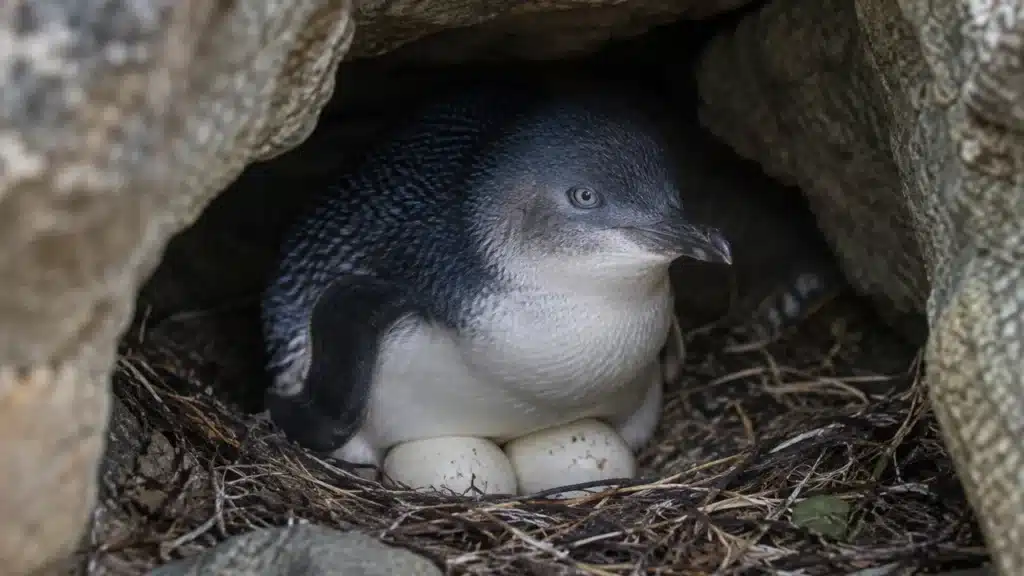
Deep inside one of the breakwater’s cavities on a still August evening, well out of sight of anyone on the boardwalk, there’s a sound: a low, steady growling grumble coming from somewhere in the rock. That’s not distress. That’s one adult little penguin telling its partner, returning from a day at sea, exactly where the nest is. Little penguin incubation is happening in there right now, and it’s a far more physical, far more negotiated process than most people watching from the pier ever realise.
Decades of volunteer monitoring have mapped the rhythm of it closely. Eggs go down anywhere from August to early November at St Kilda, always in a clutch of two, and from that point the parents are locked into roughly five weeks of shared incubation before anything hatches. Five weeks is a long stretch for a bird that weighs about a kilogram and needs to eat constantly to fuel it.
Why little penguin incubation is a two-bird job
Little penguins can’t do this alone, not really. One bird sitting the entire five weeks without a break would starve or come close to it, so the pair splits the duty into shifts. While one parent sits tight on the eggs, tucked into the cavity out of the wind and away from gulls, the other heads out into Port Phillip Bay to forage, sometimes for a day, sometimes stretching to several days running before it returns to swap over.
The bird coming home doesn’t just wander in. It calls from the water’s edge or from just outside the cavity mouth, and the sitting bird answers. Researchers who’ve spent years around this colony describe it as a recognition system as much as a greeting; each pair develops calls distinctive enough that partners can find each other in a cavity-riddled rock wall in pitch darkness, surrounded by dozens of other calling birds doing exactly the same thing. It’s genuinely one of the more remarkable things about the colony, and it’s a big part of why the breakwater gets so noisy after dark through the breeding months.
What the swap-over actually looks like
The changeover itself is unhurried, almost businesslike. The returning bird, often visibly heavier from a good feed at sea, shuffles past its partner in the cramped cavity space. There’s some mutual preening, a bit of bill-touching, and then the incoming bird settles its body down over the two eggs, rocking slightly to get proper contact between skin and shell. The outgoing bird, now free, waddles off toward the water for its own turn foraging.
This isn’t casual timing. Get the swap wrong, leave gaps too long, and the eggs cool below the temperature they need. Little penguins develop a brood patch for exactly this reason: a patch of skin on the lower belly where feathers thin out temporarily, allowing direct warmth to transfer to the eggs. Both sexes grow one. It’s a small adaptation but it’s doing a lot of work over those five weeks, and losing that skin-to-shell contact for too long during a Melbourne cold snap isn’t something the eggs can shrug off.
Picking a cavity in a 1955 rock wall
None of this works without the right kind of nest site, and that’s where the breakwater’s peculiar history comes into it. The wall itself is rubble stone, built in 1955 as part of the St Kilda Pier upgrade, never intended as habitat. The colony that formed inside its gaps and cavities did so entirely on its own, which is a large part of why this site keeps insisting the story is worth telling properly rather than as background scenery for a pier walk.
A good cavity needs to be deep enough to block direct sun and rain, tight enough to deter a gull from muscling in, and stable enough that it won’t shift or flood during incubation. Pairs that have bred successfully before tend to return to the same cavity year after year, which is one reason banding and monitoring work has been able to track individual birds’ nesting history for so long. If you want the detail on how that tracking actually works on the ground, our piece on the volunteer monitoring and banding programme covers it properly. Some of that long-running dataset traces back to Professor Mike Cullen’s fortnightly night trips from Monash University, which began in 1986 after a harbour redevelopment proposal put the colony’s future in question, and continued until his death in 2001 with Neil Blake from St Kilda Council assisting him on the ground.
That continuity matters more than it sounds. Fifteen years of consistent fortnightly visits is a genuinely unusual dataset for an urban wildlife colony this small, and it’s part of why researchers can say with confidence how these birds actually behave rather than guessing from a handful of observations.
What happens if incubation goes wrong
Not every clutch makes it. Eggs can fail to hatch, cavities can flood in a bad storm, and a parent that doesn’t return on schedule leaves its partner in a genuine bind, forced to choose between abandoning the eggs to go and feed itself or holding on and risking its own condition. This is one of the quieter costs of the colony’s unusual position: a wild breeding population squeezed onto a human-built structure right beside one of Melbourne’s busiest stretches of water, seven kilometres from the CBD, with all the boat traffic, artificial light and disturbance that comes with it.
It’s tempting to assume nest failure here is mostly about predation. It’s more often about the ordinary hard yards of timing, weather and food access than anything dramatic.
Foraging conditions in the bay directly shape how reliably a bird can get back on time. When fish stocks or water conditions in Port Phillip Bay shift, foraging trips get longer, and longer trips put more strain on the incubating partner left waiting. We’ve written before about how the bay’s water quality decides what these penguins actually eat, and it’s worth understanding as background to why incubation timing isn’t always neat and predictable, no matter how well the textbooks describe the five-week average.
Hatching and the shift to feeding duty
Chicks start appearing from September through to December, and the moment they hatch the whole dynamic in the cavity changes. Incubation behaviour, all that stillness and careful shell-warming, gives way almost immediately to something far more frantic: near-constant feeding runs, with parents returning most nights carrying whole fish for chicks that grow at a startling rate for their first few weeks.
The shared-shift habit doesn’t disappear though. It just gets repurposed, with one adult guarding tiny, thermally vulnerable chicks in the cavity while the other forages, before eventually both parents start heading out once the chicks are large enough to be left alone.
Why pairs mostly stick together, but not always
Little penguins are broadly monogamous season to season, and a pair that’s raised chicks successfully together tends to reuse the same cavity and the same partner year after year, which makes sense given how much coordination this incubation process demands. But it’s not universal. Something like 18 to 50 percent of young birds, after a first pairing doesn’t work out, will find a new mate the following season. That’s a wide range, and it probably says more about how variable individual bird behaviour is than researchers can fully pin down yet, rather than pointing to any single cause.
None of this happens where you can watch it, which is worth remembering next time you’re at the pier at dusk hoping for a glimpse. Incubation is a daytime, hidden-in-the-rock process; what you actually see on an evening visit is birds returning from the day’s foraging, calling their way back to partners and chicks after dark, which is why little penguins only ever come ashore after dark in the first place. That viewing happens from the elevated boardwalk at the end of St Kilda Pier, in free but ticketed one-hour sessions run by Phillip Island Nature Parks, with two sessions each evening and bookings essential — our visiting guide explains how to book. If you’re planning a visit during the breeding months, it’s genuinely worth pairing that trip with some background reading first; the seasonal calendar page lays out what’s happening across the whole year so you know roughly what stage the colony’s at when you turn up.
The Department of Energy, Environment and Climate Action’s species pages and Zoos Victoria’s published material on Eudyptula minor both go into the physiology of incubation and brood patches in more depth than we’ve got room for here, and they’re solid places to read further if you want the primary detail behind what researchers describe at ground level on the breakwater. What the long-running monitoring record tells us is that behind every calm little penguin waddling up the rocks at 9pm is five weeks of shift work most visitors never think about.