
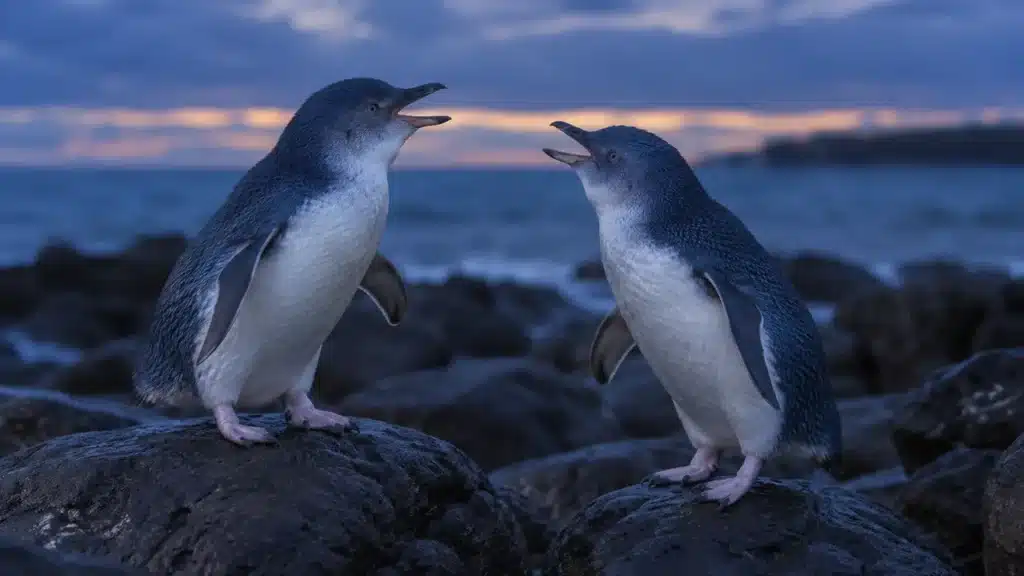
Stand on the breakwater about twenty minutes after the sun drops behind the bay and you’ll hear it before you see anything: a low, braying wail rising out of the rocks, then another answering it from somewhere further along the wall. It sounds nothing like a bird. First-time visitors often assume it’s a possum, or someone’s unhappy dog. It’s the little penguins, and if you’re wondering why St Kilda penguin calls get so loud and so constant right at dusk, the short answer is that this is peak traffic hour for a colony that’s been apart all day.
We get asked about the noise more than almost anything else on guided viewing nights. It genuinely startles people. A 30cm, one-kilogram bird producing a sound that carries fifty metres across open rock feels disproportionate, but that’s rather the point. These calls have to do a lot of work in not much time, and evolution has favoured volume over subtlety.
Why dusk is when the noise starts
Little penguins spend the daylight hours foraging out in Port Phillip Bay, sometimes travelling considerable distances chasing small fish and krill, and they don’t return to the breakwater until after dark. That’s not a quirk of this particular colony, it’s a survival strategy shared across the species’ range on the temperate coasts of southern Australia and New Zealand: coming ashore in daylight would leave them exposed to airborne predators, so they wait for cover of darkness before waddling back up the rocks. You can read more about how that daily foraging pattern works, and how conditions out in the bay shape it, on our page about foraging behaviour of little penguins.
The upshot is that an entire colony arrives home within roughly the same window, all at once, all needing to find their mate, their chick, or their nest cavity in the dark among dozens of identical-looking rock crevices. That’s the trigger for the racket. It isn’t random noise, it’s a very compressed burst of communication happening because several hundred birds need to sort themselves out fast.
The contact call: finding your own in the dark
The call most people notice first is the long, rhythmic braying duet, often described as donkey-like, that happens when a returning bird finds its partner. Little penguins are usually monogamous season to season and will reuse the same nest cavity for years running, so a returning bird isn’t searching blind. It’s heading for a known address. But partners still need to confirm it’s genuinely them, not a neighbour, and the contact call does that job. Researchers who’ve spent years on this colony describe the calls as individually distinctive enough that mates can recognise one another by voice alone, which matters enormously in a rockpile where visual identification is close to useless after dark.
If you listen carefully you’ll notice these calls often come in a call-and-response pattern, one bird starting, its partner answering from inside the burrow. It’s not that different, honestly, from someone calling out “I’m home” and getting a muffled reply from the back room. Fair dinkum, that’s basically what it is.
Aggressive and territorial calls at burrow entrances
Not every sound on the breakwater is a happy reunion. A sharper, more staccato bark or growl usually means a territorial dispute, most often when a bird returning to its burrow finds another penguin loitering too close to the entrance, or when a young, unpaired bird is testing out cavities that already belong to someone else. Nest sites on the breakwater are limited, wedged into a rubble-stone wall that was built in 1955 as part of the St Kilda Pier upgrade and was never designed with penguins in mind at all. The colony simply moved into the cavities on its own. Because good real estate is scarce, defending a burrow matters, and the calls that go with that defence are noticeably harsher and shorter than the contact duets.
This aggressive vocalising tends to spike during the courtship and nest re-forming period from late July through October, when pairs are competing for the best cavities before eggs are laid in the August-to-November window. It settles down somewhat once incubation starts and both birds are focused on the roughly five-week shared incubation of their clutch.
What all that calling is actually achieving
It’s worth stepping back and thinking about what these vocalisations are doing biologically, because it isn’t just noise for noise’s sake. Three things, broadly:
Mate and chick recognition tops the list, for the reasons above. A second function is advertising: an unpaired bird calling from a burrow entrance is, in effect, broadcasting availability and location to prospective partners. That matters more than you’d think given that somewhere between 18 and 50 percent of young birds that don’t succeed with a first pairing go on to find a different mate the following attempt. The calling is part of how that re-matching happens. Third, there’s the territorial function described above, which keeps burrow disputes from turning into constant physical fights, since a loud warning bark can do the job before it comes to biting.
Once chicks hatch, from around September through December, there’s a fourth layer: begging calls from the chicks themselves, a thinner, more insistent sound directed at returning parents carrying a stomach full of whole fish. Anyone who’s stood at the viewing area during peak chick season will know this sound, it’s higher-pitched and considerably more relentless than the adult calls.
Why the noise matters for how you should behave on the rocks
Here’s where I’ll offer a view that’s maybe a touch more pointed than strictly neutral: I think a lot of visitors underestimate how much stress they can add to an already chaotic, noisy, high-stakes half hour for these birds, simply by being loud or bright themselves. The penguins are already navigating in near-total darkness, using calls to find family in a wall full of identical crevices. Adding torchlight or flash photography into that mix doesn’t just startle an individual bird, it can disrupt the whole re-entry process for a section of the colony, delaying birds from reaching chicks that need feeding. We’ve covered the mechanics of this in more detail on our page about why flash photography and torches genuinely harm St Kilda’s penguins, and it’s also why artificial light along the foreshore more broadly is a genuine problem for the colony, which we go into on how foreshore light disrupts St Kilda penguins coming home at dusk.
Practically, this means: no flash, no torch beams pointed at the rocks, and keep your own voice down. Loud human chatter doesn’t stop the penguins calling, but it does make it harder for volunteers running guided viewing to hear what’s actually happening in the colony, and it adds one more layer of disturbance to birds that are already stressed by finding their way home in the dark next to a busy harbour.
Moult season changes the soundscape too
One thing that catches repeat visitors out is how different the breakwater sounds during the annual moult, which happens over about two weeks each summer. During moult an adult can’t go to sea, so it stays put on the rocks fasting on stored fat while it grows a fresh, waterproof coat of feathers. Moulting birds are far less vocal in that contact-call sense, since they’re not out foraging and returning each night, but they can be irritable if approached, and you may hear short, sharp warning calls if you get too close to a moulting bird tucked into a crevice. We’ve written more on what to expect during this stretch on our Moulting Time page, and there’s a companion piece on Moult is here if you’re trying to work out why the colony looks and sounds quieter on a given visit.
Listening without disturbing
I’ve stood at the viewing platform on plenty of dusk sessions now, and I’ll admit the first few times the noise threw me. It’s louder and stranger than anything you’d expect from a bird the size of a large zucchini. But once you know what you’re listening for, the pattern becomes obvious: long braying duets for reunions, sharp barks for territorial spats, thin insistent begging from chicks once the season turns. It’s basically a running commentary on the private business of several hundred birds, and you happen to be standing close enough to eavesdrop.
Trained volunteers run guided viewing sessions most nights and can point out which call is which in real time, which honestly makes a huge difference if it’s your first visit. Details on how that program works are on our guide to volunteer-guided viewing at the St Kilda breakwater, and if you’re planning a first trip it’s worth reading our general notes on how to prepare for a penguin-watching trip in St Kilda beforehand, particularly around timing, since arriving too early or too late means missing the peak calling window entirely.
For readers who want the deeper research background, Zoos Victoria’s work on little penguin biology and BirdLife Australia’s species profiles both cover vocal communication in seabirds more broadly, and are worth a look if this sort of behaviour interests you as much as it does us.
Next time you’re down after dark and the wall erupts into that donkey-like braying, you’ll know it’s not distress, mostly. It’s several hundred small, exhausted birds finding their way home the only way they can, by shouting until someone shouts back.