
Stand on the St Kilda breakwater at dusk in July and you’ll see a bird roughly the size of a rugby league football, waddling over rubble stone with a fish in its beak. Fly three hours east across the Tasman and you’ll find penguins that share an ancestor with that same bird, but nothing else about their daily life looks the same. That’s the honest starting point for any little penguin comparison with New Zealand’s species: shared heritage, wildly different circumstances.
We get asked about this a fair bit on viewing nights, usually by someone who’s just come back from a South Island trip and wants to know if what they saw at Oamaru or on the Otago Peninsula was “the same penguin.” Short answer: no. Slightly longer answer is the rest of this article.
What actually makes a little penguin comparison fair
Eudyptula minor is the smallest of the world’s 17 to 18 penguin species, depending on which taxonomy you follow, standing around 30 centimetres tall and weighing about a kilogram. It’s native to the temperate coastlines of southern Australia and New Zealand, full stop. Not Antarctica, not sub-Antarctic islands, not sea ice. If you want the fuller picture of how the whole penguin family spreads across climates from the equator to the polar circle, we’ve laid that out separately in our piece on how the world’s 17 penguin species really differ, because the “all penguins live on ice” line is one of the most persistent misconceptions we deal with here.
New Zealand actually hosts its own population of little penguins, plus several entirely different species that get lumped in casual conversation as “the NZ penguin.” That conflation is where most of the confusion starts.
New Zealand’s own little penguins aren’t a different species
Here’s the bit that surprises people: New Zealand has little penguins too, sometimes called Kororā, and until fairly recently taxonomists debated whether the NZ population deserved its own species status separate from the Australian one. Genetic work over the past two decades has generally settled on treating the Australian little penguin (Eudyptula minor) and the New Zealand white-flippered and North Island/South Island populations as closely related but with some regional genetic distinctiveness worth tracking. It’s a live area of ornithological research, not a closed case, and we won’t pretend more certainty than exists.
What matters for a St Kilda visitor is this: the little penguin you see return to the breakwater after dark is genuinely the same broad species complex as the small penguins colonising parts of New Zealand’s coast, not a separate curiosity. The birds most people picture when they think “New Zealand penguin,” though, are something else entirely.
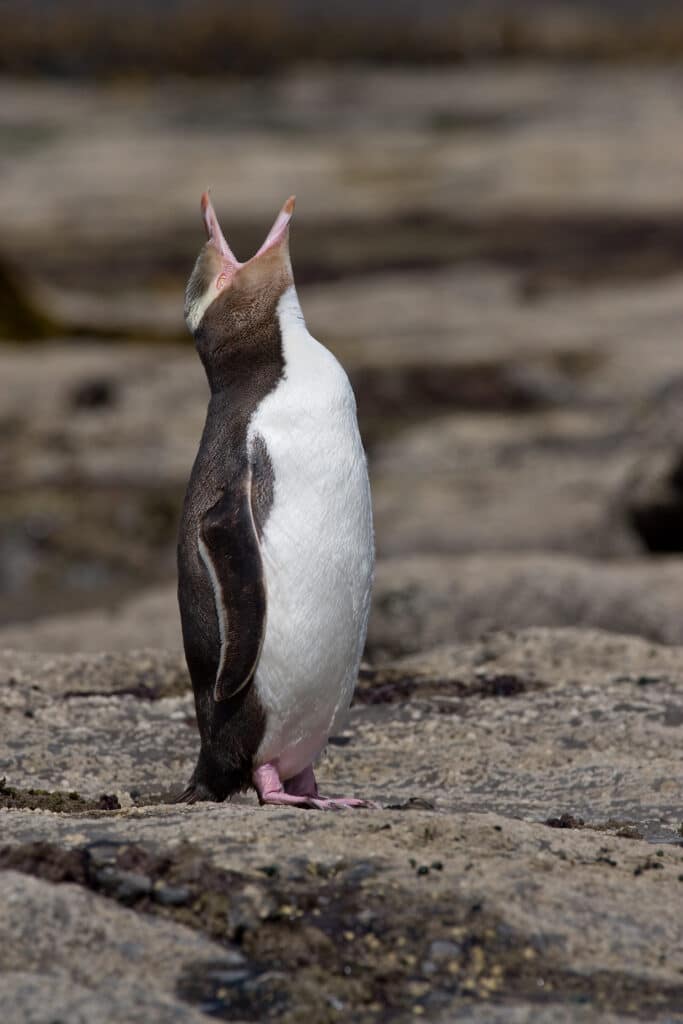
Yellow-eyed penguins: solitary, endangered, and nothing like a colony bird
The yellow-eyed penguin, or hoiho, is one of the rarest penguins on earth and it could not run a colony like St Kilda’s if it tried. Where our little penguins are comfortable nesting metres apart in the breakwater’s rock cavities, yellow-eyed penguins are famously antisocial breeders. They need to nest out of sight and sound of their neighbours, tucked into coastal forest or scrub on New Zealand’s South Island and outlying islands like Stewart Island. Put two breeding pairs within visual range of each other and you can get real stress and breeding failure.
That single behavioural difference explains almost everything about why you view the two species so differently. St Kilda works as public viewing because our colony is dense and tolerant of nearby activity when the rules are followed; a hoiho colony works the opposite way, and heavy tourism pressure has been flagged as a genuine conservation concern by New Zealand researchers over the past decade. The hoiho is also considerably bigger than a little penguin, more like 65 centimetres tall, and its population trajectory has been going the wrong way for years according to Department of Conservation monitoring data.
Fiordland penguins and the crested look
Then there’s the Fiordland penguin, or tawaki, with its yellow eyebrow-stripe crest running back from the bill, breeding in dense temperate rainforest along New Zealand’s rugged southwest coast. It’s a crested penguin, part of the Eudyptes genus, which puts it in a completely different branch of the penguin family tree to Eudyptula minor. Fiordland penguins breed earlier in the year than little penguins do and nest under root systems and in rock crevices in genuine rainforest, which is an environment about as far from a suburban breakwater as you can get while still technically being “on the mainland.”
I’ll admit the crested penguins are the ones that photograph best, with that dramatic yellow stripe, and I understand why they end up as the mental image of “penguin” for a lot of Australians who’ve never actually seen one in the wild. But photogenic isn’t the same as representative. Most of the world’s penguin species, little penguins included, are the plainer, blue-grey, business-like birds that do their work at night and don’t get postcards made of them.
Why the comparison keeps coming back to timing and access
The practical difference a visitor actually experiences comes down to when and how you see these birds, not just what they look like. Little penguins forage at sea all day and only return to the breakwater after dusk, under cover of darkness, which is precisely why public viewing here happens at night rather than during the day; we’ve gone into the mechanics of that in why little penguins only ever come ashore after dark. Yellow-eyed and Fiordland penguins have their own daily rhythms tied to their much more remote, low-disturbance habitats, and neither species offers anything like the accessible, free, dusk viewing that St Kilda does seven kilometres from Melbourne’s CBD.
That accessibility is genuinely unusual. St Kilda is the only mainland breeding colony of little penguins in Victoria sitting inside a major city, and there isn’t an equivalent for any New Zealand species I’m aware of. If you want the numbers on how our colony’s monitoring compares to the other well-known Victorian site, our comparison of St Kilda and Phillip Island’s colony size and monitoring covers that ground.
Conservation status tells a very different story on each side of the Tasman
This is where the little penguin comparison gets genuinely important rather than just trivia. Little penguins across their Australian range, including at St Kilda, are not currently considered nationally threatened, though local pressures on small colonies like ours are real and worth taking seriously; we’ve written a dedicated explainer on the little penguin’s real conservation status if you want the specifics rather than a vague reassurance.
The yellow-eyed penguin sits in a much more precarious position. New Zealand’s Department of Conservation and BirdLife International classify it as endangered, and its population on the South Island mainland has been through repeated, sometimes severe, breeding-season crashes linked to disease, food availability and predation by introduced mammals. Fiordland penguins are also considered vulnerable, largely because so much of their population is concentrated in a small number of remote breeding sites, which makes them exposed to any single bad event, whether that’s a storm, a disease outbreak or a predator incursion.
Our own colony faces a different mix of threats, mostly a consequence of being human-built and harbour-adjacent rather than remote. Off-leash dogs, marine plastic and fishing line, boat strike and artificial light disrupting the night return are the ones our volunteers deal with regularly, alongside the ever-present mainland predation risk from foxes and cats. None of that is unique to St Kilda, but the combination and the urban setting are.
Same family, different survival strategy
What I find genuinely interesting, and this is a bit of a personal view rather than settled science, is that the little penguin’s success at a site like St Kilda seems tied directly to its tolerance for crowding and its short foraging trips into a semi-enclosed bay. Port Phillip Bay isn’t open ocean, and what the birds find to eat there shapes the whole colony’s behaviour, something we cover in more detail in why Port Phillip Bay’s water quality decides what St Kilda penguins eat. The yellow-eyed penguin’s solitary strategy might work brilliantly in undisturbed rainforest coastline, but it leaves almost no margin when introduced predators or human disturbance show up. Little penguins, by contrast, seem to cope with a startling amount of proximity to people and to each other, provided the specific disturbances, dogs, lights, flash photography, are kept away from the colony itself.
Professor Mike Cullen’s long-term study of the St Kilda birds, which began in 1986 after a harbour redevelopment proposal and ran until his death in 2001, was really the first serious documentation of just how resilient this particular colony’s behaviour is inside a working harbour. Volunteer monitoring has continued in the decades since, and it’s that sustained record, not a one-off survey, that lets us say with confidence how differently this species behaves compared with its more fragile New Zealand relatives.
So next time someone tells you they “saw the same penguins” in Dunedin as they did at St Kilda, you can gently correct them. Related, yes. Cousins across a shared evolutionary line, certainly. But one is a crowd-tolerant harbour bird thriving on a 1955 rubble breakwater seven kilometres from a capital city, and the other is a solitary, endangered forest-nester fighting for every breeding season it gets. That’s not a minor distinction. It’s close to the whole story.