
Ask most people heading out along St Kilda Pier at dusk whether the little penguin is endangered, and you’ll get a shrug or a confident “yeah, definitely.” Neither answer is quite right. The little penguin conservation status nationally is not what you’d expect for a species that draws people to a rock wall seven kilometres from Melbourne’s CBD every single evening.
Plenty of visitors arrive at the viewing boardwalk with the same question: are these ones rare? The honest answer takes a bit of unpacking, because the status of Eudyptula minor depends heavily on which list you’re reading and which population you’re talking about. Nationally, the species is not listed as threatened. Locally, in Victoria, and especially for a colony sitting on an artificial rock wall next to a working harbour, the picture gets more complicated.
What the national listing actually says
Under the Commonwealth’s Environment Protection and Biodiversity Conservation Act 1999, the little penguin is not listed as a threatened species. That surprises a lot of people, given how much attention colonies like this one and the Phillip Island population attract. The species as a whole is considered secure across its range, which stretches along the temperate coastlines of southern Australia and New Zealand – nowhere near Antarctica, despite the old “fairy penguin meets ice and snow” image some people still carry around in their heads. If you want the full rundown on why that association is wrong, we’ve covered it in more detail in why St Kilda’s penguins have nothing to do with Antarctica.
The International Union for Conservation of Nature list the species globally as Least Concern, reflecting healthy overall numbers across large, stable colonies elsewhere on the Australian and New Zealand coast. That’s the global and national headline. It’s true, and it’s also not the whole story for every population wearing that species name.
Victoria’s picture is more mixed than the national one
Zoom into Victoria and the assessment shifts. The Victorian Department of Energy, Environment and Climate Action lists little penguins on the state’s advisory list of threatened vertebrate fauna, a state-level classification that sits below full statutory protection but signals real concern about particular populations and pressures within Victorian waters. That’s not a contradiction of the national picture; it’s a reflection of scale. A species can be doing fine continent-wide while individual state populations, especially small mainland ones, face genuine local pressure.
And that’s really the crux of it. St Kilda’s colony isn’t being measured against the species’ global total. It’s being measured against what it takes for a few hundred birds nesting inside the cavities of a 1955 rubble-stone rock wall to keep doing that, year after year, next to boat traffic, foreshore lighting, and a city’s worth of foot traffic. National security of the species doesn’t automatically translate to security for this particular pocket of it.
Why a small mainland colony carries different risk
Most of Australia’s largest little penguin colonies are on offshore islands, insulated to some degree from foxes, cats, and dogs simply by water. St Kilda’s colony has no such buffer. It sits on a breakwater joined to the shore, in a bay used constantly by boats, right along a foreshore lit up every night.
That’s the honest difference between “the species is fine” and “this colony needs active protection.” Off-leash dogs remain one of the most immediate risks to birds coming ashore after dark – a single encounter can be fatal, which is why dogs must be kept on a lead on the pier and are prohibited on the breakwater at all times, along with cats and fishing. Marine plastic and discarded fishing line pose an entanglement risk that has nothing to do with species-wide numbers and everything to do with what’s floating in Port Phillip Bay on any given week. Boat strike is a live risk in a working harbour. Artificial light along the foreshore can disrupt the low-light navigation penguins rely on to find their way back to the rocks after a full day foraging – we’ve gone into this in how foreshore light disrupts St Kilda penguins coming home after dusk, and it’s a bigger factor than most visitors assume. And though the colony sits on the mainland rather than an island, foxes and cats remain a documented predation risk that island colonies mostly avoid; there’s more detail on that in why foxes and cats still threaten the St Kilda penguin colony.
None of these threats show up in a global IUCN assessment. They show up in the counts, the banding records, and the day-to-day judgement calls volunteers make out on the rocks.
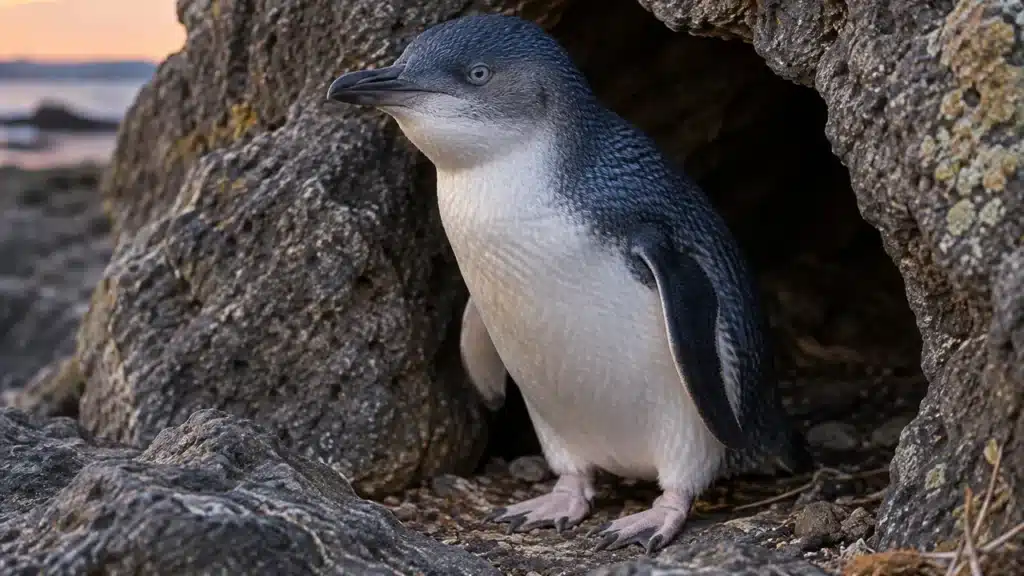
Why long-term monitoring matters more than the label
This is where we’ll offer a genuinely unfashionable opinion: the conservation-status label itself is almost the least useful piece of information for a colony like this one. A “Least Concern” tag doesn’t tell you whether this specific population is holding steady, shrinking, or quietly doing better than expected. What actually tells you that is decades of unglamorous counting.
The record here goes back further than most people realise. Professor Mike Cullen of Monash University began a long-term study of the colony in 1986, prompted by a proposed harbour redevelopment, and ran fortnightly night trips to monitor the birds until his death in 2001. Neil Blake of St Kilda Council assisted him through those years. That work didn’t stop when Cullen died – volunteer monitoring has continued in the decades since, building one of the longer continuous urban little penguin datasets in the country. You can read more about how that monitoring actually works, week to week, in inside the volunteer monitoring and banding work at St Kilda.
That’s the kind of data that actually catches a decline early, long before any list gets updated. A species-level status is a blunt instrument. Decades of counting is not.
What “not threatened” doesn’t mean for visitors
A status that says “not nationally threatened” is sometimes read by visitors as “so it doesn’t matter if I bring my dog down for a look” or “a bit of torchlight won’t hurt, there’s plenty of them.” That’s the wrong conclusion, and it’s worth saying plainly: national security of the species is not a licence to relax at the local level. Small colonies are exactly where individual bad nights add up fastest.
If you’re planning a visit, the practical behaviours matter regardless of what any list says. Viewing now happens from a 150-metre elevated boardwalk at the end of St Kilda Pier, during free but ticketed one-hour sessions run by Phillip Island Nature Parks – two each evening, capped at 150 people, with bookings essential; our penguin viewing guide covers the details. Dogs are welcome on the pier on a lead but never on the breakwater, and honestly, consider leaving them at home for this one. Skip the flash photography and torches entirely – we’ve explained the mechanics of why that specific disturbance is so damaging in why flash photography and torches genuinely harm St Kilda’s penguins. Watch quietly from behind the boardwalk railings, and take your rubbish home with you. And if you want the best chance of a good sighting without adding pressure to the colony, our guide on why winter dusk is the best time to see St Kilda penguins covers the seasonal timing in more depth than we can fit here.
The bigger picture: numbers, not labels
If you want a rough sense of scale, the Australian Museum and Zoos Victoria both note that little penguin colonies range enormously in size, from a handful of pairs to many thousands on the larger island sites. St Kilda’s colony is on the smaller, urban end of that spectrum, which is precisely why every threat gets amplified rather than absorbed by sheer numbers. A colony of a few hundred birds doesn’t have the buffer that a colony of tens of thousands does.
That’s also why the population counts, weighing, and banding volunteers carry out on the breakwater matter well beyond this one site. Data from an urban mainland colony under known pressures is genuinely useful to researchers trying to understand how the species copes with human-built habitat more broadly. If you’re curious how you can be part of that effort rather than just watching from the sidelines, how to get involved protecting the St Kilda penguin colony is a decent starting point, and How Can I Help? lays out the more general options.
So: not endangered nationally, flagged for concern in Victoria, and genuinely vulnerable at the level of this one small, human-built colony squeezed between a harbour and a city. All three of those things are true at once, and none of them cancel the others out. If someone beside you on the boardwalk asks whether these are the endangered ones, that’s roughly the answer – longer than they were expecting, but accurate.