
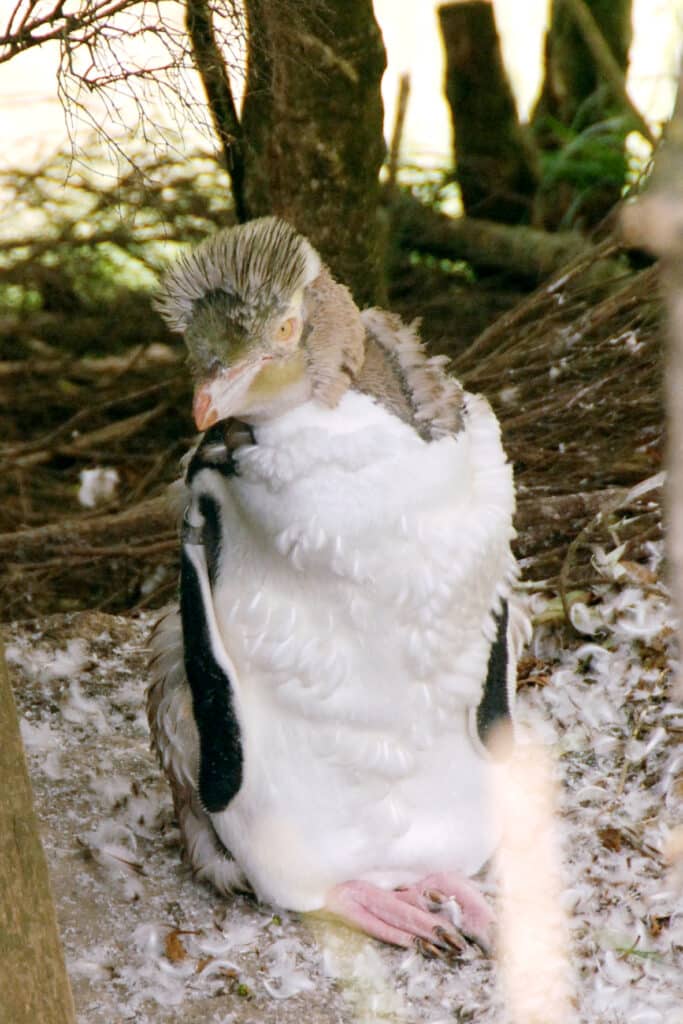
A little penguin heading into its summer moult can weigh close to double what it does on an ordinary foraging day. That gap, roughly the difference between a bird in good shape and one struggling, is exactly what our volunteers are checking for when they get a colony member on the scales in the weeks before moult. It sounds like a small thing. It isn’t.
Moulting is the one time of year an adult little penguin cannot go to sea. For close to two weeks it sits in its burrow or a rock crevice on the breakwater, replacing every feather at once, and it cannot feed itself while that’s happening. So it fasts. Everything it needs to survive that fortnight has to already be sitting under its skin as fat before the first old feather drops. Pre-moult weight isn’t a curiosity for the people who monitor this colony — it’s close to the whole ballgame.
Why pre-moult weight matters more than any other measurement
We get asked a lot why researchers bother weighing birds at all, given how much handling stress it can involve for a wild animal. The honest answer is that weight at this particular point in the year tells you more than almost any other single number you could collect on a little penguin.
A healthy adult little penguin at a normal time of year sits around the 1kg mark that gives the species its name as the smallest penguin alive. Coming into moult, though, a bird in good condition will have piled on significant additional fat reserve, often pushing well above that baseline weight. That reserve is the fuel for the whole moult fast. A bird that comes in underweight simply doesn’t have the tank capacity to sit out two weeks on land, and it either has to delay moulting, which carries its own problems, or attempt the moult anyway and risk starving before new feathers are in.
Volunteers doing this work aren’t guessing. Weighing happens as part of the same banding and monitoring programme that’s tracked this colony for decades, and it produces a dataset researchers can compare year to year, bird to bird. One skinny penguin in a season tells you very little. A pattern of underweight birds across a colony tells you the foraging conditions in Port Phillip Bay that season were poor, which is a different and more useful piece of information entirely.
What “healthy” actually looks like in the hand
I’ve stood at the edge of a monitoring session on the rocks and watched a volunteer cup a bird gently, check the keel — the breastbone — with a fingertip, and read the number off a small scale in about four seconds flat. It’s quick, deliberate, and honestly a bit unglamorous compared to how people imagine wildlife research.
A bird in good pre-moult condition feels solid across the chest, with fat padding either side of the keel rather than the bone standing out sharply. Underweight birds are the opposite: the keel is prominent, the body feels light for its size, and researchers will often flag that individual for a recheck rather than let it go into moult undocumented. There’s no single magic number volunteers are chasing — condition is judged against the bird’s own frame and against what’s typical for that time of year — but the trend is unmistakable once you’ve seen a few dozen birds handled.
What strikes most first-time visitors who get to watch this (and it does happen occasionally during organised monitoring, not general public viewing) is how fast it all is. These aren’t clinical exams. They’re brief, practised checks designed to get the animal back into its burrow with minimal stress, which matters a great deal for a bird about to enter the most physically demanding fortnight of its year.
The link between good foraging and a good moult
None of this fat reserve appears by accident. It’s built entirely on what a penguin can catch in Port Phillip Bay in the weeks leading into moult, and that in turn depends on water conditions, prey availability and how far a bird has to travel each day to find a feed. A season with good foraging generally produces plumper birds ahead of moult; a poor foraging season shows up in the weigh-ins as thinner birds, sometimes birds that delay moulting later into summer than usual.
This is part of why the health of the bay itself is so tied up with the health of this colony, something we’ve gone into in more detail in our piece on how Port Phillip Bay’s water quality decides what St Kilda penguins eat. A penguin can be the picture of a healthy, well-adapted little forager and still come up short on weight if the fish simply aren’t where they used to be that year.
It’s also worth remembering that little penguins are exclusively daytime foragers, out at sea from dawn and not returning to the breakwater until after dark — which is one reason public viewing here happens at dusk rather than during the day, as we explain in why little penguins only ever come ashore after dark. Every gram of that pre-moult fat has to be earned on long days out in the bay, often well beyond what you can see from the shore.
What happens to a bird that goes into moult underweight
This is the part that makes the weighing programme feel less like paperwork and more like genuine welfare monitoring. A little penguin that starts its moult without enough stored fat is in real trouble, because it has no way to top up mid-fast. It cannot go back to sea half-moulted; a partially replaced coat of feathers isn’t waterproof, and going into the water in that state risks the bird losing the insulation it depends on entirely.
So an underweight bird is committed, one way or another, to riding out the fast on reserves that may not be sufficient. Researchers who spot a light bird ahead of moult can’t really intervene in the wild sense — there’s no supplementary feeding programme for a healthy wild colony — but flagging it lets volunteers keep a closer eye on that individual and contributes to the broader dataset on how the colony is faring that year.
I’ll admit that sounds a bit bleak stated plainly. But this is a wild, self-established colony, not a managed sanctuary population, and part of respecting that means accepting that our job is to observe and protect the conditions around the colony rather than to manage individual birds’ outcomes directly.
Moulting season and what visitors might notice
If you’re visiting the breakwater over summer specifically hoping to see penguins, moult season is worth understanding before you go, because a moulting bird behaves quite differently to one coming and going from the sea each night. It stays put. It looks fluffy and a little unkempt as old feathers lift away in patches. It may look, to an untrained eye, unwell — when in fact a scruffy moulting penguin sitting quietly in a crevice with visible new feather underneath is often in perfectly good condition, simply mid-process.
This is one of the areas where volunteer-guided viewing genuinely earns its keep, because a guide can tell you the difference between a bird that’s fine and one that a researcher would want to check. We cover the practical side of one of these evenings in how volunteer-guided viewing works at the St Kilda breakwater, and if you’re planning an evening around it more broadly, our piece on why winter dusk is the best time to see St Kilda penguins is worth a read too, given moulting birds behave so differently to the winter breeding-season traffic most visitors picture.
Why the long-run data matters here
None of this weighing work would mean much as a one-off. What gives it value is the run of records stretching back to the fortnightly night trips Professor Mike Cullen of Monash University began in 1986, continued in various forms by volunteers ever since. A single season’s weigh-in numbers are a snapshot; decades of them are a trend line, and trend lines are what let researchers tell the difference between one thin bird having a rough year and a colony-wide signal worth worrying about.
That distinction matters a lot for a colony sitting on a human-built rock wall a few kilometres from the Melbourne CBD, exposed to boat traffic, fishing line, artificial light and all the ordinary pressures of a working harbour. Weight isn’t glamorous data. It’s not the number that makes headlines. But it’s arguably the single most reliable early signal researchers have for how this small, self-established population is actually coping, season on season, long before anything more visible goes wrong.
Next time you’re on the breakwater path at dusk and a guide mentions that a bird “looks in good nick” for moult, that offhand comment is doing a lot of quiet, careful work behind it.