
Five-thirty in the evening, late June, and the breakwater is already dark. That’s the whole trick, really. If you’ve stood at the St Kilda breakwater on a balmy January night waiting until nearly 10pm for the sky to finally give up its light, only to head home half-asleep with the kids in tow, you’ll understand why so many of our volunteers quietly rate winter as the better season for actually seeing something.
The best time to see St Kilda penguins isn’t summer, when the postcard weather and long evenings tempt most visitors down to the pier. It’s winter, when the light drops earlier, the water’s calmer more often than people expect, and the penguins come ashore at a time that suits an actual visit rather than a late-night endurance test.
Why dusk timing is the whole game
Little penguins spend their days foraging out in Port Phillip Bay, sometimes travelling a fair distance from the breakwater, and they don’t return until after dark. That’s not a scheduling quirk; it’s a survival strategy. Coming ashore under cover of darkness reduces the risk of predation and, frankly, gives them some peace from the crowds. This is why public viewing happens at dusk and not during the day; there’s simply nothing to see on the rocks at 2pm.
In December, that means waiting until close to 9:30 or 10pm for the birds to start appearing. In June or July, sunset is done and dusted by around 5:30pm, and the first arrivals can be spotted not long after. For families, for older visitors, for anyone who doesn’t love standing around on a cool esplanade at 10pm on a school night, that three-to-four-hour difference matters enormously.
The crowd factor nobody mentions
I’ll be honest: the busiest nights at the breakwater are exactly the nights you’d expect – warm, long, summer evenings when half of St Kilda has wandered down after dinner at one of the restaurants along the foreshore. There’s nothing wrong with a lively atmosphere, and volunteer-guided sessions handle it well, but a packed viewing area with phones out and kids running along the rocks is not the ideal setting for spotting a shy, 1kg bird that startles at torchlight.
Winter nights are quieter. Fewer people means less noise, less inadvertent light spill from phone screens, and a genuinely better chance of watching a penguin waddle up the rocks undisturbed. If you want the calmest version of this experience, a Tuesday or Wednesday in July beats a Saturday in January by a wide margin.
What’s actually happening in the colony through the year
Timing your visit around the breeding calendar adds another layer worth knowing. Courtship and nest re-forming start in late winter, around late July through October, which means by the time you’re standing at the breakwater on a crisp August evening, pairs are actively re-establishing themselves in their old cavities in the rock wall. Eggs follow from August into early November, incubated by both parents in shifts over about five weeks. Chicks hatch from September through December and are fed whole fish by both adults.
Late winter and early spring visits give you a reasonable chance of seeing adults arriving to swap incubation duties, or later, exhausted parents heading straight back out at first light for another day’s foraging. It’s less crowded than the January rush and biologically, arguably more interesting. Come mid-to-late summer, adults go through a fortnight-long moult during which they can’t go to sea at all and live off stored fat – a rough stretch for the birds, and one more reason summer isn’t automatically the “best” viewing season just because the weather’s nicer for humans.
If you want the fuller rhythm of the year mapped out, our seasonal calendar goes through each stage properly.
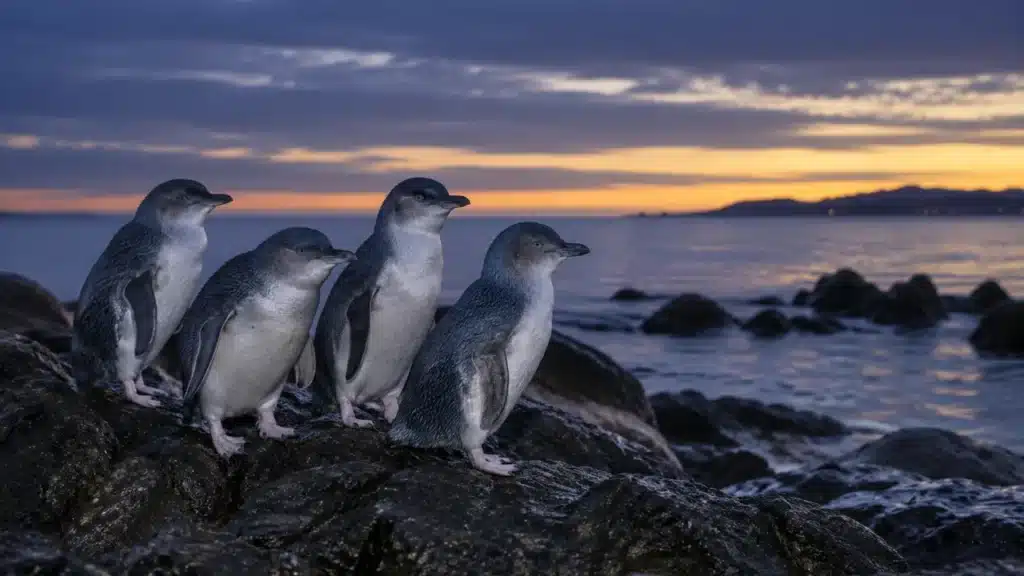
Weather still calls the shots
None of this means winter guarantees a sighting. Rough seas, strong onshore winds and heavy swell can change foraging patterns and delay or alter how penguins approach the breakwater, and that happens more in winter storm fronts than in a still summer evening. We’ve written before about exactly how wind and rough seas change what you’ll see at the breakwater, and it’s worth a read before you commit to a particular night. Sea temperature and broader weather patterns also shift how far the birds range on their foraging trips, which in turn affects what time they trickle back in.
Check the Bureau of Meteorology’s forecast for Port Phillip Bay before you head down – a wild southerly can make the whole outing miserable regardless of season, and calm, clear winter nights are honestly some of the best conditions going.
Dress for it, because winter dusk is genuinely cold
This is the trade-off. Winter timing is kinder to your schedule but far less kind to your fingers and toes. The breakwater has no shelter, it’s exposed to the water on both sides, and a still 12-degree evening feels a good deal colder once the wind picks up off the bay. Layers, a proper jacket, and closed shoes suited to uneven rock are non-negotiable. Our full rundown on what to wear and bring for a night visit is worth a look if you’re new to it, particularly if you’re bringing kids who’ll want to stay out longer than their patience for cold actually allows.
If mobility on the rubble-stone rocks is a concern for anyone in your group, it’s worth reading the accessibility guide beforehand too. Winter dusk viewing tends to happen closer to the accessible end of the breakwater simply because volunteers are managing smaller groups, but the terrain itself doesn’t change with the seasons.
Light and noise discipline matters more, not less
Because you’ll likely be one of a smaller group on a winter night, it’s tempting to think the “no flash, no torch” rule matters less. It’s the opposite. In a smaller crowd, a single phone flash or bright torch beam has a proportionally bigger impact on the birds trying to navigate ashore in the dark. We go into the reasons in detail in our piece on why flash photography and torches genuinely harm St Kilda’s penguins, and honestly it’s one of the most avoidable problems at the site – a five-second habit change fixes it entirely. Artificial light more broadly, including street and foreshore lighting, is one of the trickier ongoing pressures on this colony’s night return, something we’ve covered in more depth in how foreshore light disrupts penguins coming home at dusk.
Trained volunteers are usually on site for guided viewing sessions and they’ll ask you to keep noise down too – not out of pedantry, but because the birds are noticeably vocal once ashore, calling to mates and chicks, and a quiet crowd lets you actually hear that rather than drown it out. If you haven’t read about it, why the breakwater gets so noisy after dark explains what you’re listening for.
So, when should you actually go
My honest recommendation, and I’ll admit this is a slightly contrarian take among casual visitors who assume summer is peak season: aim for a clear, calm evening between June and September. You’ll get an earlier, more civilised dusk, a smaller and quieter crowd, a genuine chance of watching courtship or incubation behaviour, and you won’t be standing on cold rocks until nearly 10pm waiting for the sun to finally cooperate. Bring warm layers, skip the flash, and check the wind forecast on the day.
The colony has been quietly getting on with its business on that 1955 rubble-stone wall for decades regardless of who’s watching, ever since researchers first started taking a serious interest in the site in the 1980s. Winter dusk just happens to be the easiest window for the rest of us to catch a glimpse of it without turning the night into an ordeal. If you want to see how volunteer-guided viewing works before you go, it’s worth booking in – particularly on the nights you’re most likely to have the breakwater largely to yourself.