
Half an hour after sunset on a mild evening, there’s usually a quiet line of people spread along the elevated boardwalk at the end of St Kilda Pier, torches off, voices low, waiting. That’s not a coincidence and it isn’t a tour group in the conventional sense. Since 29 October 2025, this is how the public watches the colony: from a 150-metre viewing boardwalk, during free but ticketed one-hour sessions run by Phillip Island Nature Parks. If you’ve walked the pier at dusk and wondered why some people seem to know exactly where to stand and when to stop talking, this is why.
Little penguins spend their days foraging out in Port Phillip Bay, sometimes many kilometres offshore, and they only return to the breakwater after dark. That single fact shapes everything about how viewing works here. There’s no daytime show and nothing you can set a watch to months in advance, because session times move with sunset – two each evening, one around sunset and one after dark, each capped at 150 people, with bookings essential. Our penguin viewing page has the practical detail.
What a viewing session actually involves
It’s easy to assume a ticketed session means a formal walking tour with a set script. It isn’t quite that either. Guides are present on the boardwalk during sessions to help the public watch the colony without disturbing it. They’ll point out where penguins are likely to come ashore, answer questions, and – this is the important bit – step in, gently, when someone’s behaviour risks scaring the birds back into the water or off their approach altogether.
A penguin that’s spent all day fishing and is trying to get back to its nest cavity with a crop full of fish for a chick doesn’t care how photogenic the moment is. If a torch beam or a phone flash hits it mid-approach, it can turn around and delay landing, sometimes for a long stretch. Multiply that by a busy Friday night in summer and you can see why the boardwalk uses wildlife-friendly lighting, why it closes each night once the sessions finish, and why a human presence matters more than a sign ever could.
Why dusk, and not any other time
This trips people up more than anything else. Little penguins are not on display during the day the way, say, a zoo enclosure might be. They’re out foraging, often from first light until well after sunset, covering considerable distances in the bay before turning back toward the breakwater under cover of darkness. It’s a survival strategy – coming ashore in daylight would expose them to gulls and other aerial predators, and it means a daytime walk along the pier will show you an interesting rock wall and maybe a few empty burrow entrances, but no penguins.
If you want to actually see one, dusk is the only real window, and even then it depends on the season, the weather, and a bit of luck. On some nights birds start coming ashore soon after last light; on others the first arrival takes far longer. That unpredictability is why sessions are pegged to sunset rather than a fixed clock time, and why no sighting is ever guaranteed.
The actual job: protection first, interpretation second
People sometimes picture the work here as mostly educational – pointing at penguins, answering trivia questions. In practice, a large share of what guides and volunteers do on any given night is protective. Dogs are allowed on St Kilda Pier on a lead, but they’re prohibited on the breakwater at all times, and an off-leash dog in the pier precinct is a real and ongoing risk; a dog doesn’t need to catch a penguin to do damage, since the chase and the stress alone can be enough. Flash photography, handheld torches swept across the rocks, and people leaning out for a closer look at the rock wall are the other recurring problems, and all three get the same quiet, repeated correction most nights.
None of this is about being precious for its own sake. The breakwater is a rubble-stone wall built in 1955 as part of the upgrade to St Kilda Pier – it was never designed as penguin habitat, the colony simply found the cavities in the rock and moved in. That’s part of what makes it remarkable and also part of what makes it fragile. It’s a human-built structure sitting right beside a working harbour, and the birds that live in it get no natural buffer from boat traffic, artificial light, marine plastic and fishing line, or foot traffic the way a more remote colony would. If you ever spot a bird tangled in line, our entanglement guide explains who to call.
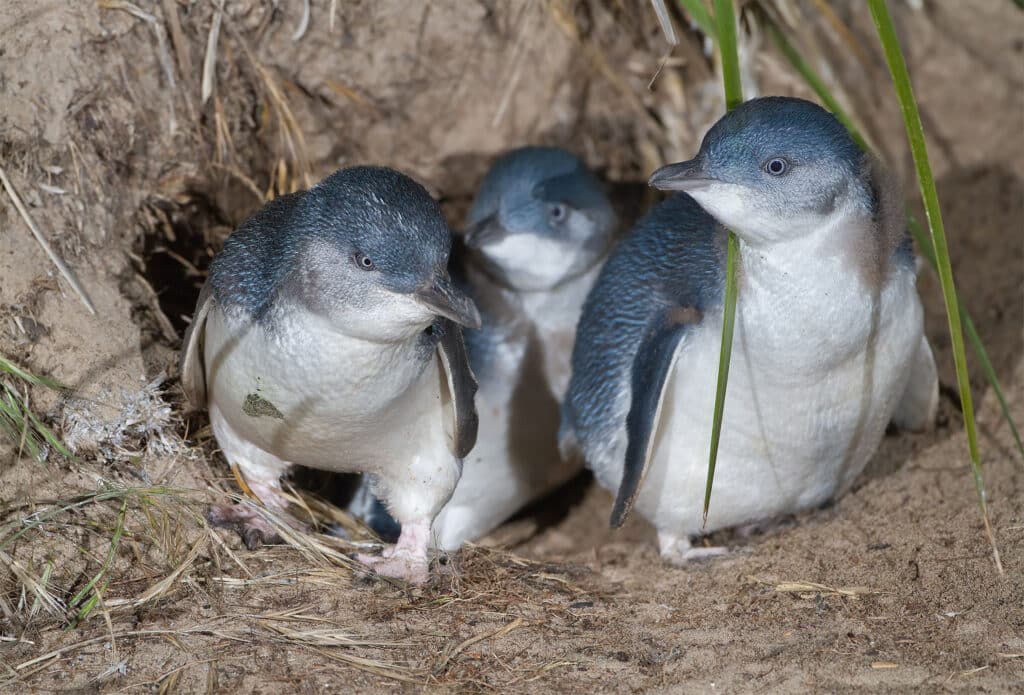 St Kilda breakwater" decoding="async" srcset="https://stkildapenguins.com.au/wp-content/uploads/2026/07/Eudyptula_novaehollandiae_family_exiting_burrow-1024x695.jpg 1024w, https://stkildapenguins.com.au/wp-content/uploads/2026/07/Eudyptula_novaehollandiae_family_exiting_burrow-300x204.jpg 300w, https://stkildapenguins.com.au/wp-content/uploads/2026/07/Eudyptula_novaehollandiae_family_exiting_burrow-768x522.jpg 768w, https://stkildapenguins.com.au/wp-content/uploads/2026/07/Eudyptula_novaehollandiae_family_exiting_burrow-1536x1043.jpg 1536w, https://stkildapenguins.com.au/wp-content/uploads/2026/07/Eudyptula_novaehollandiae_family_exiting_burrow-2048x1391.jpg 2048w" sizes="(max-width: 800px) 100vw, 800px" />
Counts, weighing and banding – the research side
The public sessions are the visible part of what happens out here, but they’re only half of it. Volunteer monitoring of this colony traces back to Professor Mike Cullen of Monash University, who ran fortnightly night trips to study the colony from 1986 until his death in 2001, assisted by Neil Blake of St Kilda Council, and it has continued in the decades since. That long run of data is genuinely unusual for an urban wildlife population and it only exists because volunteers kept showing up.
On research nights, volunteers carry out population counts, weigh birds, and check or apply bands used to identify individuals over time. This is how we know things like the rough proportion of young penguins that re-pair after an unsuccessful first breeding attempt (estimates for the species sit somewhere between 18 and 50 percent), or how a season’s breeding success compares to previous years. None of that comes from guesswork; it comes from cold, repetitive, weather-dependent fieldwork, often in wind coming straight off the bay. The romance of it wears thin by the third hour of a cold July count, but the data is the whole point.
If you’re curious about how that research feeds into broader planning, our conservation and research strategy page goes into more detail, and the original J.M. Cullen report is worth a look if you want the source material rather than a summary.
What a good visit actually looks like
Book your session first – they’re free, but they’re ticketed and they fill. Arrive before your session starts rather than after, and give your eyes time to adjust rather than relying on any light source. Stay behind the boardwalk railings; the cavities the penguins use sit among the stones below, and nobody walks on the breakwater itself. Leave the flash off entirely and leave torches switched off at the viewing area; if your camera can’t manage low light without help, honestly, just watch instead. Keep dogs at home or firmly leashed on the pier and well away from the rocks. Take your rubbish with you. And keep voices down – sound carries oddly on open water at night and a loud group can unsettle birds that are already cautious about the final approach to shore.
If you’re bringing kids, it’s worth reading our guide on the best things to do with kids in St Kilda beforehand so expectations are set correctly; a two-year-old expecting an instant, guaranteed penguin sighting on demand is setting everyone up for a rough night. Pregnant visitors and anyone with mobility considerations should also check our notes on preparing for a penguin-watching trip in St Kilda, since the session runs for an hour after dark in whatever weather the bay sends in, and it’s a fair walk out along the pier to reach the boardwalk.
A fair question people ask is whether you can just watch from the beach instead and skip the pier altogether. Sometimes, yes – we’ve covered that directly in can you see the St Kilda penguins from the beach?, though the honest answer is that your odds are much better from the boardwalk during a session, with a guide who knows where birds have been landing that week.
Seasonal rhythm matters more than most visitors expect
Viewing conditions shift a lot across the year, and it’s not just about weather. Courtship and nest re-forming run roughly late July through October, eggs are laid from August into early November, and chicks hatch from September through December, fed whole fish by both parents. Over summer, adults go through a moult lasting about two weeks, during which they can’t go to sea at all and live off stored fat – you’ll sometimes see a scruffy, moth-eaten-looking bird sitting it out in a burrow entrance rather than heading offshore. Our penguin calendar and seasonal life cycle page breaks this down month by month if you’re planning a visit around a particular stage of breeding.
Winter nights tend to be quieter for visitors, but that doesn’t mean nothing’s happening; pair bonds are reforming and cavities are being reclaimed well before the first egg is laid.
How this compares to Phillip Island
There’s a natural temptation to compare this colony to somewhere like Phillip Island – our Phillip Island Penguin Parade guide covers that better-known, larger operation, which the same organisation runs. Both are ticketed, so the real difference isn’t the booking system: it’s scale and setting. The breakwater is a small, self-formed urban colony wrapped around a public pier about 7km from the CBD, not a purpose-built visitor site on a rural coastline. The viewing infrastructure here has to sit lightly on a rock wall that was never meant to house wildlife in the first place, which is why it’s a narrow elevated boardwalk with capped numbers rather than tiered stands.
That said, “free” doesn’t mean unmanaged. Parks Victoria manages the pier and breakwater, Phillip Island Nature Parks runs the sessions and takes the bookings, and volunteers keep the monitoring going year after year, largely unpaid. If an evening on the pier leaves you wanting to do more than just watch, how you can help covers ways to support the work.
For the science underpinning why nocturnal return and artificial light matter so much to this species, BirdLife Australia’s little penguin profile and Museums Victoria’s material on the species are both solid starting points if you want to read beyond what we can cover here.
Next time you’re heading down at dusk with a booking in hand, take the quiet spot at the rail and give it time. The session isn’t a performance. It exists because on a structure built for an entirely different purpose in 1955, a wild colony decided to stay, and somebody has to make sure it still can.