
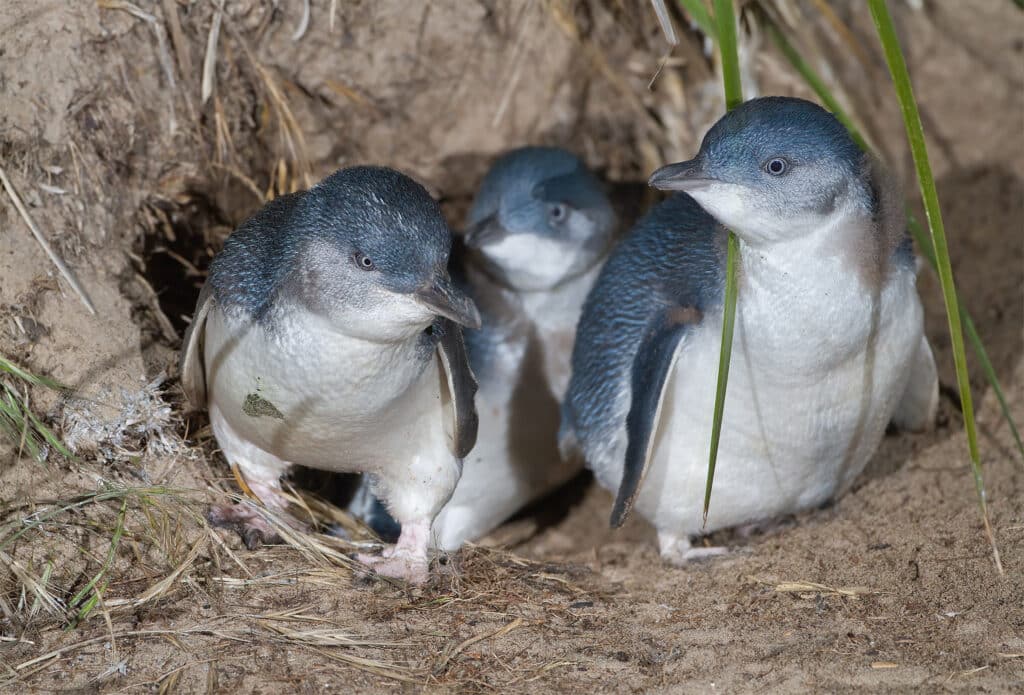
Forty-two degrees on a January afternoon does something different to a rock wall than it does to a backyard. The stone holds it. By the time our volunteers do an evening check of the St Kilda breakwater after a hot day, the rubble is still radiating warmth hours after the sun’s gone down, and that’s the crux of the problem now facing this colony. Little penguins evolved for temperate southern coastlines, not for baking granite next to a working harbour, and there’s no bushland behind them to retreat into when a heatwave hits.
I’ve stood on the pier on stinking hot evenings and watched people assume the birds will just cope, the way most wildlife supposedly does. They don’t, not automatically. A little penguin regulates its body temperature reasonably well in water and in a shaded burrow, but the St Kilda colony isn’t living in deep soil burrows the way many Phillip Island birds do. It’s living inside the gaps and cavities of a rubble-stone wall built in 1955, and rock holds and radiates heat in a way that packed earth doesn’t. That’s a structural difference between this colony and most others, and it matters more every summer.
Why a heatwave risk for penguins looks different here
Most of what’s written about heat stress in little penguins comes out of colonies with room to move, sandy dune systems, vegetated headlands, places where a bird can shift twenty metres to a cooler, deeper burrow if the one it’s in gets too hot. St Kilda’s colony doesn’t have that option. The breakwater is a fixed, human-built structure about 7km from the Melbourne CBD, and it’s the only mainland colony in Victoria that exists inside a major city. Its entire footprint is the wall itself. There’s no buffer zone, no hinterland, nowhere to shuffle sideways to when the cavity a pair has used for years turns into an oven.
That’s not a small distinction. Rock retains and re-radiates solar heat well after air temperature drops, which is exactly what you want in a cold snap and exactly what you don’t want in a heatwave. On a 40-plus degree day followed by a warm night, the surface layer of the breakwater can stay hot into the evening return period, right when penguins are coming ashore hungry and dehydrated from a full day at sea. Add humidity and a run of consecutive hot days, and adult birds already carrying the physiological load of incubation or chick-provisioning don’t get the overnight cool-down they’d usually rely on.
Chicks and moulting adults carry the most risk
Not every penguin on the wall is equally exposed. Adults that are free to forage can at least spend the day at sea, where water temperature is far more stable than a rock in full sun. The birds with the least room to move are chicks still confined to the nest cavity, and adults in moult.
Moult happens over about two weeks each summer, and it’s a genuinely vulnerable stretch for any little penguin, heatwave or not, because the bird can’t go to sea and has to fast on stored fat reserves while it grows a fresh waterproof coat. A moulting adult is stuck wherever it’s moulting. If that happens to be a shallow cavity on the sun-facing side of the wall during a heatwave, there’s no plan B. Chicks are in a similar bind: too young to leave the nest, dependent on parents returning with fish, and unable to simply relocate to a cooler spot the way an adult theoretically could. If you want the detail on how that provisioning and fledging process actually works, we’ve covered it separately in how St Kilda’s penguin chicks are fed, and when they finally leave.
Breeding season for this colony runs roughly late July through to early summer, with eggs laid August to early November and chicks hatching September through December, which means chick-rearing and the tail end of the breeding calendar now regularly overlaps with Melbourne’s hottest weather. That overlap didn’t used to be as sharp a problem. It’s becoming one.
An urban colony with nowhere to retreat
I’ll be honest about where I land on this: I think the “urban colony” framing that gets used to celebrate this site, and it is genuinely remarkable that penguins breed successfully 7km from the CBD, slightly undersells how precarious that same urban setting makes them under climate stress. Being close to the city is a wonderful thing for public access and community connection. It’s a much less wonderful thing when you’re trying to model where 1,000-plus individual birds might disperse to if the wall becomes unliveable during a heat event. There isn’t a nearby stretch of coastal scrub they can shift into. The wall is the colony’s entire world, hemmed in by a harbour on one side and open bay on the other.
This is a different category of threat to the ones we usually talk about on this site, things like off-leash dogs or fishing line, which are acute, direct, and to some extent manageable through fencing, signage and volunteer presence at dusk. Heat stress is slower, structural and much harder to intervene on directly. You can’t put up a barrier against a heatwave. The Bureau of Meteorology’s climate outlooks have consistently flagged more frequent and more intense extreme heat days for south-east Australia, and a colony with a fixed, heat-retentive habitat and zero capacity to relocate is about as exposed to that trend as an urban wildlife population gets.
What actually helps on the hottest days
There’s no single fix, but there are things that measurably reduce the load on the colony during heat events, and most of them are about reducing every other pressure so the birds aren’t fighting heat stress and human disturbance at the same time.
Shade matters more than people think, both the shade thrown by the wall’s own structure and any vegetation nearby, which is part of why ongoing foreshore planting work is more than cosmetic; we’ve written about that in why foreshore revegetation matters as much as the rocks do. Keeping the birds’ evening return as undisturbed as possible on a hot night is also more important than usual, because a heat-stressed bird that’s also spooked by torchlight or an off-leash dog burns reserves it can’t easily replace. That’s one more reason the existing rules around dogs, light and noise at the breakwater aren’t just etiquette, they’re part of the buffer this colony has against a genuinely harder climate.
Population counts, weighing and banding done by trained volunteers also become more useful in a warming climate, not less, because they’re how researchers actually detect whether heat events are affecting body condition or breeding success over time, rather than guessing. If you’re curious how that identification work is done bird by bird, there’s more detail in how researchers tell St Kilda’s penguins apart for banding, and the broader monitoring programme is covered in inside the volunteer monitoring and banding work at St Kilda.
How this sits alongside the colony’s other threats
Heat doesn’t replace the other pressures on this colony, it stacks on top of them. Dogs off lead, marine plastic and fishing-line entanglement, boat strike from harbour traffic, artificial light disrupting the after-dark return, and the standing predation risk from foxes and cats are all still live issues, and we’ve dealt with each of those in detail elsewhere on the site, including why off-leash dogs are the biggest threat to St Kilda’s penguins. What’s changed is that heat stress now sits alongside them as a chronic background pressure rather than an occasional bad afternoon. A single extreme heat day is unlikely to cause visible harm to a healthy adult penguin. A summer of repeated heat events, layered onto a fixed structure with no cooler ground to fall back on, is a different proposition entirely, and it’s one this colony will keep facing more often as our summers trend hotter.
If there’s a genuinely useful thing a visitor can do about any of this, it’s not complicated: keep noise and light down at dusk, keep dogs leashed well back from the rocks as covered in why dogs must stay leashed and off the rocks at St Kilda, and don’t add avoidable stress to birds that are already managing more than they used to. It won’t cool the rock down. But it protects the small margin the colony does have.