
A dog doesn’t need to catch a penguin to wreck its night. It just needs to get within a few metres of a nest cavity with its nose down and its owner thirty seconds behind it. That’s the whole problem in one sentence, and it’s why volunteers who monitor the St Kilda breakwater will tell you, without much hesitation, that off-leash dogs are one of the biggest night-to-night threats this colony faces.
On a typical evening the crowd builds along St Kilda Pier as the light drops, waiting for that night’s viewing session to start. Most people are there for the right reasons. Then someone lets a dog off the lead “just for a run” near the wall, and the colony’s behaviour can change in real time. Penguins that were about to come ashore hold back in the water. Birds already in their cavities go silent. It doesn’t take a mauling to do damage here. It takes a smell and a shadow.
Why dogs are worse for penguins than almost anything else on land
Little penguins evolved with essentially no land predators across most of their range along the temperate coastlines of southern Australia and New Zealand. They’re not built to read a dog’s body language the way a rabbit or a rat might. A dog on the rubble-stone wall reads, to a penguin, as an unknown four-legged animal moving fast and smelling strongly of predator, and the response is instinctive: freeze, flee, or refuse to come ashore at all.
That last one matters more than people think. Little penguins forage at sea all day and only return to the breakwater after dusk, under cover of darkness, specifically because it’s safer than coming ashore in daylight. If a dog has just been through the colony, or is still nearby, a penguin can spend the night circling offshore rather than risk the walk up to its cavity. An adult that skips a return might just lose a night’s rest. A chick waiting in a nest cavity for a feed doesn’t have that luxury.
Compare that to the colony’s other predation risk, foxes and cats, which is real but occasional and mostly nocturnal-opportunistic – we’ve covered that ground in more detail in our piece on foxes and cats as a mainland predation risk. Dogs are different because they arrive with people, during the exact window when the most penguins are moving between water and nest. Visitors are kept up on the elevated viewing boardwalk and dogs aren’t allowed on the breakwater at all, but there’s no fence or moat around the rock wall itself, and a dog off its lead on the foreshore can be among the cavities in seconds.
The mechanics of a bad encounter
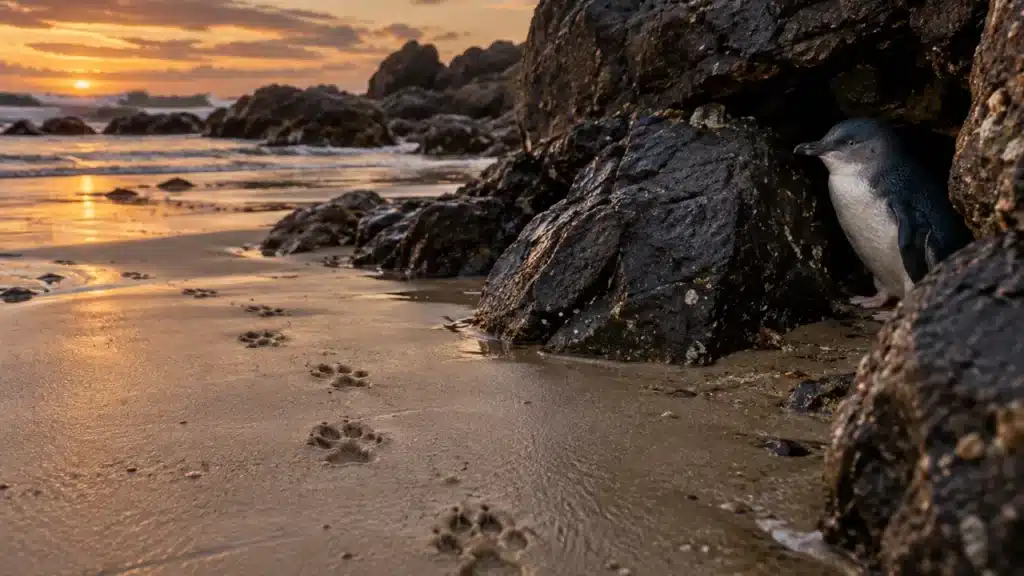
It rarely looks dramatic. A dog noses into a gap between rocks. A penguin bolts, sometimes into open water, sometimes deeper into the wall where it can be crushed against stone by its own panic. Eggs get abandoned mid-incubation, which matters given that incubation is already a tight five-week shared effort between two parents – we go through what that process actually involves in our piece on the five-week incubation. A parent flushed off eggs at the wrong moment can mean a failed clutch for the season, not because the dog touched anything, but because the birds abandoned the site out of fear.
Chicks are worse off again. They can’t outrun anything, can’t leave the nest, and rely entirely on parents returning on schedule with fish. If dog disturbance keeps adults offshore or diverts them to a different, unfamiliar landing point along the wall, feeding gets delayed. Over a season that adds up in ways that don’t show up as a single dramatic incident, just as slightly lower fledging numbers when volunteers do their counts.
It’s not really about aggressive dogs
This is the part people misunderstand most. Nobody’s worried about vicious dogs specifically. The family labrador off the lead for a stretch of the beach is just as disruptive as anything more aggressive, arguably more so because owners assume a friendly dog is a safe dog. It isn’t, not here. Penguins don’t distinguish between a dog that wants to play and a dog that wants to hunt. Scent, movement and size are what trigger the flight response, and a bouncy, curious dog investigating rock crevices ticks every one of those boxes.
The rules reflect that. Dogs are welcome on St Kilda Pier itself provided they’re on a lead, but dogs and cats are prohibited on the breakwater at all times, precisely because of this colony. Assistance dogs are welcome in Parks Victoria parks. It’s one of the more sensible, targeted uses of a leash rule you’ll find anywhere on the bay, and the practical point for owners is simple: the lead stays on for the whole walk, not just the bits where someone’s watching.
Why the breakwater makes this worse, not better
Unlike a fenced reserve, the St Kilda breakwater is a rock wall built in 1955 as part of the upgrade to St Kilda Pier. Nobody planned a penguin colony into that design; it formed on its own in the cavities between the rubble stone, and it has stayed there because the site, imperfect as it is, offers enough shelter and enough proximity to feeding grounds in Port Phillip Bay to work. That accidental origin is part of what makes this colony remarkable, being the only mainland breeding colony of little penguins in Victoria that sits inside a major city. It’s also what makes it fragile. There’s no natural buffer zone between nesting birds and a busy harbour, a busy pier and a busy foreshore, often after dark when visibility is poor for everyone involved.
Parks Victoria manages the pier and breakwater, and Phillip Island Nature Parks runs the nightly viewing sessions, with guides present while the public is on the boardwalk. Volunteers, meanwhile, carry out the counts, weighing and banding that track how the colony is faring. It’s not glamorous work and it’s mostly quiet, unremarkable vigilance rather than dramatic rescue. You can read more about what that role actually involves in our rundown of how guided viewing at the breakwater works.
What a responsible visit actually looks like
If you’re planning to come down for an evening, the honest advice is to leave the dog at home. You can legally walk a leashed dog on the pier, but an evening when penguins are coming ashore isn’t the time, and a dog that slips its lead near the wall is the one scenario nobody can undo. This isn’t really a debate about good dogs versus bad dogs. It’s about a species with zero evolved defence against a domestic predator, living in a rock wall that sits metres from where people walk.
Viewing itself is now free but ticketed: two one-hour sessions each evening from the elevated boardwalk at the end of the pier, each capped at 150 people, with bookings essential through Phillip Island Nature Parks – our penguin viewing guide explains how that works. Beyond that, the same disturbance principles apply that we cover across most of our visiting guides: no flash photography, no torches or bright lights, no touching or feeding, and no climbing on the breakwater. If you haven’t been before, it’s worth reading through what to bring for a night visit and why patience matters more than timing before you go, since a good chunk of a successful, low-impact visit comes down to expectations rather than gear.
The bigger picture: one threat among several, but a controllable one
Dogs sit alongside marine plastic and fishing line entanglement, boat strike in Port Phillip Bay, and artificial light disrupting the night return as the main pressures on this colony, and we’ve written about each of those separately, including how marine plastic and fishing line injure the penguins and how foreshore lighting disrupts the return at dusk. What sets off-leash dogs apart is that it’s almost entirely preventable, immediately, by individual choice, on the night. You can’t stop a storm surge or fix water quality in Port Phillip Bay by changing your own behaviour for one evening. You can absolutely stop your dog from running along the breakwater.
Zoos Victoria’s work on urban wildlife makes a similar point about coexistence in general terms: the species most at risk from introduced or domestic animals are usually the ones with no evolutionary experience of them, and little penguins fit that description precisely. BirdLife Australia’s guidance on shorebird and seabird disturbance says much the same thing about leash laws near breeding sites more broadly, not as an inconvenience but as one of the few conservation measures an ordinary visitor can apply themselves, tonight, without any training.
Professor Mike Cullen’s monitoring of this colony began back in 1986, and the fortnightly night trips he ran until his death in 2001 built the foundation for everything volunteers still track today, from population counts to banding. None of that long-run data means much if disturbance on any given night pushes birds away from cavities they’ve used for years. Little penguins are creatures of habit, usually monogamous from season to season and loyal to the same nest cavity – we go into that pattern in our piece on how citizen scientists help protect the colony. A dog doesn’t undo decades of monitoring. But a bad five minutes, repeated often enough across a breeding season, can undo a clutch, a season, sometimes a bird’s confidence in a site it’s used for years.
So: lead on, or better, dog at home. It’s the cheapest, easiest thing anyone visiting the breakwater can do for this colony, and it’s the one piece of advice we’d want every single visitor to hear before they head down the pier.