
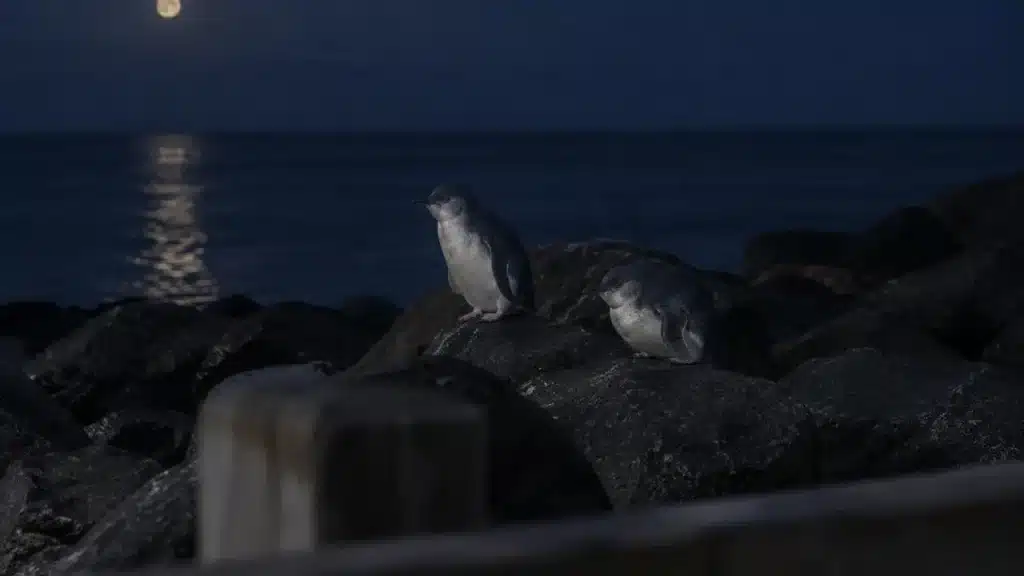
Spend an evening on the viewing boardwalk at the end of St Kilda Pier and you may well see it: a phone flash going off toward the rocks, a chorus of shushing from the people nearby, and a penguin freezing mid-waddle three metres from shore, unsure whether to come in. It’s the single biggest point of friction between visitors and the guides and volunteers who look after viewing here, and it’s worth explaining properly why a camera flash is such a big deal to a bird that’s just trying to get home after a day at sea.
The short version is this: little penguins return to the breakwater specifically because it’s dark. Take away the dark and you take away the one advantage they’ve got against predators and against the general chaos of coming ashore on a rock wall next to a working harbour.
Why little penguins depend on darkness to come ashore
Little penguins, Eudyptula minor, spend the entire day foraging at sea, sometimes many kilometres offshore, and only return to the breakwater after the sun is well down. This isn’t a quirk of St Kilda’s colony specifically – it’s standard behaviour for the species right along the temperate coastlines of southern Australia and New Zealand, the only places little penguins are found. They are not, and this bears repeating because people still assume otherwise, an Antarctic or polar species. There’s no ice involved anywhere in their range.
Coming ashore at night is a predator-avoidance strategy that’s worked for the species for a very long time. On land, a penguin is slow, clumsy, and vulnerable in a way it never is in the water. Darkness is the cover that gets it from the shoreline to its nest cavity in the rock wall without becoming an easy target. Their eyes are adapted for exactly this: good low-light vision tuned for dim conditions, not for coping with a sudden burst of white light at close range.
That’s the whole problem with flash photography in a nutshell. A camera flash doesn’t just “surprise” a penguin the way it might startle a person. It temporarily wrecks the low-light vision they need to navigate the rocks, spot obstacles, and get to their burrow. Researchers and volunteers who have monitored this colony describe the same thing: a flashed penguin often stalls completely, sometimes retreating back toward the water rather than pushing on toward its nest.
What repeated flashes actually do over a season
One flash is an inconvenience. Repeated flashes, night after night, across a whole viewing season, are something else. Breeding pairs need to get back to their chicks reliably to feed them whole fish brought up from the day’s foraging; a bird that hesitates at the shoreline for an extra ten or fifteen minutes because it’s disoriented is a bird burning energy it can’t really spare, especially during incubation or when it’s feeding two chicks in the nest.
The pattern is a consistent one: it’s rarely a single dramatic incident, it’s the cumulative disturbance across a viewing season that does the damage. A colony squeezed onto a human-built rock wall, a few hundred metres from a working boat harbour, doesn’t have much margin to begin with. Adding avoidable stress from flash and torchlight on top of the existing pressures – boat traffic, fishing line, dogs off-lead nearby – is the sort of thing that’s entirely within a visitor’s control to fix, which is exactly why volunteers push so hard on it.
The Victorian Government’s environment agencies and bodies like Zoos Victoria have documented artificial light disruption as a recognised issue for coastal and urban wildlife more broadly, and it’s consistent with what’s observed here at St Kilda specifically: light at the point of return is the problem, not light in general.
Torches aren’t a gentler alternative
A reasonable assumption is that a torch, especially on a dim setting, must be less disruptive than a flash going off in a burst. In practice it’s often worse, because a torch beam is sustained rather than instantaneous. A phone flash is over in a fraction of a second. A torch swept along the rocks looking for penguins, or held steady on a burrow entrance while someone tries to get a look, keeps a patch of the colony lit for as long as the beam is pointed there, which for a returning penguin can mean the difference between confidently continuing toward its nest and stopping, doubling back, or diverting into a different, unfamiliar gap in the rocks to wait it out.
That last point matters more than people realise. Penguins here are highly faithful to a single nest cavity, reusing the same one year on year with the same partner in most cases (though, interestingly, somewhere between roughly 18 and 50 percent of younger birds do end up re-pairing after a first match doesn’t work out – breakwater life has its share of complicated romances). A bird that gets spooked into the wrong gap isn’t just delayed, it can end up in a cavity that’s already occupied, or exposed in a spot it doesn’t know well.
What to bring instead
None of this means you can’t see the colony, or photograph the experience of being there. It just means the gear list is different to what people expect.
Phones should have flash switched off entirely before you get anywhere near the water, not just “not used” – plenty of phones will fire an auto-flash in low light unless you’ve disabled it in settings beforehand. If you want a photo of the evening, take it of the pier, the bay, the group gathered at dusk; save the wildlife photography for a place where flash won’t do harm, and understand that a phone camera generally isn’t going to capture a dim, fast-moving penguin well in the dark anyway. That’s simply the physics of it, not a failure of your phone.
Red-light torches, where any light is used at all, are the accepted compromise, because red wavelengths interfere far less with a penguin’s night vision than white light does. Volunteers on site carry these for their own population counts, weighing and banding work, and use them sparingly and only when necessary. Visitors, though, aren’t permitted to use torches or bright lights of any colour at the viewing area, so leave yours in your bag and let your eyes adjust to the dark, the way they would at any stargazing spot. Give it ten minutes and you’ll be surprised how much you can actually see. Carrying a torch for the walk back to the car or the tram stop afterwards is perfectly fine – just don’t switch it on at the colony.
Come dressed for standing still in the cold near open water rather than moving around a lit path – most of a session here is spent quietly waiting at the railings, which suits the colony far better than a group constantly shifting and re-lighting phones to check the time or send a text.
Where and when you’ll be watching from
Since 29 October 2025, the colony is watched from a 150-metre elevated viewing boardwalk at the end of St Kilda Pier during nightly one-hour sessions run by Phillip Island Nature Parks. The sessions are free but ticketed: two each evening, one at sunset and one after dark, each limited to 150 people, and bookings are essential. Session times move with sunset through the year, because that’s when the birds come in – turning up in the middle of the day will get you an empty rock wall and nothing else. The boardwalk itself uses wildlife-friendly lighting and closes each night once the sessions have finished, which is another reason your own torch isn’t needed. Our penguin viewing guide covers timing and booking in more depth, and if you haven’t been before, it’s worth reading how guided viewing works at the St Kilda breakwater beforehand, since the guides on the ground are there specifically to help you see penguins without disturbing them.
You watch from behind the boardwalk railings rather than from the rocks themselves – beyond the disturbance issue, the breakwater’s rubble-stone construction (it was built in 1955 as part of the pier upgrade, and the colony moved in entirely on its own afterwards) is uneven and genuinely not built for foot traffic. If mobility is a consideration for your visit, our accessibility guide for the breakwater is worth reading before you plan the trip.
The bigger picture beyond the lighting question
Light discipline is one piece of a longer list: dogs kept on a lead on the pier and off the breakwater, where dogs, cats and fishing are prohibited at all times; fishing line and marine plastic that can entangle a bird, which we cover in our entanglement guide; boat strike; and simply keeping the colony’s night return as predictable as a busy harbour allows. Parks Victoria manages the pier and breakwater and Phillip Island Nature Parks runs the sessions, while volunteers carry out the population counts, weighing and banding. None of this is new. Fortnightly monitoring of this colony goes back to 1986, when Professor Mike Cullen of Monash University began the long-term study that Neil Blake of St Kilda Council helped support, and that tradition of careful, low-impact observation has essentially continued in the volunteer monitoring that still happens today.
Most visitors who flash a photo aren’t being careless, they just haven’t been told why it matters, and a single clear sign or a quiet word from a guide usually fixes it on the spot. Where it becomes a real problem is with the small number of people who’ve been asked once already and do it again anyway, and that’s a different conversation entirely, one about the pressure a genuinely wild colony faces from being wedged into a busy, well-lit corner of a major city, a situation this colony finds itself in more than almost any other little penguin population in Victoria. The Victorian Department of Energy, Environment and Climate Action lists light pollution among the broader pressures facing coastal wildlife in developed areas, and St Kilda is about as developed a setting as a wild seabird colony gets anywhere in the state.
If you’re planning a first visit and want the fuller rundown on etiquette and logistics beyond the lighting question, the tips for visiting St Kilda guide and the site’s FAQ page both cover the practical basics. Book your session, bring warm layers, bring patience, leave the flash and the torchlight out of it, and you’ll get a far better look at the colony than anyone fumbling with their phone settings in the dark ever will.