
Plenty of people turn up for a St Kilda penguin session in a cotton hoodie, having checked the daytime forecast, seen 16 degrees and decided that was close enough. It isn’t. The wind off Port Phillip Bay at dusk has a way of finding every gap in your clothing, and if you’re underdressed you’ll spend the whole session waiting for it to end rather than watching the birds. This is the bit nobody tells you before you book, so let’s cover it properly.
Penguin viewing at dusk is a genuinely different proposition from a daytime stroll along the pier. The colony is watched from a 150-metre elevated boardwalk at the end of St Kilda Pier, during free but ticketed one-hour sessions run nightly by Phillip Island Nature Parks – two each evening, one at sunset and one after dark, each limited to 150 people, with bookings essential. Our guide to penguin viewing at St Kilda covers the booking side. Dressing for a still, exposed hour outdoors after sunset isn’t complicated, but getting it wrong makes the difference between an evening you’d repeat and one you cut short.
Why timing changes everything about what you need
Little penguins spend the day foraging out in the bay and only return to the breakwater after dusk, under cover of darkness, which is precisely why viewing happens at night rather than during the day. That single fact drives almost every packing decision here. You’re not visiting a heated, brightly lit attraction with a gift shop. The boardwalk uses wildlife-friendly lighting, it sits out over an exposed rubble-stone wall built in 1955, and it offers next to nothing in the way of shelter from the wind.
Because the birds won’t come ashore while there’s still meaningful light or disturbance, you can be out there a while before anything happens. Sometimes it’s quick. Often it isn’t. Plan your clothing and your patience for the longer version of the hour, not the best-case one.
Layers, not a single jacket
Melbourne’s foreshore temperature at 8pm in April bears no relationship to what it was at 2pm. The Bureau of Meteorology’s Melbourne forecasts will give you an evening minimum, and that’s the number worth checking, not the daytime maximum. Even then, treat it as a floor. Wind chill off the water routinely knocks the felt temperature down further, and there’s very little shelter out on the boardwalk.
Better to turn up in three light layers you can adjust than one heavy coat you’re stuck with. A thermal or long-sleeve base, a fleece or wool jumper, and a windproof outer shell handles most Melbourne nights from autumn through spring. Beanies and gloves aren’t overkill in winter; they’re standard kit if you’re planning to stand still for an hour. Summer evenings are milder, obviously, but a light jacket still earns its place once the sea breeze picks up after sunset.
Footwear is where people get caught out
The walk out along the pier and the boardwalk itself are exposed and often damp with sea spray or recent rain, and you’ll be on your feet, largely still, for the length of the session. Thongs, sandals and anything with a smooth or worn sole are a poor choice here. Closed, flat, grippy shoes are the baseline. If you own comfortable trainers with decent tread, wear them.
Nobody walks on or stands among the breakwater rocks: visitors watch quietly from behind the boardwalk railings, which keeps people off the nest cavities and stops birds being startled mid-return. If you’re visiting with children, our separate piece on visiting the St Kilda penguins with kids respectfully goes into extra detail on managing little legs on a dark boardwalk, and if mobility is a concern for anyone in your group, the accessibility guide to the breakwater is worth reading before you book.
The torch question, answered properly
Bring a torch if you want one for finding your car or the tram stop afterwards. Don’t switch it on during the session, and never point it at the water or the rocks where penguins are moving.
Little penguins navigate their return to the colony in darkness, using the relative dimness of the shoreline against the lighter horizon to guide them in. A sudden beam of light, even a phone screen held up to check a map, can disorient a bird mid-approach and cause it to turn back out to sea rather than risk coming ashore near a threat. Flash photography does the same thing, arguably worse, because it’s sudden and bright rather than steady. Torches and flash are both prohibited during viewing. We’ve written at length about why flash photography and torches genuinely harm St Kilda’s penguins, and separately about how foreshore light disrupts penguins coming home at dusk, and both are worth a read if you’re bringing a camera or a curious kid with a phone.
Practically: if you need light to walk safely, use it on the approach and put it away before the session starts. Honestly, most nights you won’t need any light on the boardwalk at all once your eyes adjust.
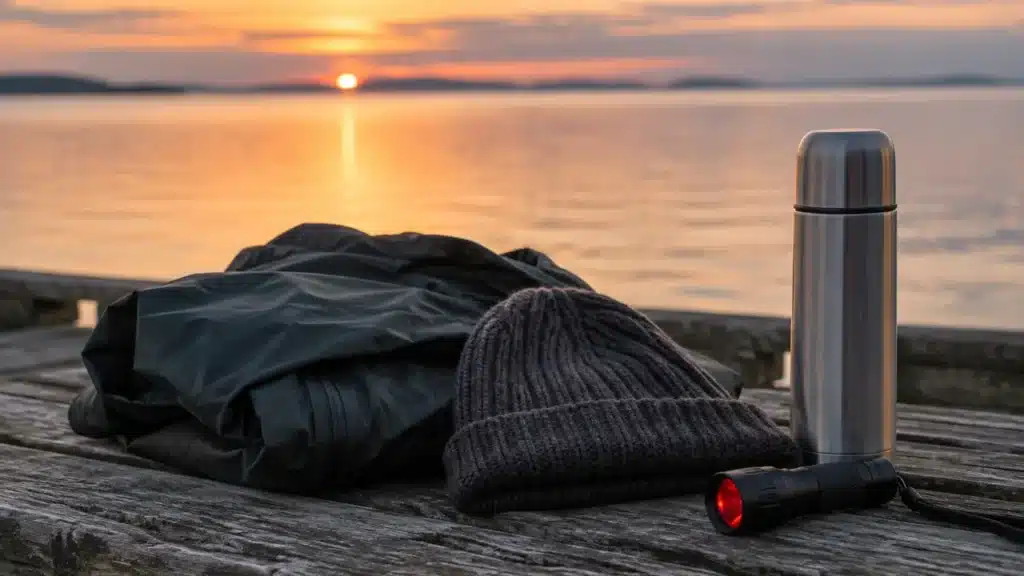
What’s actually worth carrying
You don’t need much. A small daypack rather than a handbag makes it easier to keep your hands free at the railing. Worth including: a warm layer beyond what you’re wearing, since the temperature keeps dropping the longer you stand there; a reusable water bottle; and, if you’re prone to getting cold hands, gloves you can still use to hold binoculars.
Binoculars are genuinely useful here, more than at most wildlife sites, because the rules explicitly rule out approaching the birds or using flash to see them better. A modest pair lets you watch properly from where you’re standing. Leave the tripod and the long lens setup at home unless you really know what you’re doing in near-darkness without a flash; it’s more gear than the situation rewards, and it tempts people to shuffle around hunting for a better angle when everyone else is trying to stand still and watch.
Skip anything scented (perfume, strongly scented sunscreen or repellent) if you can. Dogs are allowed on St Kilda Pier on a lead, but they’re prohibited on the breakwater at all times, and the birds do best if yours stays home for the evening. Off-leash dogs are one of the most persistent threats to this colony, and even a well-behaved dog on a lead introduces a stress cue the birds don’t need at the one time of day they’re most vulnerable, arriving ashore alone in the dark. Assistance dogs, of course, are welcome. Alcohol is prohibited on the pier and breakwater, so leave that at home too, and take your rubbish with you.
Reading the tide and the wind before you go
It’s tempting to ignore the wind forecast and just check for rain. That’s a mistake. A clear, dry evening with a 25-knot southerly is a genuinely miserable one to stand still in for an hour, more so than a still evening with light drizzle. Check the Bureau of Meteorology’s marine or coastal wind forecast for Port Phillip Bay, not just the general Melbourne forecast, and factor that into your layering more than the temperature number alone.
Weather doesn’t just affect your comfort, either. Sea conditions and water temperature influence how far penguins forage and roughly when they return, which our piece on how weather and sea temperature change penguin foraging trips covers in more detail. A rough night at sea can mean a later or more staggered return, so if the forecast looks wild, dress for the full hour and then some.
Getting the timing right and keeping things quiet
Session times move with sunset, so check the time on your booking and arrive with a little to spare rather than turning up as your session starts. Phillip Island Nature Parks guides are on the boardwalk during the sessions to explain what’s happening and answer questions, while volunteers continue the long-running monitoring work of counting, weighing and banding the colony. Our guide to how guided viewing works at the St Kilda breakwater has the practical detail on how an evening generally runs.
If you’re new to the area, a wander down St Kilda Pier before dusk, perhaps with a coffee from one of the cafés along the foreshore first, is a reasonable way to get your bearings while there’s still light to see the rock wall’s layout. Once dusk properly sets in, keep group chatter low. Penguins are more easily disturbed by movement and noise than most visitors expect, and a loud group can push birds back out to sea to wait it out, delaying their return home.
None of this is complicated, and none of it requires specialist gear. Closed shoes, warm layers you can add or shed, a torch you keep off once you’re on the boardwalk, and the patience to stand quietly for a while. The colony’s been finding its way home in the dark since long before anyone was watching it do so, and the least we can do is not get in the way of that.