
Forty knots out of the south-west and a two-metre swell running into Port Phillip Bay will empty the breakwater faster than anything on the calendar. On nights like that, visitors stand hood-up on the boardwalk and watch only a handful of birds come ashore across a whole session, where a calm night the week before had produced a steady procession. If you’ve booked a session specifically to see little penguins at the St Kilda breakwater and the forecast looks rough, it’s worth understanding why the wind matters more than the date on your calendar.
Most people planning a visit check tide times or moon phase and call it done. Fair enough, those things matter too. But wind direction, swell height and barometric pressure change the whole rhythm of the night far more than most visitors expect, and they’re the variables nobody tells you to check before you drive down. The nightly viewing sessions at the end of the pier are free but ticketed, and bookings are essential, so you’re usually locking in a night well before you can see a reliable forecast for it.
Why breakwater penguin viewing depends on the sea, not the shore
Little penguins spend their entire day at sea foraging, sometimes travelling many kilometres from the colony chasing small fish and krill, then return to the breakwater after dusk under cover of darkness. That return trip is the whole show for visitors. Nothing happens until the birds actually come in, and how easily they can come in depends almost entirely on sea conditions at the rock wall itself, not on what the weather’s doing on the promenade behind you.
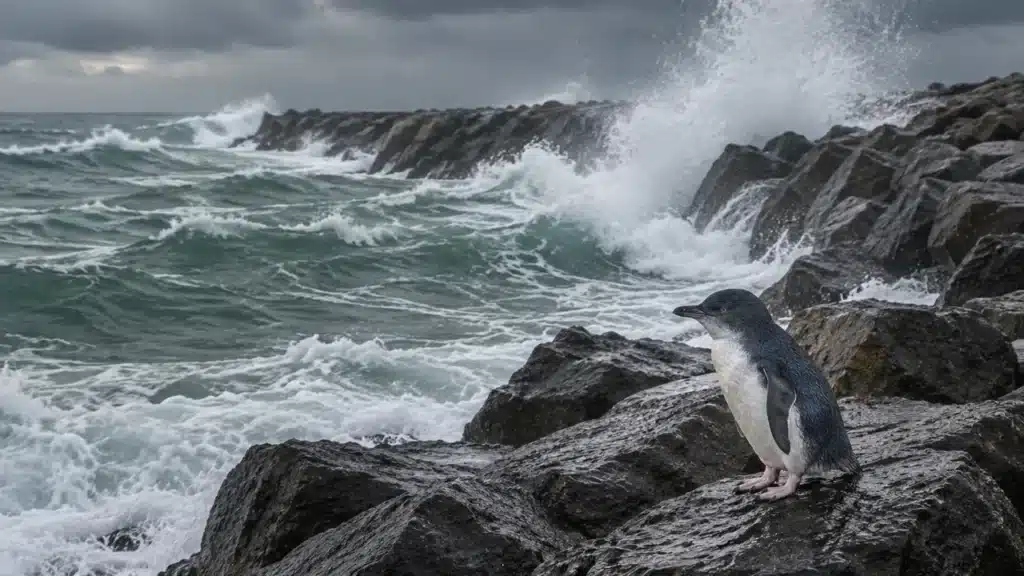
A rubble-stone wall built in 1955 as part of the pier upgrade wasn’t designed with landing conditions for a seabird in mind, obviously. It was built to break waves, which is precisely why a big swell turns the birds’ entry points into something closer to a washing machine. Little penguins are small, light and not built to fight surge against jagged rock. On a rough night they’ll often sit offshore, riding the swell in rafts, waiting for a lull before making a run at the wall. Sometimes that lull doesn’t come for hours after their usual return window, and sometimes they’ll peel off and try again somewhere along the wall’s length where the water’s a bit more forgiving.
What a southerly blow actually does to arrival numbers
Wind direction matters more than wind speed alone. A southerly or south-westerly pushing straight into the bay stacks up swell against the ocean-facing side of the breakwater, and that’s usually the worst combination for viewing. A northerly, even a strong one, tends to blow offshore relative to the wall and the water on the colony side can stay comparatively settled even when Port Phillip out past the heads is a mess.
We’ll be honest about our own bias here: we think too many visitor guides gloss over this because it complicates a simple “penguins come home at dusk” pitch. The truth is messier. On a bad-wind night you might see a handful of birds punch through early, then nothing for forty minutes, then a rush of a dozen all at once as a wave lull opens a window. It’s not a queue, it’s not a schedule, it’s opportunistic and swell-dependent, and that unpredictability is honestly part of what makes it interesting if you go in with the right expectations.
The Bureau of Meteorology’s marine wind and swell forecasts for Port Phillip Bay are the most useful free tool for this. Check the swell height and direction for the bay, not just the general Melbourne forecast, before you commit to a night. If you see a warning for strong wind or you’re watching a two-plus metre swell forecast for the bay itself, expect a quieter night with birds arriving later and in smaller, more hesitant groups.
Rain, temperature and the nights people assume will be bad but aren’t
Rain on its own doesn’t put the birds off much at all. Little penguins are waterproof by design and a drizzly, still night with no wind can actually produce excellent viewing, because the water stays flat and the birds come in confidently and on something closer to their usual timing. Visitors often give up their booking on a rainy forecast and it’s frequently the wrong call. What you want to avoid is wind, not water falling from the sky.
Extreme heat is a different story and it cuts the other way to what people expect. On very hot days the birds may delay their return further or the whole colony can seem subdued, and volunteers keep a closer eye on heat-stressed birds during summer scorchers, particularly around moult when an adult can’t go to sea at all and is fasting on stored fat while its feathers replace. A hot, still night isn’t necessarily a bad viewing night for swell reasons, but it’s one where the birds are under more physiological pressure generally, which is worth knowing even if it doesn’t change your evening much as a visitor.
For a broader look at how sea temperature and conditions shape where the birds go to find food during the day, our piece on how weather and sea temperature change penguin foraging trips goes into more depth than we can here.
Reading the wall itself on the night
If you’re out on the boardwalk and it’s clearly blowing, don’t assume the night’s a write-off and leave after fifteen minutes. Give it time. The guides on duty that night will usually have a read on which stretches of the wall are seeing more activity, since penguins will often shift their preferred landing points along the breakwater’s length depending on where the swell is hitting hardest. That’s one of the real practical benefits of having guides on hand during the sessions rather than guessing at the railing on your own, and it’s worth reading our guide on how guided viewing works at the St Kilda breakwater before you go.
You’ll also hear the colony differently on a windy night. Calls carry less predictably in gusty conditions and can sound sparser even when birds are present in normal numbers, simply because the wind’s eating the sound. Our article on why the St Kilda breakwater gets so noisy after dark explains the calling behaviour itself, but it’s worth remembering that a quiet-sounding night in rough weather isn’t the same as an empty one.
What this means for the calendar versus the forecast
Breeding season timing still matters for what you’re likely to see. Courtship and nest re-forming run roughly late July through October, eggs are laid August into early November, and chicks hatch from September through December fed on whole fish brought back from those same foraging trips. During the peak of chick-feeding, adults are more strongly motivated to get ashore regardless of conditions because there are hungry chicks waiting in the cavity, so you may find birds pushing through marginal weather with more determination than they would outside breeding season. It’s not a guarantee, but it does shift the odds slightly in your favour on a dicey-weather night if you’re visiting during that window.
Outside breeding season, and particularly around the two-week moult period each summer, there’s simply less urgency for a bird to fight a bad sea, and you’ll more often see the colony thin out and wait.
None of this is a reason to over-engineer your visit with spreadsheets. Check the Bureau of Meteorology marine forecast for Port Phillip Bay a day or two out, favour a night with light wind and low swell if you have the flexibility to choose when you book, and don’t panic about drizzle. If you do end up out there on a blustery night, that’s not wasted time either, because watching birds work the swell and time their approach is its own kind of interesting, arguably more revealing about how tough this species actually is than a calm night where the birds stroll in without drama.
Dressing and positioning for a rough night
A windy night at the end of the pier is colder than the forecast suggests, full stop, because there’s no shelter and you’re standing still for long stretches. Layer up more than you think you need to, and our guide on what to wear and bring for a night visit to the St Kilda penguins covers the practical side of this well, including why a torch or phone light is off the table at the viewing area regardless of conditions. Artificial light disrupts the birds’ night vision and their return timing even on a calm night, and on a rough night when they’re already struggling to time a landing against swell, a stray torch beam is the last thing they need. If you want to understand exactly why that matters, it’s worth reading how foreshore light disrupts St Kilda penguins coming home at dusk.
The rocks themselves are lethal footing in wind and spray, which is one more reason the public watches from the elevated boardwalk rather than from the wall, however tempting a closer vantage might look. Stay behind the railings, keep any dog on its lead on the pier and well away from the rocks, and let the guides do their job — they’re there for exactly this reason, among others, keeping an eye on both the colony’s wellbeing and yours.
Next time you’re checking the forecast before a trip down to the pier, skip straight past the seven-day icon summary and look at the actual wind direction and swell height for the bay. It’ll tell you more about your night than anything else on that page.