
 St Kilda breakwater" decoding="async" srcset="https://stkildapenguins.com.au/wp-content/uploads/2026/09/St_kilda_Beach-1024x683.jpg 1024w, https://stkildapenguins.com.au/wp-content/uploads/2026/09/St_kilda_Beach-300x200.jpg 300w, https://stkildapenguins.com.au/wp-content/uploads/2026/09/St_kilda_Beach-768x512.jpg 768w, https://stkildapenguins.com.au/wp-content/uploads/2026/09/St_kilda_Beach-1536x1024.jpg 1536w, https://stkildapenguins.com.au/wp-content/uploads/2026/09/St_kilda_Beach-2048x1365.jpg 2048w" sizes="(max-width: 800px) 100vw, 800px" />
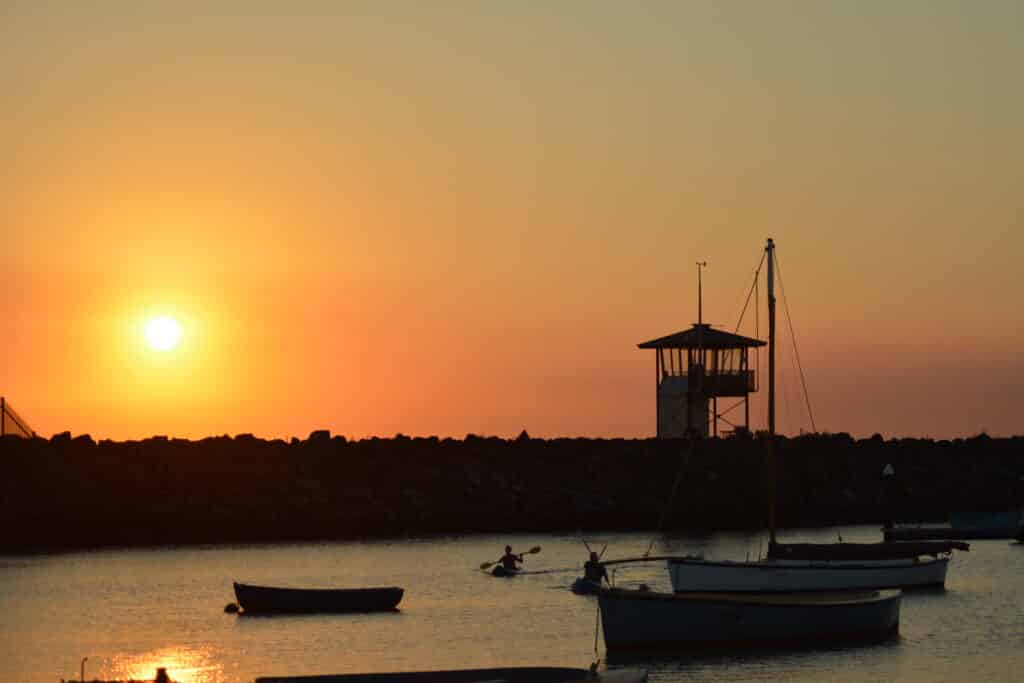
Stand at the end of St Kilda Pier on any mild evening and you’ll hear it before you see it: outboard motors idling back toward the marina, a yacht under sail cutting across the fairway, the low thrum of something bigger further out near the shipping channel. The little penguins that call the breakwater home swim through all of it, twice a day, in the dark. That’s the part people don’t always clock. This isn’t a remote colony with a quiet bay to itself. It’s a wild seabird population foraging and returning inside one of the busiest recreational and commercial waterways in Victoria.
Propeller strike risk isn’t a hypothetical for a colony like this. It’s a structural feature of where the birds happen to live. We’re not writing this to alarm anyone, and there’s no need to invent numbers to make the point land. The facts on the ground are enough.
Why a working harbour and a penguin colony end up sharing the same water
The breakwater itself is a human structure, built in 1955 as part of the upgrade to St Kilda Pier. The penguins didn’t move in because someone thought it would make a good colony site; the rubble-stone cavities in the rock wall turned out to be exactly the kind of shelter little penguins look for, and a population established itself there without any planning or intent behind it. That’s worth remembering when you think about boat traffic, because it cuts both ways. The birds are wild and free to forage wherever the fish are, but the water immediately around their home is also a functioning marina channel, used by pleasure craft, fishing boats, the odd larger vessel and personal watercraft heading in and out most days of the year.
Little penguins forage at sea for hours at a stretch, sometimes travelling a fair distance from the colony to find prey, then return to the breakwater after dusk under cover of darkness. That return happens exactly when a lot of recreational boat traffic is also coming back into the marina for the evening, or heading out for a night fish. The overlap in timing and space is the whole issue in a nutshell.
What propeller strike actually risks for a small, low-profile bird
A little penguin stands around 30 centimetres tall and weighs about a kilogram; when it’s swimming, most of that body sits low in the water with just the head and a sliver of back visible, if that. From a boat travelling at speed, especially in low light or chop, a penguin at the surface is close to invisible until it’s very close, and by then there’s often no time to react. It isn’t like spotting a swimmer or a paddleboard. The bird can dive, but not instantly, and not always in the right direction if a hull is already bearing down.
This is a well-documented risk category for coastal seabirds and marine mammals wherever boat traffic and foraging or transit routes overlap, and it sits alongside net entanglement and marine debris as one of the standard, named threats for animals that spend meaningful time at the surface. We’re not going to invent a specific injury count or a named incident for this colony, because that’s not information we have, and honestly it wouldn’t help anyone to make it up. What we can say is that the physical mismatch between a fast-moving hull and a small surface-swimming bird is real, well understood, and applies here as it does anywhere boats and marine wildlife share water.
Why darkness makes this harder, not easier
You’d think penguins returning after dark would have less to worry about, given most recreational traffic has usually thinned out by then. But dusk and early night are also when visibility for boat operators drops fastest, and that’s precisely the window the birds use to come ashore. Little penguins only ever come ashore after dark as a predator-avoidance strategy that’s served the species well for a very long time. It wasn’t designed around outboard motors and marina traffic, obviously, and that mismatch is one of the quieter costs of the colony’s location.
Artificial light along the foreshore complicates this further. Boat traffic and shore lighting interact in ways that aren’t always obvious: a penguin trying to time its approach to the rocks in the dark can be disoriented by boat lights, foreshore lighting, or a combination of both, at the exact moment it needs to be reading the water for other hazards. We’ve written before about how foreshore light disrupts penguins coming home at dusk, and boat traffic is really the maritime half of the same problem.
How this compares with the colony’s other pressures
I’d put propeller strike somewhere in the middle of the threat list for this colony, not the top, and I’ll say that plainly because I think it’s the honest read rather than the cautious one. Off-leash dogs on the breakwater rocks are a more immediate, more frequent risk because they’re a direct, land-based encounter that trained volunteers deal with regularly during viewing hours. Marine plastic and fishing line are arguably a bigger day-to-day hazard too, given how much of both ends up in Port Phillip Bay regardless of boat speed or intent. Boat strike sits alongside these as part of a broader pattern: a colony perched on a small, human-built structure right next to a busy harbour is exposed to almost every kind of pressure that comes with proximity to a city, and boat traffic is simply the one that comes with the water itself rather than the shore.
It’s also worth setting this against the mainland predation risk from foxes and cats, which is a completely different category of threat but sits on the same list for the same underlying reason: this colony exists inside a heavily used, human-dominated landscape, on both land and water. We’ve covered that side of things in more depth if you want the fuller picture on why foxes and cats still threaten the colony.
What actually reduces the risk
There’s no single fix for propeller strike risk around a colony like this, because you can’t relocate a marina and you’re not going to convince every boat owner to memorise a foraging return schedule. What helps is the accumulation of smaller things. Boat operators travelling at reduced speed through marina channels and near the breakwater at dusk and after dark genuinely matters, simply because slower speeds give both the operator and the animal more time to react. Keeping engine noise and wake down near the rock wall itself, rather than right up against it, matters too.
Awareness plays a real part as well. Recreational boaties who know a little penguin colony operates literally metres from the marina are, in our experience, more careful than those who don’t. That’s part of why volunteer-run public viewing exists in the first place: not just so visitors get to see the birds respectfully from shore, but so there’s an ongoing, visible reminder in the area that this stretch of water isn’t only a boating channel. Volunteer-guided viewing at the breakwater keeps people on the rocks doing the right thing, and by extension keeps the profile of the colony high enough that boat operators using the same water aren’t operating in ignorance of it.
Population monitoring also plays a quiet role here, even though it’s not designed specifically around boat strike. Regular counting, weighing and banding gives researchers a long-run picture of colony health, and any unusual pattern in injuries or absences would show up in that data over time rather than through a single dramatic incident. That kind of longitudinal tracking traces back to the fortnightly night trips Professor Mike Cullen of Monash University began in 1986, continued with the help of Neil Blake of St Kilda Council, and it’s a tradition of volunteer monitoring and banding work that’s carried on well beyond either of their involvement.
Living next to a working harbour, permanently
None of this is going away, and I don’t think it’s realistic to pretend otherwise. St Kilda Marina isn’t closing, recreational boating in Port Phillip Bay isn’t slowing down, and the colony isn’t relocating to somewhere quieter. That’s just the deal with an urban colony that formed by accident inside a 1955 breakwater about 7 kilometres from the CBD, rather than on a protected island reserve. The Port Phillip Bay environment more broadly, including water quality and the health of the fish stocks penguins rely on, gets covered by the Victorian Government’s environmental monitoring work and by peak marine bodies tracking bay-wide conditions, and boat traffic management sits inside that same wider picture of a working, shared waterway.
For visitors, the practical takeaway is small but real: if you’re ever on the water near the breakwater at dusk, slow down, and know that what looks like empty water might have a penguin surfacing for a breath fifteen metres off your bow. For everyone else watching from the rocks, it’s another reason the guided viewing程序 matters as much as it does, keeping people on land doing right by a colony that has to contend with the water side of things whether we notice it or not.