
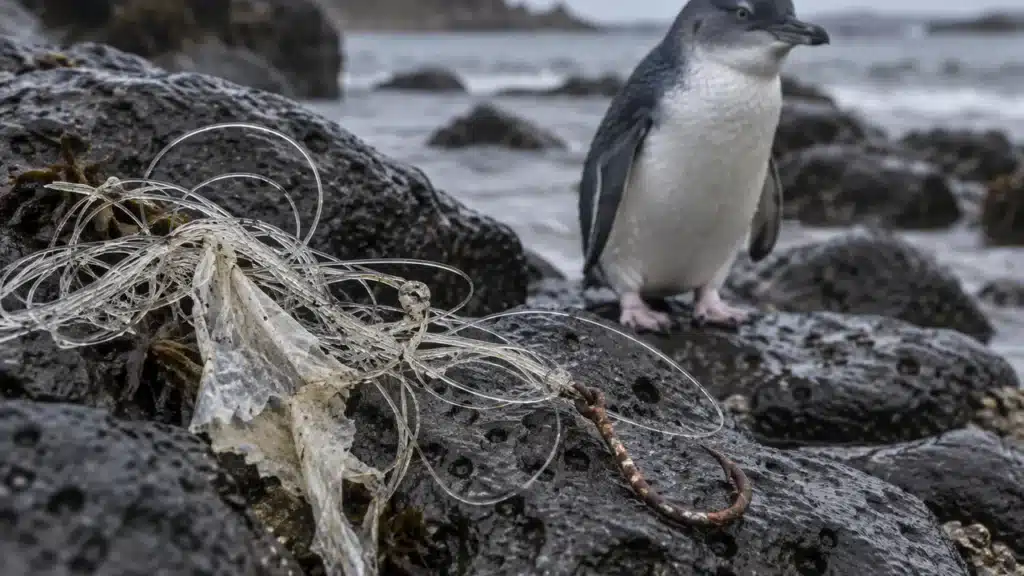
Look along the breakwater at low tide and there’s usually something wedged in the rubble that shouldn’t be there: a knot of burley bag, a length of monofilament line tangled round a rock, the plastic ring off a bait box. None of it looks dramatic. That’s rather the point. Marine plastic and discarded fishing line don’t announce themselves as a threat to the little penguin colony living in the cavities of that wall – they just sit there, quietly, until a bird finds them.
Of all the rubbish that collects on that rock wall, line is the material that does the most damage. A dropped bait bag is obviously rubbish. A stray length of fishing line looks almost natural, pale and thin, easy to miss against wet rock at dusk, which is exactly when the penguins are coming ashore.
Why fishing line is worse than it looks
Monofilament line is designed to be strong, thin and close to invisible in water. Those are excellent qualities for catching fish and genuinely bad qualities once the line is lost or discarded near a colony. A little penguin doesn’t see a hazard; it sees clear space between rocks, the same gaps it’s used for years to reach its nest cavity. Line that’s snagged around the breakwater’s rubble can loop around a flipper, a foot, or the neck, and because the birds are strong swimmers built for constant motion, a snag often tightens rather than releases as the animal struggles.
The injuries that come from this are the kind you don’t always see from the boardwalk. Line can cut into skin over days or weeks, restrict circulation, or drag a bird down in the water while it’s trying to surface and breathe between dives. Volunteers doing routine health checks as part of the colony’s monitoring work occasionally find old scarring consistent with past entanglement – a reminder that not every close call ends in a dramatic rescue. Some birds simply carry the damage. Our guide to penguin entanglement walks through six real cases, from netting to line wrapped around a flipper.
Ingestion is a slower, quieter problem
Little penguins hunt small schooling fish and squid in the shallows of Port Phillip Bay, diving repeatedly through the day before returning after dark – a foraging pattern we’ve written about separately when it comes to how these penguins actually feed. They’re not typically confused by plastic fragments the way some seabirds mistake floating rubbish for prey. But that doesn’t mean plastic ingestion is off the table for this colony, particularly indirectly, through prey fish that have themselves ingested microplastics in the bay.
Port Phillip Bay is a semi-enclosed body of water with a lot of urban catchment feeding into it, and what ends up in that water eventually shapes what’s available for a penguin to eat. It’s one more reason the bay’s water quality and the colony’s foraging success are so tightly linked, something covered in more detail in our piece on how water quality shapes what St Kilda penguins eat.
The breakwater itself makes this harder to manage
Here’s the uncomfortable bit: the very structure that gives this colony its nesting cavities is also a magnet for exactly the kind of rubbish that hurts it. The breakwater was built in 1955 as a rubble-stone rock wall, part of the upgrade works around St Kilda Pier, and nobody designed it with a penguin colony in mind – the birds moved in on their own and have bred there ever since. That’s part of what makes this colony so unusual; it’s the only mainland little penguin breeding colony in Victoria sitting inside a major city, roughly 7 kilometres from the CBD.
A rock wall like that is brilliant for a penguin looking for a dark, secure crevice. It’s also brilliant at snagging drifting line and trapping floating plastic in its gaps, especially on a harbour edge that sees constant boat traffic, fishing activity off the pier, and tidal movement pushing debris up against the rubble. The same geometry that protects nests from predators also collects the things that hurt the birds using them.
What volunteers actually do about it
This isn’t a problem solved by a single clean-up. Volunteers who monitor the colony also do the less visible work: walking the rock wall, clearing line and plastic where it’s safe to do so without disturbing nest cavities, and keeping an eye on birds for signs of entanglement during the population counts, weighing and banding work that’s been part of the colony’s monitoring since the 1980s. That monitoring tradition goes back to Professor Mike Cullen of Monash University, who began fortnightly night trips to the colony in 1986 after a harbour redevelopment proposal raised concerns about the birds’ future, assisted by Neil Blake from St Kilda Council. Cullen ran that study until his death in 2001, and volunteer monitoring has continued in the decades since – you can read more about how that programme works today in our piece on the volunteer monitoring and banding work at St Kilda.
If you want to know what an evening at the wall actually looks like for visitors, we’ve also covered how guided viewing at the breakwater works.
None of this is glamorous. Nobody’s writing grant applications about picking burley bags out of rubble crevices with a torch under red cellophane so as not to spook a returning bird. But it’s the actual, unglamorous mechanism by which this colony’s plastic and line risk gets managed, one gap in the rocks at a time.
It sits alongside other pressures, not apart from them
We’d push back gently on treating marine plastic as the single biggest threat to this colony, because in our view that framing undersells how compounding the risks are. Off-leash dogs on the foreshore, boat strike in a working harbour, artificial light disrupting the night return that these birds depend on, and the ever-present predation risk from foxes and cats on the mainland side all sit alongside plastic and line as part of the same overall pressure of being a wild colony wedged into a human-built structure next to a busy stretch of water.
We’ve written separately about why foxes and cats still threaten the colony and about how foreshore light disrupts penguins coming home at dusk, and it’s worth reading those threats as a set rather than in isolation. A colony surviving on a rubble wall a few kilometres from the CBD isn’t dealing with one clean, isolated problem. It’s dealing with several small, ongoing ones at once, and plastic and fishing line are simply the two that are easiest for the average visitor to actually do something about.
What actually makes a difference if you’re visiting
Public viewing now happens from the 150-metre elevated boardwalk at the end of St Kilda Pier, during free but ticketed one-hour sessions run each evening by Phillip Island Nature Parks, with two sessions a night and bookings essential – the practical details are in our guide to penguin viewing. You don’t need to join a clean-up crew to help, though that’s obviously welcome. The more immediate thing is simpler: take your own fishing line and bait packaging home, and if you spot line snagged in the rocks, mention it to a guide at the viewing session rather than trying to free it yourself, since pulling at line wedged near a nest cavity can do more harm than leaving it for someone trained to remove it safely. If you’re fishing off the pier itself, a bin run before you pack up genuinely matters more than it seems like it should. Dogs are welcome on the pier on a lead, but never on the breakwater rocks.
Watching quietly from behind the boardwalk railings at dusk, which is the only time these birds come ashore after a full day foraging at sea, also means you’re less likely to send a spooked bird diving back toward the rocks in a hurry, which is when entanglement risk near the shoreline edge goes up. Flash photography, torches and bright lights aren’t permitted at the viewing area for the same reason. For more on why that timing matters so much, our guide on why little penguins only ever come ashore after dark covers the reasoning in full.
The Australian Marine Conservation Society and CSIRO have both published research on plastic loads in Australian coastal waters that puts this in a wider context – Port Phillip Bay isn’t unique, it’s a smaller version of a problem affecting most of the country’s urban coastline. The Museums Victoria collection also holds useful background on the species’ foraging range and general biology if you want to go deeper than what we can cover here. Either way, the practical takeaway for anyone watching from that boardwalk at dusk is the same: what you carry in, carry back out, and if in doubt, ask a guide rather than have a crack at fixing it yourself.