
A little penguin dive rarely lasts longer than a minute, and most sit well under that. Researchers working with little penguin colonies elsewhere in southern Australia have recorded typical foraging dives in the range of 20 to 40 seconds, reaching depths usually under 20 metres, though the species is capable of diving considerably deeper when the water and the fish demand it. That’s not a dramatic number next to an emperor penguin’s twenty-minute Antarctic dives. But little penguins aren’t Antarctic birds at all, and they’re not built for that kind of endurance. They’re built for something else: short, fast, repeated dives, hundreds of them a day, each one a quick stab at a school of small fish before surfacing to breathe and going straight back down.
That rhythm is the whole story of how a little penguin makes a living. It’s not one big dramatic hunt. It’s volume.
Little penguin diving depth in practice
Depth isn’t fixed. It moves with what’s underneath the bird on any given night. In Port Phillip Bay, where St Kilda’s colony forages, the water is shallow compared with open ocean, generally less than 25 metres across most of the bay, so dives here tend to sit toward the shallower end of what the species is physiologically capable of. That’s a point worth being specific about, because visitors sometimes picture penguins working some distant, deep hunting ground. They’re mostly not. They’re working the bay itself, and the bay’s own geography puts a natural ceiling on how deep a St Kilda penguin typically needs to go.
Depth also shifts with the season and with where the fish are sitting in the water column. Small schooling species move up and down depending on light, temperature and their own feeding behaviour, and the penguins follow them. A dive that targets fish holding near the surface on a calm evening looks completely different from a dive chasing the same species deeper down after a cold change has pushed the water around. We’d be cautious about any single “average depth” figure presented as gospel for every night of the year; the honest answer is a range, and the range depends on conditions on a given evening more than on any fixed rule.
How long a single dive actually takes
Little penguins are built around short dives and quick recovery, not long breath-holds. A typical working dive during active foraging lasts well under a minute, and the bird surfaces, takes several breaths, and goes back down almost immediately. Multiply that by an entire day at sea and you start to understand the physical demand of the job. A penguin foraging from dawn until dusk, as our guide to how far St Kilda’s penguins swim in a single night covers in more detail, isn’t diving occasionally. It’s diving almost continuously, for hours, in cold water, before it even starts the swim home.
This is where the size of the bird actually works in its favour. At around a kilogram and 30 centimetres tall, Eudyptula minor is the smallest of the world’s 17 to 18 penguin species, and a smaller body cools and reheats faster, recovers oxygen debt faster, and can afford to dive in short violent bursts rather than one long controlled descent. It’s a completely different strategy to the big polar species, and it’s the right strategy for a bird hunting small schooling fish in shallow temperate water rather than large prey in the open ocean.
What they’re actually hunting for
Little penguins are opportunistic pursuit hunters. The diet leans heavily on small schooling fish, anchovy and pilchard-type species among them, along with squid and small crustaceans depending on what’s abundant in the bay at the time. There’s no fixed menu. A little penguin eats whatever is present in workable quantity and size, and that composition can shift across a season as different fish move through Port Phillip Bay.
Water quality and productivity in the bay directly shape what’s on offer, which is why the bay’s condition matters more to this colony than people visiting for the first time tend to assume; our piece on Port Phillip Bay water quality and penguin foraging goes into that link in more detail. A bay that’s turbid, overheated or under algal stress doesn’t just look worse, it changes where fish sit and how visible they are to a hunting penguin, and that in turn changes how hard the bird has to work for the same feed.
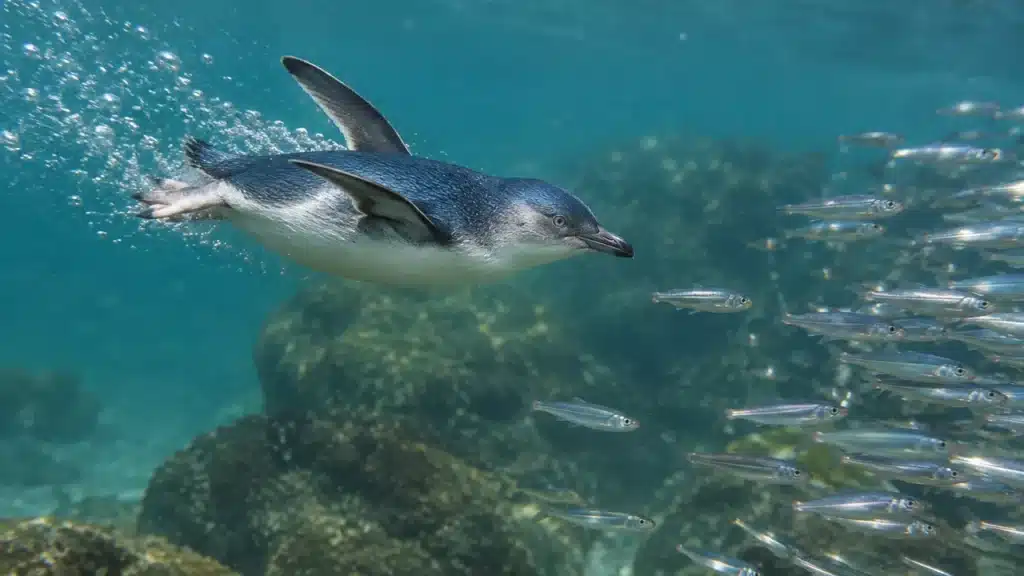
Vision, not sonar, does the work underwater
There’s a persistent assumption that diving seabirds use some kind of underwater sonar or acute low-light vision built for total darkness. Little penguins don’t have anything like that. They hunt by sight, in daylight, which is one of the less obvious reasons they forage during the day and return to the breakwater only after dusk under cover of darkness rather than the other way around, a pattern covered on this site’s explainer on why little penguins only come ashore after dark. Penguin eyes are adapted for a species that needs reasonably sharp vision both in air and underwater, a genuine engineering problem given how differently light behaves in each medium, and the birds compensate with a flattened cornea and a lens that does more of the optical work than a human eye relies on.
Pursuit itself is visual and physical rather than passive. A little penguin chasing a small fish is using short bursts of wing-powered swimming, essentially flying underwater, with the feet and tail used mostly for steering rather than propulsion. It’s an efficient system built entirely around speed and manoeuvrability in short chases, not around covering long straight-line distance underwater, which is consistent with how the whole foraging day is structured: lots of short intense dives clustered around patches of fish, rather than long straight transects through open water.
Why so many short dives beats one long one
It’d be reasonable to assume a bird would rather make fewer, longer dives if it could. Little penguins don’t, and honestly that’s the more sensible strategy for what they’re hunting. Small schooling fish move fast and erratically, and a hunting bird needs to commit to short, high-effort chases rather than one slow methodical sweep. Diving in quick repeated bursts also means the bird never accumulates the kind of oxygen debt that would force a long, exposed recovery period at the surface, which matters in a bay that also carries boat traffic and other surface hazards the birds are better off not lingering in longer than necessary. Our page on boat traffic and propeller strike risk at the St Kilda breakwater covers why time spent at the surface isn’t entirely risk-free either.
There’s also a simple energetic argument. Diving costs energy on the way down and the way up, regardless of depth, so a bird that can find fish shallow and close together does better working fast and often than diving deep and infrequently. Given the whole colony is feeding out of a relatively shallow bay rather than deep open coastline, that shallow, high-frequency approach isn’t a compromise. It’s arguably the most efficient option available to them, and it’s roughly what fits a small-bodied bird’s physiology best anyway.
What this means for chick provisioning
None of this diving happens in isolation from the breeding calendar. Through the chick-rearing months from spring into summer, adults are making these same short, repeated dives specifically to bring back whole small fish for chicks waiting in the nest cavity, a process covered in the site’s guide to how St Kilda’s penguin chicks are fed and when they fledge. A parent that isn’t finding fish efficiently near the surface, in shallow accessible water, has a harder time keeping up with a growing chick’s demand, which is one more reason bay conditions in a given season quietly shape breeding success even though nobody watching from the boardwalk sees any of the actual hunting.
It’s easy to watch a penguin porpoise along the surface near the pier and think of that as the interesting part. The interesting part, for our money, is entirely out of sight: hundreds of short dives, mostly shallow, chasing fast small fish by eyesight alone, repeated for most of a day, in a bay whose condition the birds have absolutely no say over.
For background on the species more broadly, Museums Victoria’s little penguin profile and the Australian Museum’s fact sheet on Eudyptula minor are both solid, independently verified references worth reading alongside anything on this site.