
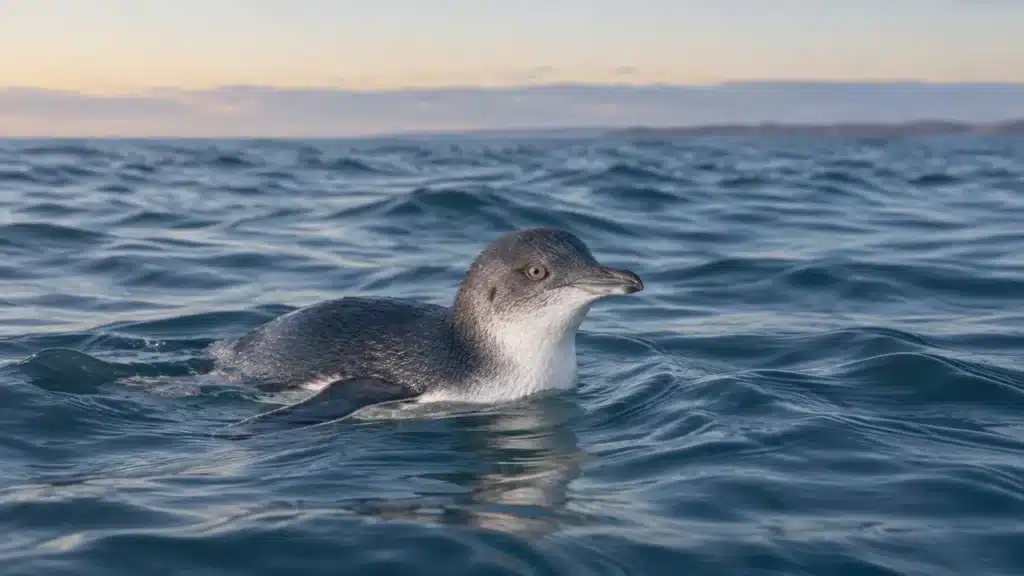
A little penguin weighing about a kilogram leaves the breakwater at first light, swims out into Port Phillip Bay or further into Bass Strait, and comes home after dusk having chased fish, squid and krill for something like ten to twelve hours straight. Multiply that by a season and you start to appreciate why researchers who study this colony keep coming back to one question: how far do these birds actually go?
It’s a harder question to answer than it sounds. You can’t follow a penguin by eye once it clears the pier, and for a bird this small, strapping on tracking gear has to be done carefully so it doesn’t affect the very behaviour you’re trying to measure. Most of what’s known about little penguin foraging ranges comes from satellite and GPS tracking studies done on colonies elsewhere in south-eastern Australia, cross-referenced with the population data our volunteers and researchers collect at St Kilda through weighing and banding work. The picture that emerges is a bird that’s a genuinely serious commuter.
What a St Kilda penguin foraging trip typically looks like
During the breeding season, when a bird has a partner sitting on eggs or minding chicks back in the nest cavity, foraging trips tend to be shorter and closer to home, often within twenty or so kilometres of the colony, sometimes less if the food is close. That makes sense: someone has to come back and swap incubation duty, or bring food for hungry chicks before they get too cold or too hungry to wait.
Outside the breeding season, when there’s no nest to hurry back to, trips can stretch out considerably further. Little penguins tracked at other Victorian and South Australian colonies have been recorded travelling journeys covering many tens of kilometres from their base colony in a single day, occasionally more, depending on where the fish are running. St Kilda’s birds aren’t fundamentally different animals to those tracked elsewhere: same species, same physiology, so there’s no reason to think they behave wildly differently, even though the breakwater’s exact figures haven’t been published in the same way Phillip Island’s larger population has been studied.
What’s consistent across the research is that little penguins are pursuit divers, not surface skimmers. They’re chasing small schooling fish – anchovy, sprat, sometimes small squid – often diving to depths of ten to twenty metres, sometimes deeper, and doing this dozens or even over a hundred times in a single trip. It’s less a leisurely swim and more a full working day of repeated short, sharp dives.
Why the bay itself shapes the trip
Port Phillip Bay isn’t the open ocean, and that matters. It’s a relatively shallow, semi-enclosed body of water with its own currents, temperature patterns and food supply, quite different to the exposed Bass Strait waters around Phillip Island. Water quality and prey availability inside the bay directly shape how far a St Kilda bird has to travel before it finds a decent feed. In years or seasons when baitfish are abundant close to the breakwater, birds may not need to go far at all. When conditions push prey schools further out or into deeper channels, trips lengthen accordingly.
This is also where the CSIRO’s long-running work on Bass Strait and southern Australian marine ecosystems is useful background, even though it isn’t penguin-specific research: sea surface temperature and productivity in these waters shift year to year, and that has knock-on effects for anything relying on small schooling fish, penguins included.
We’d argue this is actually the more interesting story than a single “how many kilometres” figure: the variability itself. A bird that swims fifteen kilometres one week might be pushing forty the next, purely because of where the food has moved. Foraging distance isn’t fixed. It’s a response to conditions that change with the season, the tide, and the year.
Reading the calls when they get home
Anyone who’s stood on the St Kilda boardwalk after dark and heard the racket coming off the rocks has heard the audible evidence of a big day at sea. The calls exchanged between mates and neighbours at the breakwater aren’t random noise: the calling that erupts after dark partly reflects birds re-establishing contact with a partner or chick after ten-plus hours apart, and partly territorial noise between neighbouring burrows. A bird that’s swum a long way and fed well often arrives back heavier and, frankly, louder about it.
Navigation without landmarks
How a penguin finds its way back to one specific gap in a rubble-stone wall, in the dark, after a day spent entirely out of sight of land, is still not fully understood by science in precise mechanistic terms. It’s assumed to involve a combination of visual memory of the coastline, possibly some sensitivity to wave direction and swell, and strong site fidelity built up over repeated trips from the same colony. Finding the exact nest cavity in the dark is a separate skill again, layered on top of just finding the right stretch of coastline in the first place. It’s a reminder that the return trip is arguably harder than the outbound one – leaving in daylight is easy; coming home after dusk, under cover of darkness that the species relies on for predator avoidance, is the trickier navigational feat.
The moult changes everything
For about two weeks each summer, all this foraging stops entirely. During the annual catastrophic moult, penguins can’t waterproof properly and can’t go to sea at all, so they fast on fat reserves built up beforehand. Building up enough weight before the moult begins is essentially banking two weeks of foraging in advance, which puts the long nightly swims in a slightly different light. Every extra kilometre chased after a school of anchovy in the weeks before moult isn’t just a good feed, it’s insurance against a fortnight of enforced fasting on the rocks.
Weather, wind and why some nights are shorter
Sea conditions on any given evening change what’s visible from the boardwalk and, we’d guess, what the birds themselves are dealing with out in the bay. Onshore wind, chop and rough seas can make both foraging and the final approach to the breakwater harder going, and rough weather is known to change the pattern of return – sometimes birds come in later, sometimes in tighter groups (there’s safety in numbers against predators near the rocks), sometimes visibly more fatigued after a hard night’s swimming against a swell. This is one of the genuine unknowns still being worked out through ongoing observation rather than settled fact, and it’s exactly the sort of pattern that keeps long-term monitoring worthwhile.
Why this matters for a colony this exposed
None of this foraging effort happens in a vacuum. A colony squeezed onto a human-built rock wall about seven kilometres from the Melbourne CBD is already working with a smaller margin than a colony on a more remote coastline. Every hour spent foraging is an hour a bird could also be exposed to boat traffic and propeller strike risk in a working harbour, or forced to swim around marine plastic and fishing line that shouldn’t be in the water in the first place. A longer foraging trip, in other words, isn’t just a matter of curiosity. It’s more time in a stretch of water shared with recreational boats, shipping and litter that has nothing to do with the birds and everything to do with an urban bay.
This history goes back further than most visitors realise. Professor Mike Cullen of Monash University began the long-term study of this colony in 1986, after a harbour redevelopment proposal raised questions about what was actually living inside the breakwater wall, running fortnightly night trips with the assistance of Neil Blake from St Kilda Council until Cullen’s death in 2001. That early work laid down the baseline that volunteer monitoring has built on ever since, and it’s part of why anyone can now say with confidence that these birds are genuinely working animals, not the sedentary or ornamental image “fairy penguin” sometimes conjured up historically: a naming issue covered in more detail in our piece on why that name fell out of use.
If you’re watching from the boardwalk at Phillip Island Nature Parks’ ticketed evening sessions and wondering why some birds waddle up looking plump and unhurried while others seem to stagger in exhausted, foraging distance and success on that particular day is very likely part of the answer. It’s not a performance. It’s the tail end of a working day that, for a one-kilogram bird with no engine and no map, covered more of Port Phillip Bay than most of us will cross by car in a week.