
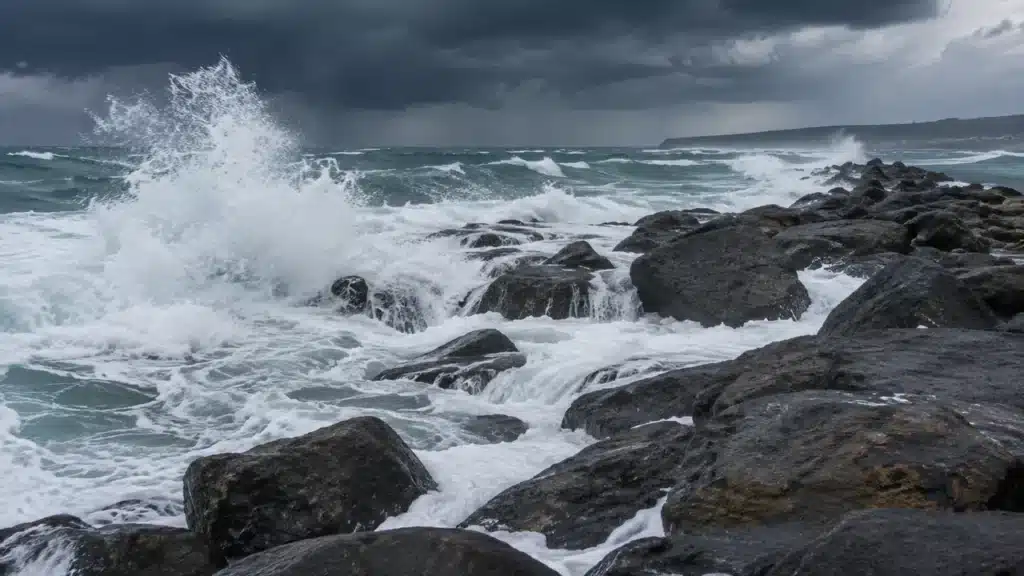
Stand at the end of St Kilda Pier on a rough night, wind coming hard off Port Phillip Bay, and you’ll see water slap clean over the top of the breakwater’s rubble stones. That wall is the entire colony’s home. Not a beach, not a dune system that can shift and reform with the tide, but a fixed pile of rock dropped there in 1955. Rising sea levels and storm surge are not an abstract climate topic for these birds. They’re a direct threat to the only structure the colony has ever known.
We’ve spent a fair few winter evenings out on that breakwater watching volunteers do their rounds, torches down, counting who’s home. It’s easy to focus on the threats you can see up close, a dog off its lead, a bit of fishing line tangled in the rocks. The sea level question is slower and less dramatic, which is exactly why it deserves more attention than it usually gets.
A colony that never had a choice about where it lives
The breakwater was built to protect St Kilda Pier, not to house wildlife. Little penguins found the gaps between the rubble stones on their own and started nesting in them, and over decades that accidental colony became the only mainland breeding colony of little penguins in Victoria that sits inside a major city, roughly 7km from the CBD. Nobody engineered nest boxes into that wall with sea level rise in mind, because nobody was planning a penguin colony there at all.
That matters when you think about what happens as the water starts sitting higher against the wall for longer periods each year. A dune-nesting colony, like some of the birds’ cousins further along the Victorian coast, can in theory shift landward as conditions change. A colony wedged into a fixed rock structure has nowhere to go. The cavities are where they are. If the lower ones start flooding more often, the birds either compete harder for the higher, drier gaps or they lose nesting options altogether.
What storm surge actually does to a rock-wall nest
Storm surge is the temporary rise in sea level during a storm, caused by wind and low pressure pushing water up against the coast, and it’s a different beast to the gradual creep of long-term sea level rise. The Bureau of Meteorology’s storm surge material describes it as an add-on to the normal tide, meaning the worst flooding happens when a surge coincides with an already high tide. For a colony living in the gaps between rocks a metre or two above the waterline, that coincidence is the dangerous bit.
During the breeding season, eggs are laid in a clutch of two between August and early November, with around five weeks of shared incubation before hatching runs through to December. That’s spring, which is also when Melbourne can still get its share of low-pressure systems and rough weather off the bay. A storm surge that reaches into a nest cavity partway through incubation doesn’t need to be catastrophic to do damage. Chilled eggs, or wet chicks in a colony where the parents are already stretched thin feeding through the evening, don’t need a dramatic wall-toppling event to suffer.
Add long-term sea level rise on top of that and the baseline keeps shifting. CSIRO and the Bureau of Meteorology’s State of the Climate reporting has tracked sea level rise around the Australian coastline for years now, and Port Phillip Bay isn’t exempt from that trend. It’s not the kind of thing that shows up as a single bad night. It shows up as the “reasonably safe” cavities of ten years ago slowly becoming the marginal ones of today.
Why a rock wall is a poor substitute for a natural dune system
I’ll be honest, I think this is one of the more overlooked structural problems with the colony’s situation, and it doesn’t get discussed as much as dogs or plastic because it’s less visually confronting. A natural coastal dune absorbs wave energy, it can be colonised by vegetation that stabilises sand, and over time the whole system can migrate. The breakwater does none of that. It’s rubble stone, essentially inert, sitting in a fixed position that engineers chose for pier protection reasons that had nothing to do with penguin welfare.
That’s not a criticism of the structure for what it was built for. It’s done its job protecting the pier for close to seventy years. But it means the colony’s entire nesting habitat is one fixed, non-adaptive asset in a spot where the water level around it is trending upward. There’s no natural process underway that will let the colony “move up the beach” the way a dune-nesting population further along the coast theoretically could.
The compounding effect with other pressures
None of this happens to a colony that’s otherwise thriving in isolation. Little penguins here are already dealing with marine plastic and fishing-line entanglement, the risk of boat strike in a working harbour, and the disruption artificial light causes to their after-dark return to the breakwater. Storm surge adds a layer on top of all that rather than acting alone.
A wetter, rougher nesting season also puts pressure on adult condition. Birds that come ashore already worn down from a hard foraging day, then lose a night’s rest sheltering from surge-driven swell, have less in reserve. And the annual moult, when an adult can’t go to sea for around two weeks and has to fast on stored fat, is a vulnerable window in its own right; timing that against a summer of increasingly warm, disrupted conditions doesn’t do the birds any favours either.
What monitoring tells us, and what it can’t tell us
Long-term monitoring of this colony goes back to 1986, when Professor Mike Cullen of Monash University began fortnightly night trips after a harbour redevelopment proposal raised concerns about the birds, assisted by Neil Blake from St Kilda Council. That work ran until Cullen’s death in 2001, and volunteer monitoring has continued in the decades since through population counts, weighing and banding.
That kind of dataset is genuinely valuable, it’s one of the longest continuous little penguin monitoring records on the Australian mainland. But it’s built around counting birds and breeding outcomes, not modelling engineering resilience of a 1955 rock wall against projected sea level scenarios. So while we can say with confidence how many pairs bred in a given season, nobody can currently tell you with precision how many nesting cavities will still be viable in twenty or thirty years under a higher baseline sea level. That’s a genuine gap, and in my view it’s one worth researchers and the relevant coastal management authorities turning attention to sooner rather than later, given how slow-moving and irreversible the underlying trend is.
Is there anything that can practically be done
This is where I’ll admit the honest answer is: not much, quickly. You can’t relocate a wild colony that has chosen its own nesting site over decades, and nobody credible is suggesting that. Coastal engineering responses to sea level rise around Port Phillip Bay, of the kind considered under frameworks like Victoria’s coastal hazard guidance, tend to be about protecting built infrastructure such as piers and foreshore paths rather than wildlife habitat specifically. Whether penguin nesting cavities factor into any future maintenance or upgrade work on the breakwater itself is, as far as we’re aware, an open question rather than a settled plan.
What can genuinely help, in the meantime, is keeping every other pressure on the colony as low as possible so the birds have more resilience in reserve. That’s the unglamorous, practical stuff: keeping dogs on leads near the foreshore, not shining torches or using flash photography, giving the colony night after night of quiet, undisturbed return. None of it stops the tide. All of it buys the colony a bit more margin while the slower-moving sea level question plays out.
What this means if you’re heading down for a look
None of this should put you off visiting, and it’s not a reason to expect visible disruption on any given evening. The birds are extraordinarily resilient and have kept breeding on that wall since long before anyone was talking about sea level projections. But it’s worth understanding, if you’re standing on the pier at dusk waiting for the first birds to porpoise in from their day’s foraging, that the ground beneath them is under a kind of pressure that has nothing to do with dogs or torches or fishing line, and everything to do with a slowly rising number on a tide gauge somewhere out in the bay.
If you want to see it for yourself, dusk viewing is guided by volunteers at the breakwater, and it’s worth reading up on why the birds only come ashore after dark before you go, so you know what to expect and how to behave once you’re there. If this kind of structural, slow-burn threat interests you, it’s worth reading alongside the piece on mainland predation risk and the one on marine plastic and fishing line, since together they give a fuller picture of what a small, human-built colony is actually up against. And if you’d like to support the ongoing counts and banding work that keeps track of how the colony is faring year to year, the volunteer monitoring programme page explains how that work is done.