
Eight photographs and eight one-line captions. That was the whole photo gallery on the old version of this site, archived by the Wayback Machine in 2011 and 2012, and people still go looking for it. This page is our rebuild of those St Kilda penguin photos as a walk through the little penguin breeding year, from pairs settling into the breakwater rocks to the scruffy, hungry weeks of the moult.
We don’t have the rights to the original pictures, so we haven’t used them. Every photo here is a licensed image of the same species, taken at other colonies around southern Australia and New Zealand, and each one stands in for a caption from the old gallery. The text explains what was happening in each frame, with every timing checked against published research.
What the old St Kilda penguin photos gallery showed
The original page was a set of small photos with a “click to enlarge” note. Its captions, in the order they appeared, were: two penguins in a nest; penguins on rocks; penguin eggs (abandoned); a three-week-old chick; a six-week-old chick; an overweight penguin ready to moult; a penguin on eggs; and two-week-old chicks.
Read in that order, it jumps around the calendar. Put back into season order, the same eight subjects tell the story of a full year on the breakwater, so that’s how we’ve arranged this page.
Most of what those photos showed happens out of sight. The colony of about 1,400 penguins nests among the rocks of the breakwater at the end of St Kilda Pier, and the birds come and go after dark. Visitors see adults coming home at dusk; eggs and small chicks stay tucked away in the cavities.
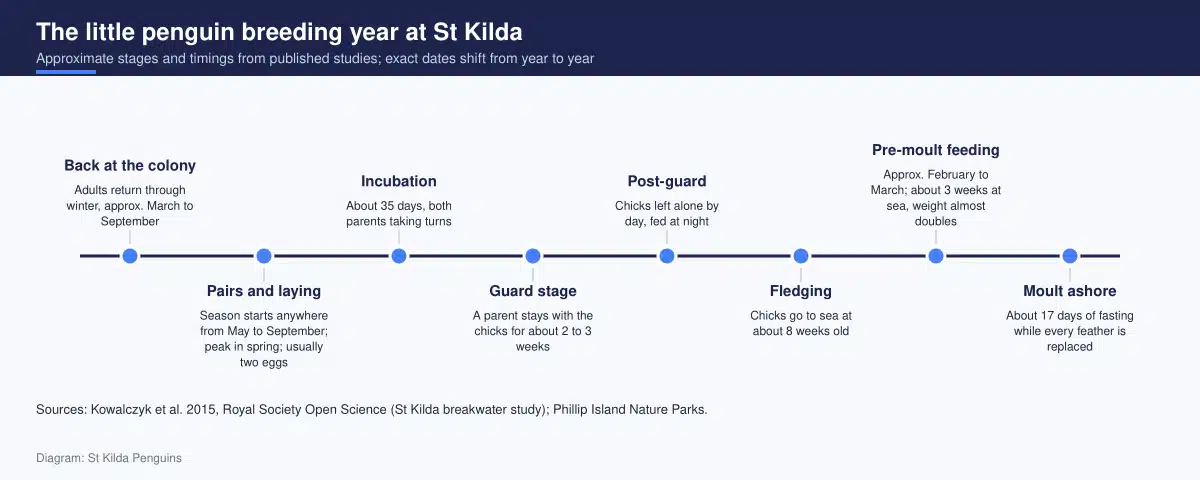
The timeline below sets out the stages we follow. Its timings come from a St Kilda breakwater study by Nicole Kowalczyk and colleagues at Monash University, published in Royal Society Open Science in 2015, alongside Phillip Island Nature Parks’ guide to little penguins. For month-by-month detail, our penguin calendar and seasonal life cycle covers the colony year in depth.
Pairs and nests among the breakwater rocks
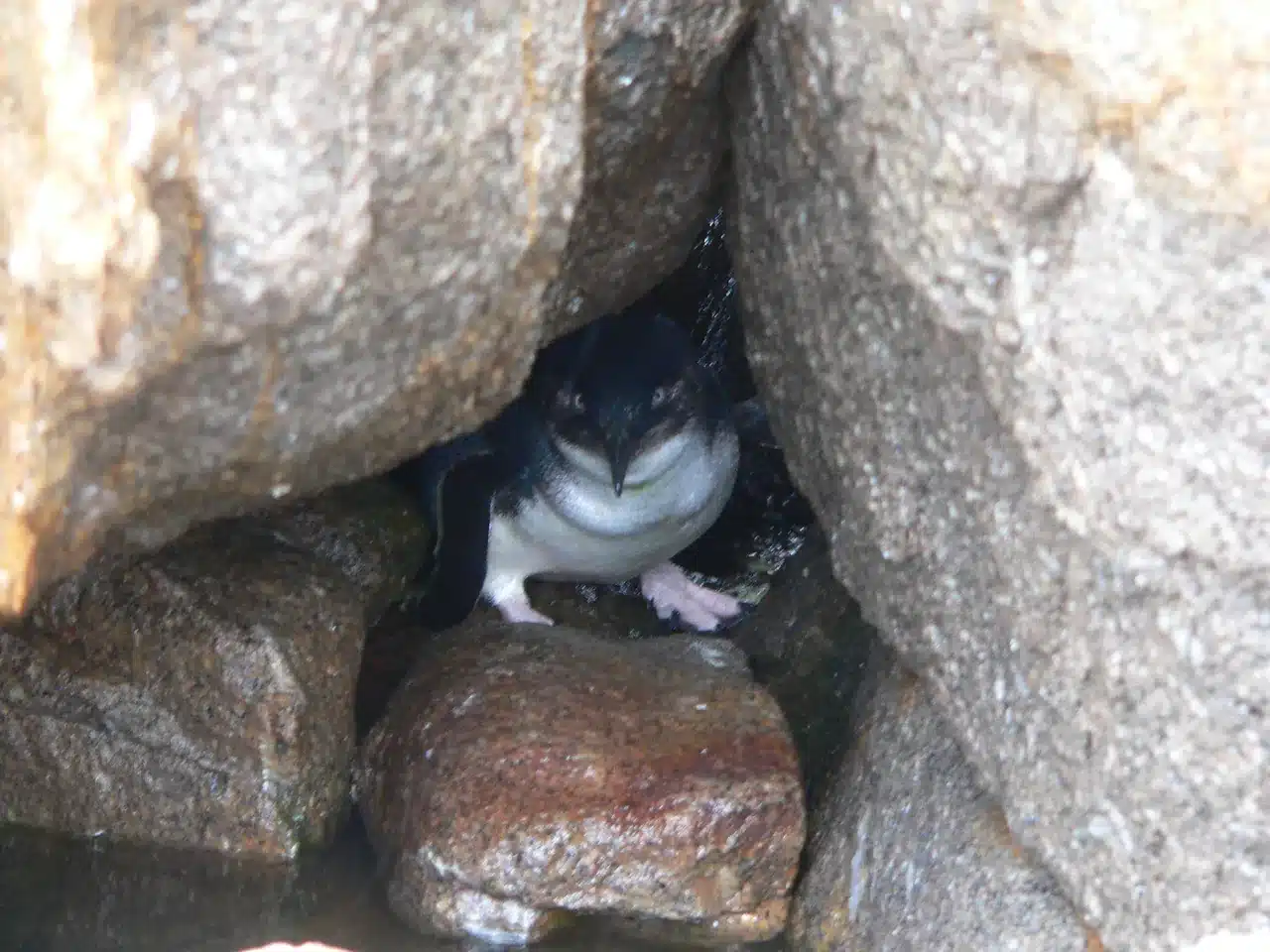
The first two captions in the old gallery, “two penguins in a nest” and “penguins on rocks”, belong at the start of the season.
Little penguins usually nest in burrows dug into sand or soil, but they will also use caves and rock crevices. On the St Kilda breakwater the birds nest among the rocks instead, in the gaps between the boulders. The photo in this section comes from Montague Island in New South Wales, yet a penguin peering out from a rock crevice is close to what a breakwater nest looks like.
Adults don’t simply turn up on laying day. In the St Kilda study’s summary of the annual cycle, birds come back to the colony through winter, roughly March to September, and spend more and more time ashore as breeding approaches. The start of the season is highly variable, anywhere from May to September depending on the colony and the year, with the peak in spring.
Pairs are fairly loyal. Phillip Island Nature Parks says most couples pair up again each breeding season, although between 18% and 50% “divorce” if a season doesn’t produce chicks. Both birds build and maintain the nest, lining it with vegetation.
How a bird picks out the right crack in a wall of near-identical rocks, at night, is a story of its own. We’ve told it in how a penguin finds its own nest cavity in the dark.
Eggs, incubation and the abandoned clutch
Two old captions were about eggs: “a penguin on eggs” and, more sadly, “penguin eggs (abandoned)”.
A normal clutch is two eggs. Phillip Island Nature Parks compares them to a chicken’s egg in shape and size, and Wikipedia’s species account gives a typical weight of about 55 grams, with the pair laid one to four days apart. Both parents incubate, taking turns, and the eggs hatch after around 35 days. A single shift on the nest can last anywhere from one to ten days.
That’s a long time to go without food. A study of two New Zealand colonies by Mihoko Numata, Lloyd Davis and Martin Renner, published in 2000, spelt out the trade-off: the bird left on the nest has to fast while its partner forages at sea. Where trips were longer and birds were in poorer condition, the risk of eggs being deserted went up.
Disturbance is the other documented cause. South Australia’s little penguin fact sheet from the state’s environment department warns that touching a penguin, chick, egg or burrow can make birds abandon breeding, and it gives hatching success as about 60%.
Honestly, we think the abandoned eggs were the most useful picture in the whole old gallery. Penguin photos tend to show only the appealing part of the season. A cold, deserted clutch shows how thin the margins are.
The swap-overs, the growling at the nest entrance and the rest of that month are covered in what happens during the five-week incubation.
Chicks at two, three and six weeks
Three of the old captions followed chicks as they grew: two weeks, three weeks and six weeks. They’re the stages people most want to see, and they change quickly.
Newly hatched chicks are covered in black down, with their eyes closed, and can’t hold their heads up. South Australia’s fact sheet tracks the next few weeks closely: heads up within a day, eyes fully open at seven days, the black down replaced by chocolate-brown down at two weeks, and the upper surface of the feet turning black at about three weeks.
Two to three weeks: the guard stage
Early on, one parent stays at the nest while the other feeds at sea. The St Kilda study describes this “guard” stage as lasting two to three weeks. Phillip Island Nature Parks says parents take turns staying with their chicks until they’re three to four weeks old, and Wikipedia gives a brooding range of 18 to 38 days. The old “two-week-old chicks” and “three-week-old chick” photos caught this stage, when a chick never has the nest to itself.
Six weeks: home alone
After guard comes “post-guard”. Both parents forage, the chicks are left alone in the nest during the day, and the adults come back at night to feed them. Phillip Island Nature Parks puts the switch at around four weeks.
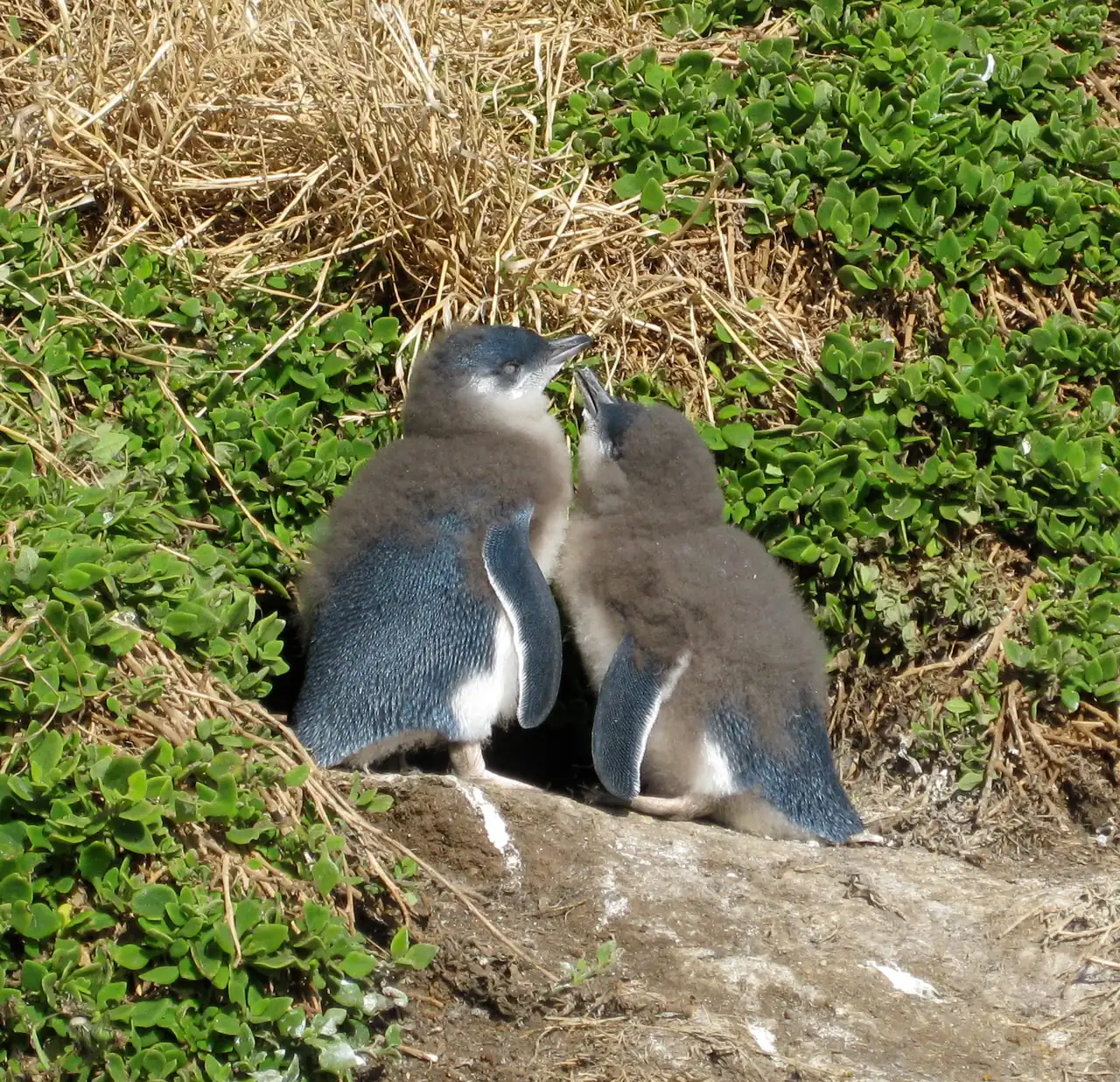
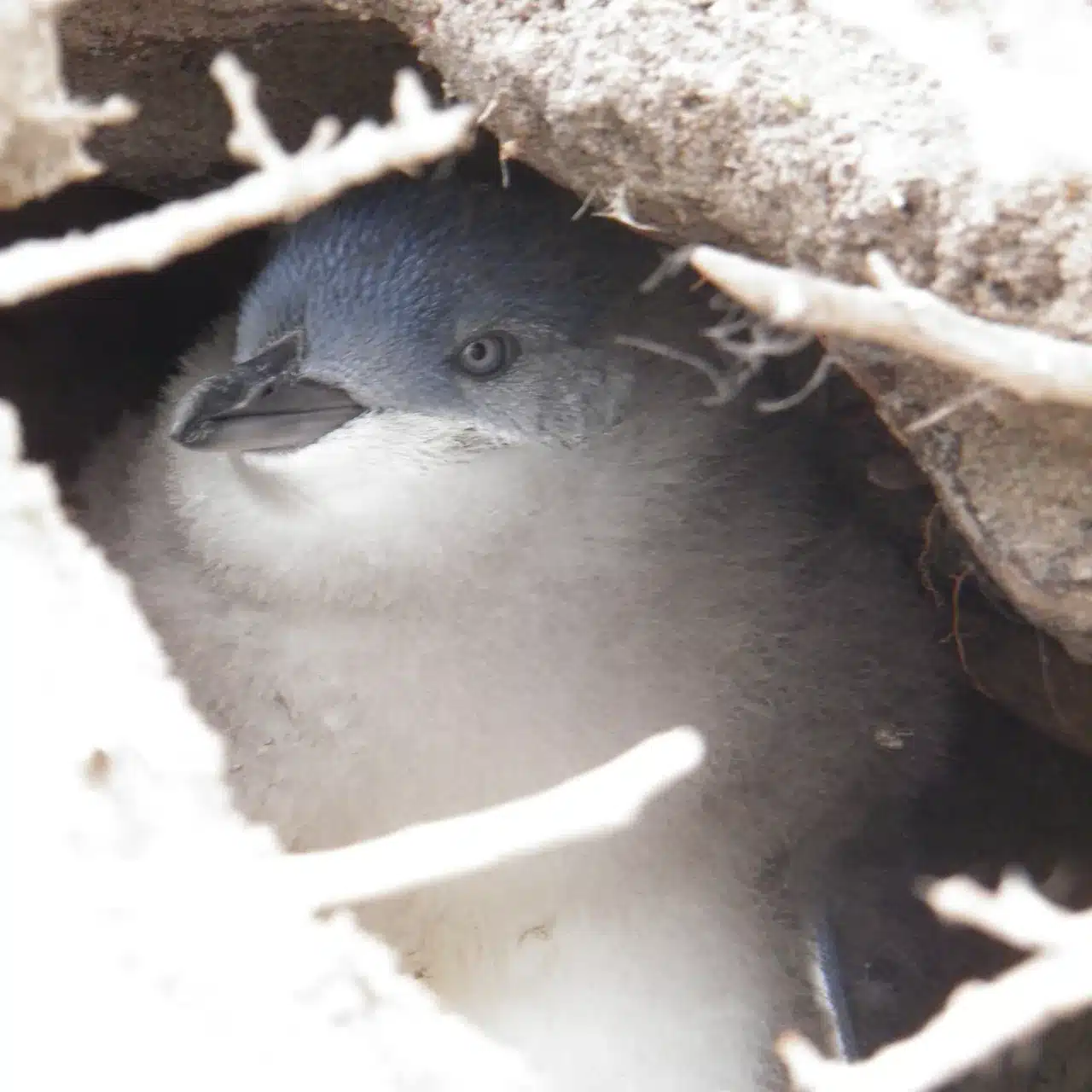
By six weeks a chick is big, hungry and partway out of its down. That’s the look of the two Phillip Island chicks in this page’s main photo: blue feathers showing on the flippers and back, fluffy brown down still clinging everywhere else. The chick below, in a sandy burrow in South Australia, is still well wrapped in down.
Feeding a chick that size is a serious job for the parents. Our article on how St Kilda’s penguin chicks are fed and when they leave covers it, so we won’t repeat it here.
Fledging: when the last of the down goes
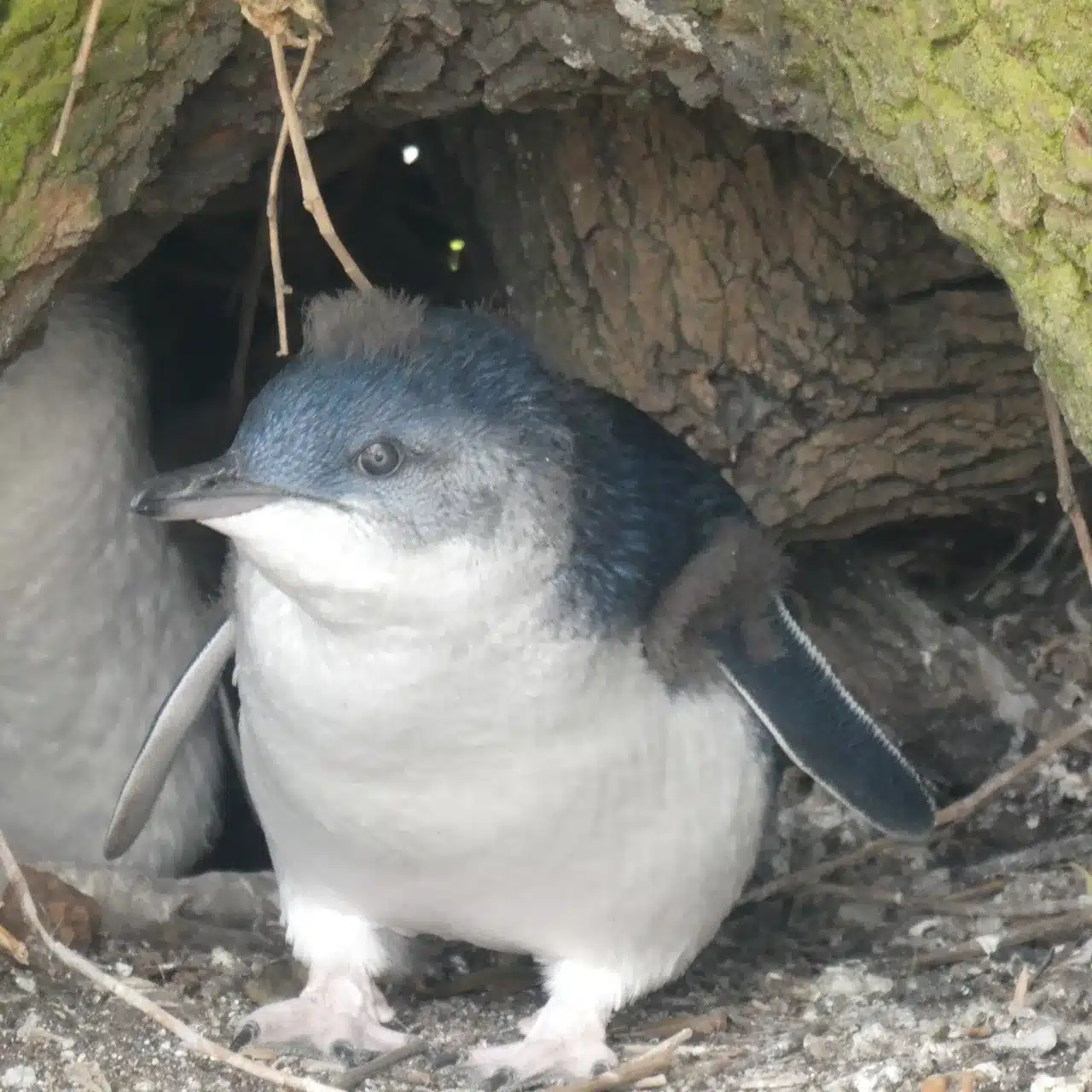
The old gallery stopped at six weeks, but the chicks weren’t finished. Phillip Island Nature Parks says chicks leave the nest and head to sea for the first time at around eight weeks of age, and the St Kilda study gives the same figure. South Australia’s fact sheet describes the juvenile shedding its brown down and becoming free-living after about 57 days.
The young bird in this photo, at Low Head in Tasmania, is nearly there. Its body is fully feathered, but a tuft of brown down still sits on its head and another at the base of one flipper.
Nobody teaches them anything. Fledglings learn to swim and catch food by instinct, and in their first year they travel further than adults do. Those that survive return to the colony at about a year old and start breeding from two to three years of age.
The season doesn’t always end there for the parents. Australian little penguins can lay a second clutch once the first chicks have fledged, and the St Kilda study notes females have been recorded laying up to three clutches in one season.
The overweight penguin: pre-moult and the moult itself
“Overweight penguin ready to moult” was the caption in the old gallery most likely to raise a smile. It also marks one of the toughest stretches of the year for an adult.
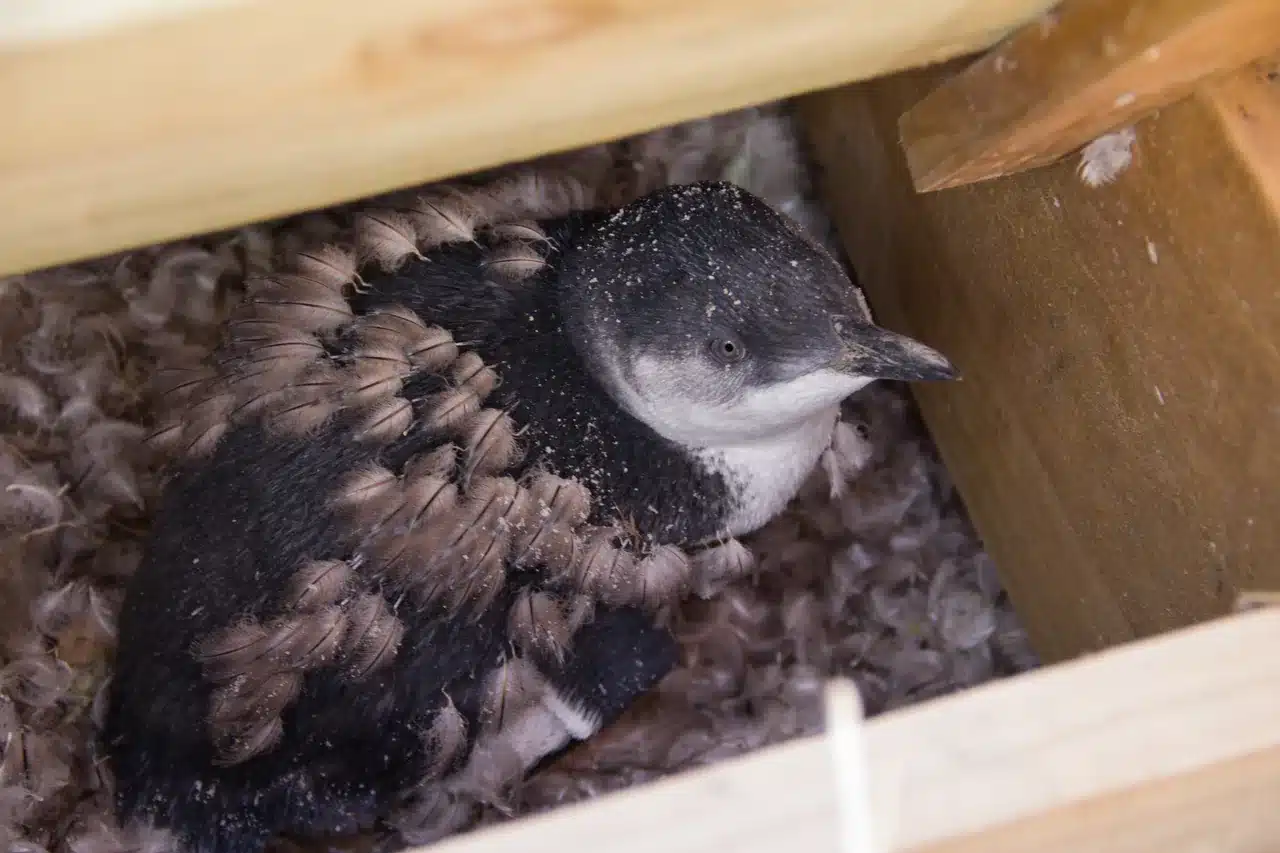
After breeding, each adult replaces every feather at once. While that happens its plumage isn’t waterproof, so it can’t go to sea and can’t eat. It has to bank the energy first. In the St Kilda study’s summary, pre-moult runs roughly February to March, with an intensive feeding bout of about three weeks in which a bird can almost double its normal body mass. Then it comes ashore and fasts for about 17 days.
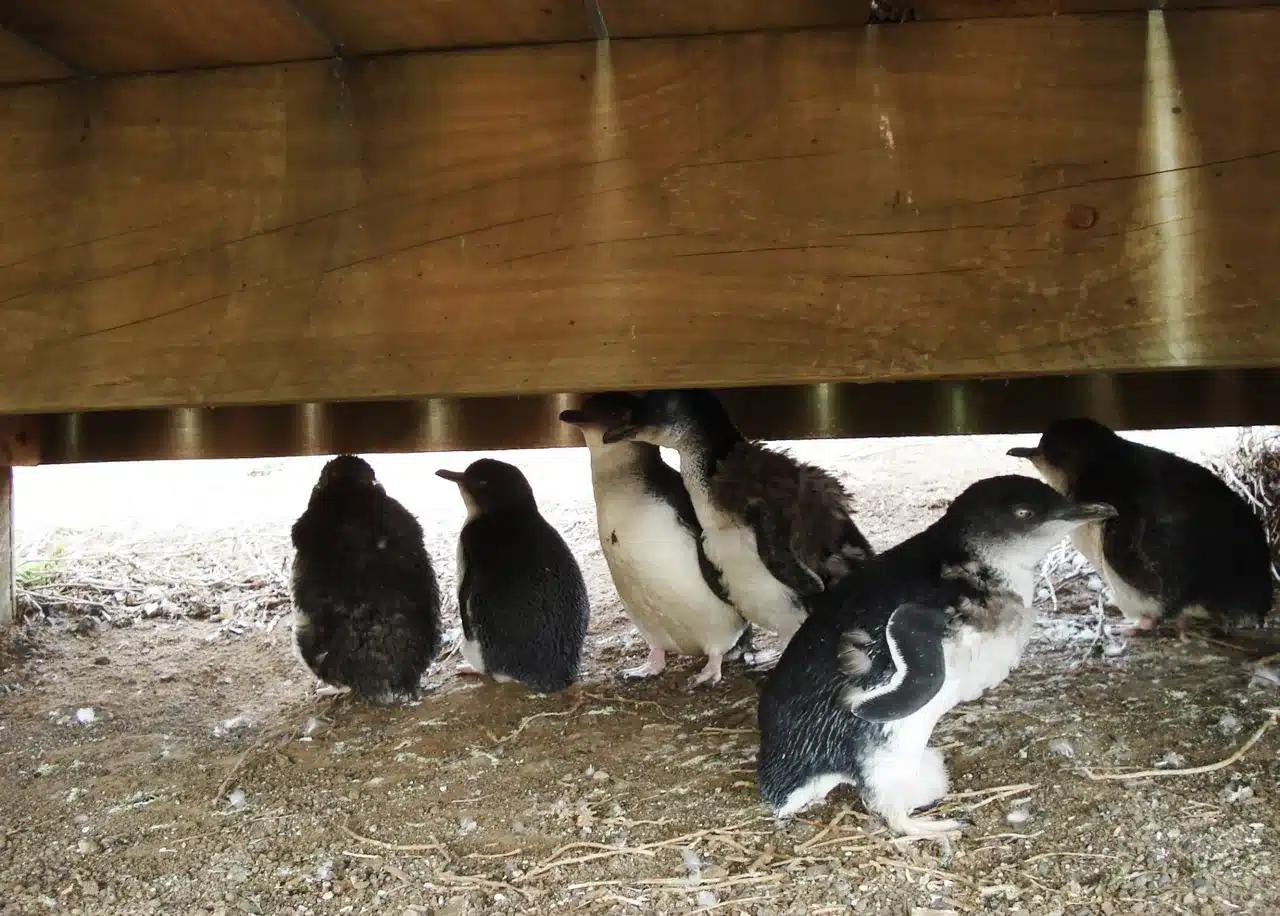
A 2025 Phillip Island moult study by Wells and colleagues in Biology Open measured this closely. Moult lasted a median of 17.5 to 18 days. Birds started at a median of about 1,650 to 1,680 grams and lost roughly 45% of their body mass by the end. The earliest birds began in mid to late January, and the onset peaked in February.
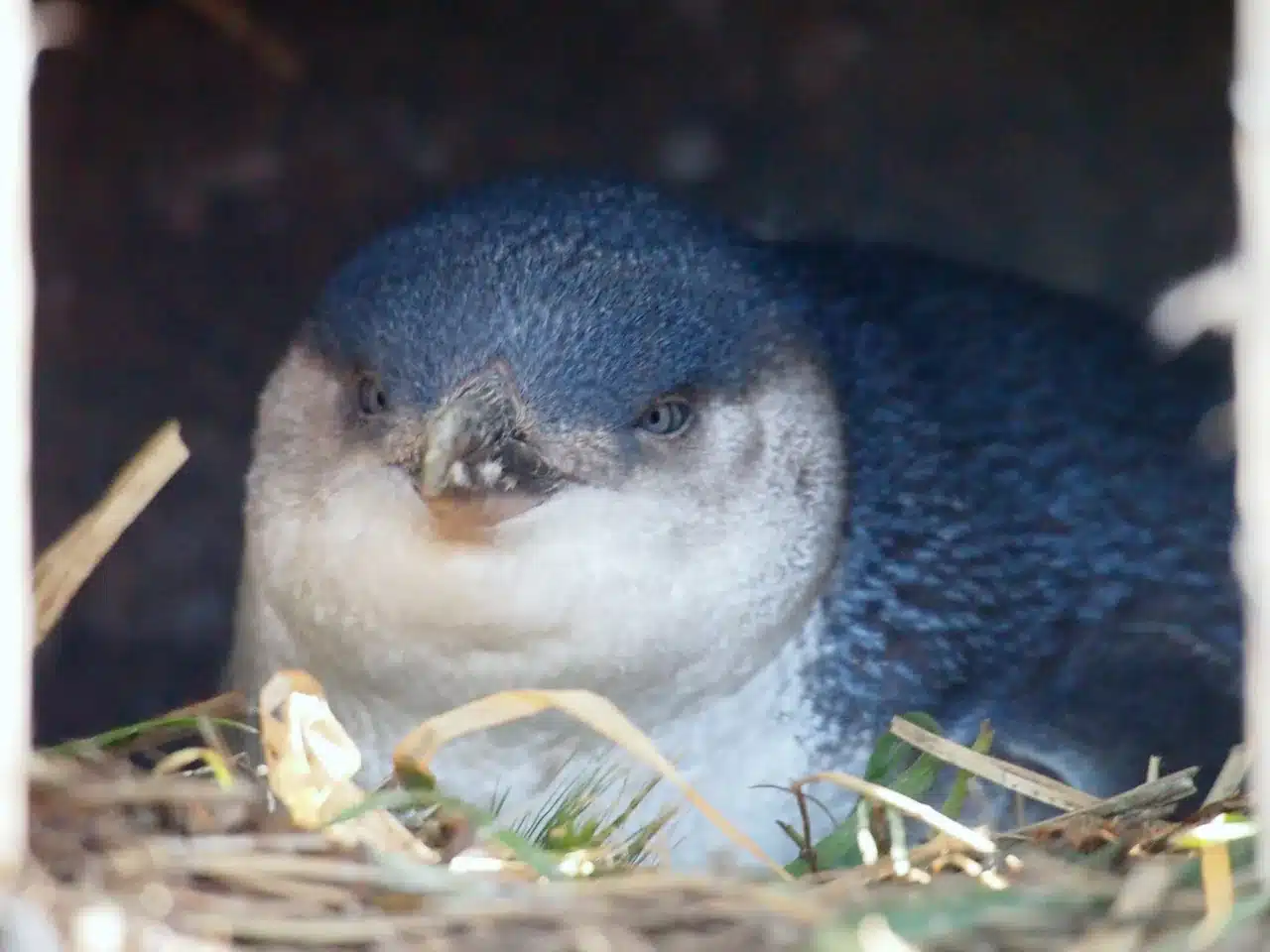
The two photos in this section show what that looks like. The group sheltering under timber on Phillip Island are at different points of the moult, some with ragged patches of old plumage. The close-up, from a nest box on Taputeranga Island in New Zealand, shows old feathers being pushed out in tufts.
It’s the hard yards of the penguin year. Wikipedia’s species account notes that in Victoria one of two seasonal peaks in dead penguins follows the moult, because some birds return to sea in a weak condition. For why that starting weight matters so much, see what a healthy pre-moult weight looks like.
Frequently asked questions
Were these St Kilda penguin photos taken at St Kilda?
No. The original gallery’s photos aren’t ours to reuse, so each picture here is a licensed photo of little penguins at another colony, including Phillip Island, Montague Island, Lipson Island, Low Head in Tasmania, and Oamaru and Taputeranga Island in New Zealand. It’s the same species doing the same things; the breakwater birds just do most of it inside the rocks.
Can I take photos at the St Kilda penguin viewing platform?
Yes, with the flash switched off before you step onto the platform. Phillip Island Nature Parks, which runs the free ticketed viewing sessions about 450 metres along St Kilda Pier, asks visitors to turn flashes off because a sudden bright light can frighten or disorientate a penguin. Torches are prohibited. The penguins are wild, so the platform is as close as anyone should get. Our explainer on why flash photography and torches harm the penguins covers the eyesight side of it.
When are chicks around at St Kilda?
Breeding peaks in spring, and on Australia’s east coast chicks are generally raised between August and March. Chicks spend their first weeks inside the nest cavities, though, so a sighting is never guaranteed. The adults are the reliable part: Phillip Island Nature Parks says you can see penguins at St Kilda all year round, and on a good night you’re watching the same breeding year these eight old captions once tried to fit on a single page.