
Watch from the elevated viewing boardwalk at the end of St Kilda Pier on a summer evening and you’ll see a penguin come ashore on the rocks below. It doesn’t wander. It hauls out of the water, gives itself a shake, and within a few minutes it’s threading through rubble and rock gaps like it’s reading a map only it can see. Which, in a sense, it is. The question visitors ask most often isn’t “where are the penguins” – it’s how, in pitch dark, among what can be several hundred occupied cavities packed into one rock wall, does a single bird find the exact crevice it left that morning.
The short answer is that it isn’t one sense doing the work. It’s three or four, stacked on top of each other, refined over a breeding life spent returning to the same few metres of rock. The longer answer is more interesting, and it says a fair bit about why the breakwater is such an unusual place for this to be happening at all – a 1955 rubble-stone rock wall, built for a pier upgrade, never designed to be housing, yet now home to Victoria’s only mainland little penguin colony sitting inside a major city.
Why finding a nest cavity in the dark is even a problem
Little penguins are shore-dwellers, not the ice-and-snow species people sometimes picture. Eudyptula minor is native to the temperate coasts of southern Australia and New Zealand, and at St Kilda they forage out in Port Phillip Bay all day before returning after dusk under cover of darkness. That timing isn’t incidental. Coming ashore in daylight would expose a 1kg bird to gulls, and historically to a wider range of predators, so evolution has pushed the whole homecoming into the low-light hours. We’ve written before about why little penguins only ever come ashore after dark, and the nest-finding behaviour is really the second half of that same story.
The trouble is, the breakwater at night gives a bird almost nothing to look at. No streetlight, ideally – artificial light spilling in from the foreshore actually disrupts this whole process, which is one reason torches and phone flashes aren’t permitted at the viewing area, and why the boardwalk itself uses wildlife-friendly lighting. So a returning penguin is moving through a maze of rubble, in the dark, past dozens of other birds calling from their own burrows, needing to locate one specific gap among hundreds that looks, to any human eye, identical to the fifty either side of it.
Smell does more of the work than most visitors expect
Seabirds generally get a bad rap for having a poor sense of smell, a hangover from very old assumptions about birds in general. Little penguins don’t fit that assumption well. Research into burrow-nesting seabirds – much of it out of the tubenose family, but with growing interest in penguins too – has found olfactory cues matter more than was once believed, and little penguins appear to use scent to help discriminate their own burrow from a neighbour’s. Each nest cavity accumulates a particular smell over a season: guano, feathers, the bird’s own preen oil, the specific microclimate of that pocket of rock. To a penguin, that’s a signature.
This is one of those areas where the research is still filling in, and we’d be cautious about anyone who tells you it’s fully settled, but the working model among researchers who have spent years monitoring these rocks is that smell narrows the search from “somewhere in this general stretch of wall” down to a much smaller set of candidate gaps.
Spatial memory and the advantage of reusing the same nest
Then there’s memory, and this is where the breeding biology of the species does a lot of the heavy lifting. Little penguins are usually monogamous season to season and they reuse the same nest cavity for years running, which means an individual bird isn’t learning the layout of the breakwater from scratch each spring. It’s walking a route it has walked, in some cases, for several breeding seasons in a row.
That repetition matters. A penguin returning to a cavity it has used before isn’t solving a fresh puzzle every night; it’s retracing a path it has already encoded, landmark by landmark, however alien those landmarks look to us. A particular gap in the rubble, a certain angle of approach from the tideline, the position relative to a large anchor stone – all of it gets built into spatial memory over repeated trips. Roughly 18 to 50 percent of young birds do end up finding a new partner after a first pairing doesn’t work out, and when that happens there’s often a new cavity to learn too, which is presumably harder on a young or inexperienced bird than on an old hand returning to a burrow it’s used for years.
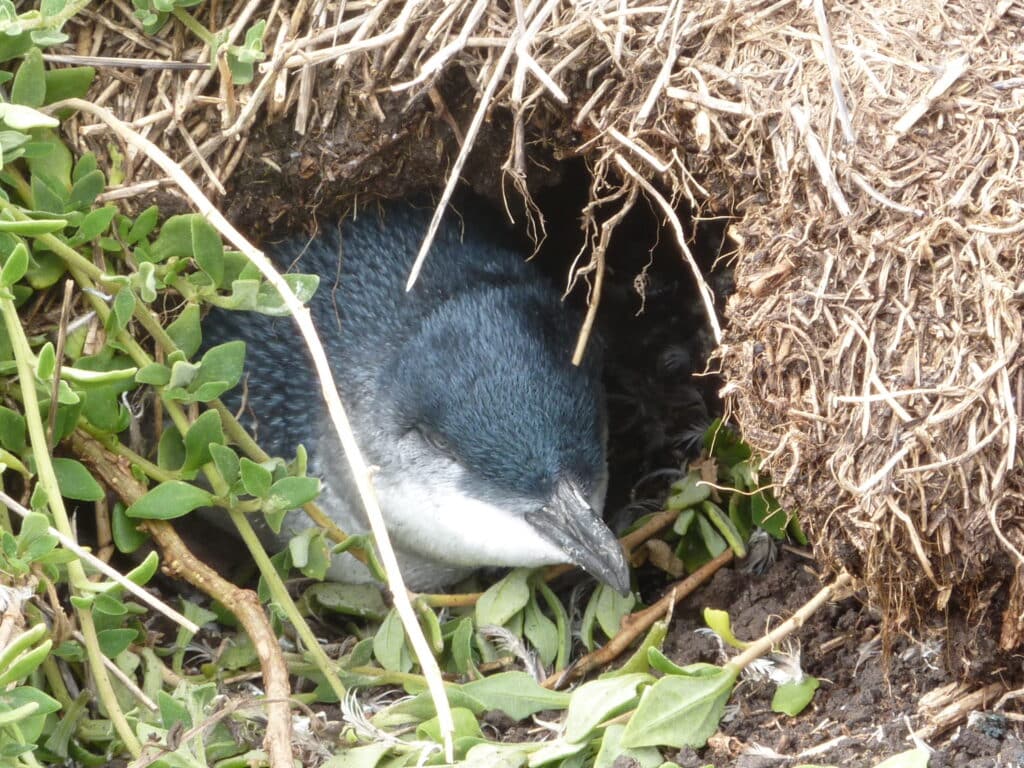
The calling and why the noise at dusk isn’t random
Anyone who has spent an evening at the end of the pier after dark knows the colony is not quiet. It’s the opposite – a rolling chorus of braying, honking calls that can sound almost comic until you realise what’s actually happening. Partners call to each other, and there’s decent evidence that little penguins can recognise their mate’s voice specifically, not just “a penguin’s voice.” A bird approaching the rocks calling out, and getting an answering call back from roughly the right spot, gets a final confirmation layered on top of scent and memory. It’s not so different, honestly, from calling out to someone in a dark carpark and homing in on the reply.
We’ve gone into the acoustic side of this in more detail in why the St Kilda breakwater gets so noisy after dark, but it’s worth flagging here because it’s one more sensory thread woven into the nest-finding process, not a separate behaviour.
What the actual approach looks like on the rocks
Watch closely on a calm night and there’s a fairly recognisable sequence. The bird comes ashore in a small group – little penguins often raft up offshore and land together, which is thought to dilute individual predation risk – then there’s a pause on the exposed rock, a bit of preening, before it moves off with what looks like real purpose. It’s not casual wandering. It threads a specific route through the rubble, often pausing at junctions, occasionally doubling back if a gap is blocked or another bird is in the way, and it disappears into a cavity with very little hesitation once it’s close.
Visitors who watch this play out from the boardwalk tend to find it never really stops being a bit remarkable. A structure with no design intent whatsoever, built in 1955 purely to protect a pier, has ended up functioning as a navigable home range for an animal that treats every crevice in it as a distinct, memorised address. That’s not something the engineers who piled that rubble ever had in mind, and it’s part of why this colony gets so much attention from researchers relative to its size – Professor Mike Cullen’s long-running study, begun in 1986 after a harbour redevelopment proposal, ran fortnightly night trips for fifteen years partly because a colony behaving like this, in a structure like this, right next to a capital city, is genuinely unusual.
Where this navigation ability breaks down
None of these senses work as well as they should when the environment around the breakwater is disrupted. Artificial light from the foreshore is the clearest example – it doesn’t just delay birds coming ashore, it can throw off the visual component of navigation for birds already close to their cavity, and it’s a big part of why foreshore light disrupts St Kilda penguins coming home at dusk is such a persistent management issue. Torches and camera flashes do something similar at close range, which is why they’re not allowed at the viewing area; you can read more on that in why flash photography and torches genuinely harm St Kilda’s penguins.
Disturbance around the rocks themselves is another factor. A bird that’s confident in its route can be genuinely thrown by an off-lead dog crossing its path, or by people on the breakwater at the wrong time of night, both of which force a detour or a retreat back to the water. It’s a good part of why off-leash dogs are considered the biggest threat to the colony, and why dogs need to stay leashed on the pier and off the breakwater full stop, not just during the day.
What all this means for a first-time visitor
If you’re heading down for your first evening viewing, the practical takeaway is fairly simple: stillness and darkness help the birds do something they’re already very good at. Viewing happens from the 150-metre boardwalk at the end of the pier during free but ticketed one-hour sessions run by Phillip Island Nature Parks, so book ahead – our guide to penguin viewing at St Kilda runs through how the sessions work. You don’t need to see the nest-finding to appreciate that it’s happening a few metres away, in a gap in the rock you’d never spot as a burrow entrance yourself. Guides are on hand during the sessions and generally know which stretches of wall are more active on a given night, so following their lead and watching quietly from behind the railings is honestly the whole trick to a good visit – something we cover in more detail in why patience matters more than timing at the St Kilda breakwater.
For a species with a brain the size of a walnut, sat on a rock wall built for an entirely different purpose seventy-odd years ago, finding one specific gap out of hundreds, in the dark, using smell and memory and the sound of its partner’s voice, is a fairly serious piece of navigation. So much of little penguin biology still surprises people who assume all penguins are more or less interchangeable, and this is a good example of why that assumption doesn’t hold up on close inspection.