
A little penguin’s wing beats at roughly the same rate underwater as a small bird’s wing beats in the air. That’s the detail that tends to reframe the whole question. These birds haven’t lost the ability to fly in some sad, broken sense. They’ve simply moved the flying somewhere else: into the water, where it counts for a bird that makes its entire living catching fish.
Visitors watching the colony from the boardwalk at the end of St Kilda Pier often ask some version of the same thing: why didn’t evolution just give them wings that do both? It’s a fair question, and the honest answer is that doing both, properly, isn’t really an option. Flight and diving propulsion pull a skeleton and a set of muscles in opposite directions. Little penguins picked a lane, and it happens to be the lane that makes them one of the most efficient swimming birds alive.
A wing built for water, not air
Look closely at a little penguin’s flipper and you’re not looking at a modified wing so much as a redesigned one. The bones are flattened and fused, the joints stiffened, and the whole structure has been compressed into something closer to a rigid paddle than the flexible, jointed wing you’d see on a gull or a tern. There’s almost no bend at the elbow or wrist. That rigidity is a cost in the air: a flexible wing generates lift efficiently, a stiff paddle doesn’t, but it’s exactly what you want moving through a denser medium like seawater.
Flight-capable birds also rely on hollow, air-filled bones to keep body weight down. Little penguins have largely given that up. Their bones are denser and heavier, which sounds like a disadvantage until you remember what the bird is trying to do: stay under water, not stay up in the air. Extra density helps control buoyancy and makes diving less of a fight against your own body.
The breastbone tells the same story. In a flying bird it anchors huge flight muscles that pull the wing down through air. In Eudyptula minor it anchors muscles built for pulling a stiff flipper through water at speed, repeatedly, for hours. It’s the same basic architecture as a flying bird, just re-tooled for a completely different job.
Why the trade-off happened at all
Penguins as a lineage split away from flying ancestors tens of millions of years ago, and the fossil record shows the transition wasn’t instant – there were intermediate forms that could probably still get airborne in a limited way while already diving well. Over time the diving side of that trade won out completely, in every one of today’s 17 to 18 penguin species. None of them fly. All of them swim.
That’s the pattern worth sitting with for a second: flight and wing-propelled diving appear to be mutually exclusive at the extremes. A handful of other diving birds, like some auks, sit in the middle – wings that manage a poor version of both. Penguins didn’t stay in the middle. Full commitment to underwater propulsion pushed them to abandon flight entirely, and in exchange they became extraordinarily good at the thing they kept.
It’s worth being clear here too, because it trips visitors up regularly: little penguins are a temperate species from southern Australia and New Zealand, not an Antarctic one. The physical adaptations that let them swim well have nothing to do with ice or polar cold. They evolved for a mild, southern-coast marine environment, which is exactly what Port Phillip Bay is.
What “extraordinary swimmer” actually looks like
On land, a little penguin waddles. There’s no getting around it – short legs set far back on the body make walking upright on rock genuinely awkward, which is part of why the breakwater’s rubble-stone cavities suit them so well; they don’t need to walk far. In the water, the same body becomes something else entirely.
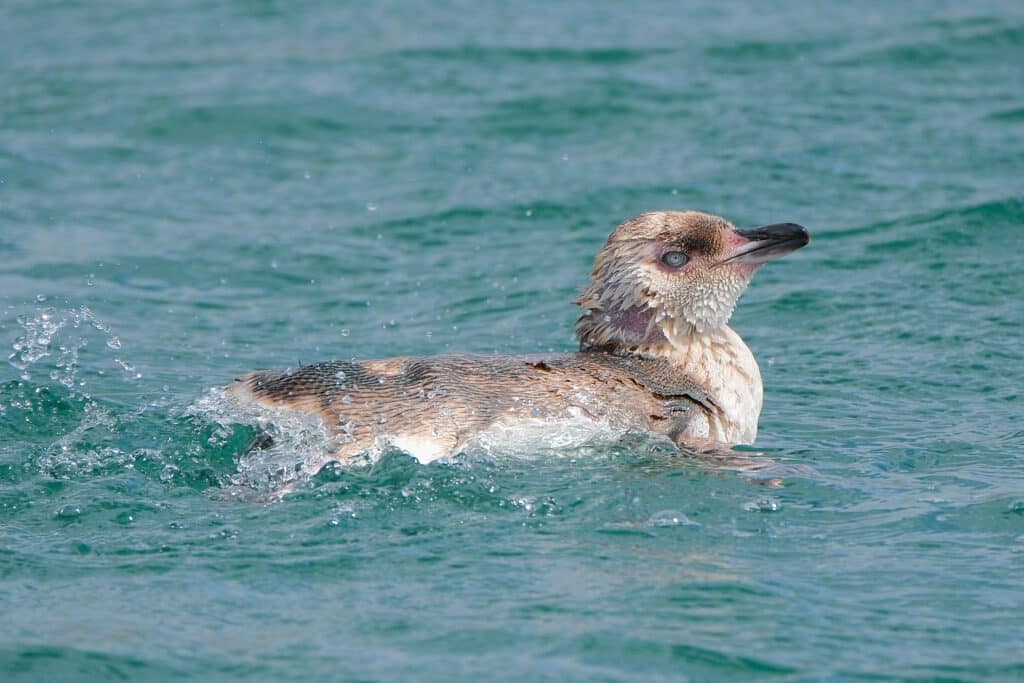
Little penguins swim by flying through water, flapping their flippers in a down-and-forward stroke that generates thrust on both halves of the beat, not just one. Their streamlined torpedo shape, dense waterproofed plumage and that stiff paddle-wing combine to let them reach sustained swimming speeds well beyond what their size would suggest, with short bursts considerably faster again when chasing prey or avoiding a predator underwater. For a bird that’s about 30 centimetres tall and roughly a kilogram, that’s a genuinely impressive amount of speed to generate.
They also dive far more often, and more efficiently, than most people expect from such a small animal – we’ve covered the mechanics of that in more detail in how deep do little penguins dive, and how do they hunt. The short version is that the same flipper-driven propulsion that rules out flight is what makes dozens of dives across a single feeding trip physically sustainable.
Waterproofing is doing more work than people assume
None of this swimming ability matters without a coat that keeps the cold bay water off the skin. Little penguins spend a meaningful chunk of their time on land preening oil from a gland near the base of the tail through short, densely packed feathers that overlap like tiles. It’s not decorative. A penguin with damaged waterproofing loses insulation fast, and in a temperate bay that gets genuinely cold in winter, that’s a serious problem, not a cosmetic one.
This is also why environmental contamination is taken so seriously around the colony. Oil in particular strips waterproofing almost instantly and is very difficult for a bird to recover from on its own. There’s a fuller explanation of that mechanism, and why even small amounts of pollution are disproportionately dangerous, at how St Kilda’s penguins waterproof feathers, and why oil is fatal.
Marine plastic and fishing line create a related but different hazard: entanglement rather than contamination, though both ultimately threaten the same waterproof coat and the mobility a penguin needs to swim well. If you ever come across a penguin that looks tangled or in distress, the right move is never to intervene yourself. Ring the Zoos Victoria Marine Response Unit on 1300 245 678, or Wildlife Victoria’s 24-hour line on (03) 8400 7300, and follow the guidance at our entanglement guide.
The land-versus-sea trade-off, seen from the boardwalk
Everything about a little penguin’s body is a compromise struck in favour of the water, and nowhere is that clearer than watching one come ashore at St Kilda. They forage at sea through daylight hours and only return to the breakwater after dusk, using darkness as cover from predators on the approach, which is precisely why public viewing happens at night rather than during the day. We’ve written more on the reasoning behind that timing at why little penguins only ever come ashore after dark.
Once a penguin does reach the rocks, the change in grace is obvious even from 150 metres up a boardwalk. A bird that looked half-comic thrashing through the shallows a minute earlier is suddenly negotiating rubble-stone gaps with the same short-legged waddle every other penguin uses, heading for a specific cavity it’s used before. It’s not elegant. It doesn’t need to be – the elegant part already happened offshore, mostly out of sight, which is honestly the trade-off I find most interesting about this species: all that specialised athleticism is invisible to almost every visitor who comes to see it.
Not every penguin swims the same way
It’s tempting to treat “penguin” as a single body plan, but the 17 to 18 species vary more than casual assumption suggests, from the little penguin at around a kilogram up to emperor penguins many times that size, built for entirely different water temperatures and diving depths. Little penguins are the smallest of the lot, and their proportionally small size is part of what makes their sustained swimming speed and dive frequency so notable relative to body mass. There’s a broader comparison of how the species differ in build and range at not all ice: how the world’s 17-18 penguin species really differ, and a closer look at the little penguin’s nearest relatives across the Tasman at little penguins vs New Zealand’s penguins: cousins, not copies.
The Australian Museum’s research on penguin evolution and Museums Victoria’s collections both document this same broad pattern across the family: flight loss correlates tightly with diving specialisation, and the smallest species tend to be among the most manoeuvrable underwater rather than the fastest in a straight line. It’s a reasonable rule of thumb, even if St Kilda’s birds don’t read the literature before they dive.
Why this matters for a colony on a breakwater
None of this is trivia for its own sake. A colony that depends entirely on swimming ability to feed itself is also a colony that’s unusually exposed to anything that degrades water quality, food supply or the clear run between open water and the rocks. Port Phillip Bay’s conditions directly shape what’s available to hunt, which we’ve gone into at why Port Phillip Bay water quality decides what St Kilda penguins eat. Boat traffic across that same stretch of water introduces a separate, blunter risk that has nothing to do with feeding efficiency and everything to do with simple bad luck at the surface.
The birds you’ll see from the boardwalk at dusk, then, aren’t failed flyers making do. They’re the product of a very old, very complete evolutionary trade, one that happened to land a small, temperate seabird on a 1955 rubble-stone breakwater seven kilometres from Melbourne’s CBD, of all places. That’s a strange enough outcome on its own terms, without needing the wings to work both ways.