
Stand on the St Kilda breakwater at dusk in July and you’re watching something genuinely unusual: a wild penguin colony breeding on the Australian mainland, within sight of a capital city’s skyline. It sounds like it shouldn’t be remarkable. Penguins and Australia go together in most people’s minds. But of the world’s 17-18 penguin species, exactly one breeds on mainland Australia at all, and even that one is mostly restricted to islands and a handful of protected coastal pockets. The mainland itself is close to a penguin-free zone. Understanding why tells you a lot about what makes the St Kilda colony worth protecting.
I’ll admit the “why doesn’t Australia have more penguins” question sounds like trivia. It isn’t. It comes down to predators, climate, and geography lining up against penguins almost everywhere except a narrow band of southern coastline and a scatter of offshore islands.
Only one penguin species calls Australia home
Eudyptula minor, the little penguin, is the only penguin species that breeds in Australia, full stop. There’s no second mainland species, no subspecies tucked away in Tasmania doing something different. Little penguins breed along parts of the southern Australian coast and around New Zealand, and that’s the entire Australian penguin story. Compare that to South America, where you get Magellanic penguins, Humboldt penguins, and the odd vagrant king penguin all sharing overlapping ranges, or the sub-Antarctic islands where several species breed within a few hundred kilometres of each other. Australia got one species, and even that species is patchy.
This matters for how you read a place like the St Kilda breakwater. It isn’t one colony among many mainland options. It’s one of very few mainland breeding sites for the only penguin species Australia has, which is a very different thing to “a penguin colony in a city.”
Predators did most of the work eliminating mainland colonies
Penguins are hopeless on land. They can’t run from anything, they’re not built to fight, and their only real defence is nesting somewhere predators can’t reach. Islands work. Mainlands, historically, did not, because foxes arrived in Australia in the 1850s for recreational hunting and spread across the continent within decades, and cats did similar damage well before that. A ground-nesting seabird with a five-week incubation period and chicks that can’t fly for two to three months is exactly the kind of prey a fox specialises in.
That’s the blunt, unglamorous reason mainland penguin colonies are so rare here now. It’s not that the coastline is unsuitable, plenty of it is; it’s that anything without a physical barrier against foxes and cats got wiped out or pushed onto islands generations ago. Zoos Victoria’s fox management research is fairly stark on how efficient foxes are as predators of ground-nesting native species, and little penguins sit right in that vulnerable category.
The St Kilda breakwater survives partly because it’s a rubble-stone wall, not open ground. The gaps between the rocks give birds a defensible cavity a fox can’t easily dig into or squeeze through, which is a big part of why foxes and cats remain a threat but haven’t ended the colony the way they have elsewhere on the mainland.
Ice has nothing to do with it, and that trips people up constantly
Here’s the misconception this whole topic exists to correct: most people assume penguins in general need cold, ice, snow. They don’t. Only a handful of species, the emperor and Adélie chief among them, actually live and breed on Antarctic ice. Most of the world’s penguin species live in temperate or even subtropical conditions. Galápagos penguins breed almost on the equator. African penguins breed on the coast of South Africa in weather that wouldn’t look out of place in Portsea. Little penguins are firmly in this temperate camp, native to southern Australian and New Zealand coastlines, never Antarctic, never ice-dwelling.
So when visitors ask our volunteers whether the St Kilda birds get cold in an Australian summer, the honest answer is that summer heat is the actual risk, not winter cold. It’s the opposite problem to what people expect. If you want the full physiology of how the world’s penguin species actually differ by climate and range, we’ve laid it out in more depth over at how penguin species differ in size, range and climate, and the Antarctic myth specifically gets its own treatment on why St Kilda’s penguins have nothing to do with Antarctica.
Geography narrows the options even within the temperate band
Even accounting for predators, mainland Australia’s coastline doesn’t offer much of what little penguins actually need to nest: soft or cavity-rich ground close to reliable, cool, food-rich water, with limited human and predator disturbance. Most of the southern mainland coast is either exposed surf coast unsuitable for burrowing, or it’s been built over.
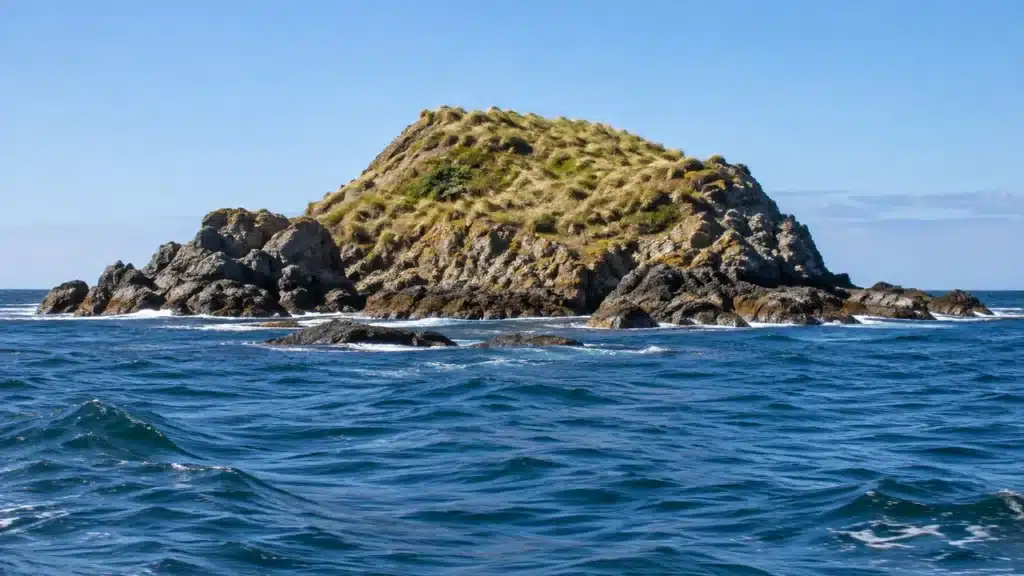
Islands solved this problem naturally by removing the predator issue entirely, which is why Phillip Island’s Summerland Peninsula became the well-known Victorian colony, and why smaller island and headland colonies persist elsewhere along the southern coast. The mainland options that do exist tend to be recent, human-made, or heavily protected sites, not undisturbed natural habitat. St Kilda fits the first category. The breakwater was built in 1955 as part of the pier upgrade and was never intended as habitat. The colony arrived on its own, using the cavities in the rock as a fox-proof, disturbance-limited substitute for an island. Nobody planned it. It’s arguably one of the more interesting accidents of urban infrastructure in Melbourne, and I don’t think that gets said often enough, most people walk past assuming a ranger set this up deliberately.
What St Kilda’s oddity actually proves
The scarcity of mainland breeding sites is exactly why researchers have paid such close attention to this particular colony since Professor Mike Cullen of Monash University began his long-term study in 1986, following a proposed harbour redevelopment. He ran fortnightly night trips until his death in 2001, with Neil Blake of St Kilda Council assisting him, and volunteer monitoring has continued in the decades since. A mainland colony sitting seven kilometres from the CBD, inside a city, is scientifically valuable precisely because it’s such an anomaly. Most of what we know about little penguin behaviour more broadly comes from island colonies where human disturbance is tightly controlled by permits and fencing. St Kilda gives researchers a rare comparison point: a colony living with off-leash dogs, foreshore lighting, boat traffic and unrestricted public access, all at once, and still returning to breed most years.
If you want to see how that monitoring actually works on the ground, the volunteer monitoring and banding programme at St Kilda is worth a read, it’s the same tradition of nightly observation Cullen started, just continued by a new generation.
The trade-off of being the exception
I’d argue the “penguins in the city” framing that gets used for St Kilda slightly undersells how precarious that exception is. Being one of the only mainland colonies isn’t a badge of resilience, it’s a reminder of how much stacked against these birds elsewhere. The same absence of predators and disturbance that let this colony form on a rock wall is exactly what’s missing from almost every other stretch of mainland coast in the state. That’s not a reason to panic about St Kilda specifically. It’s a reason to take the ordinary threats here, dogs off lead, torches and flash photography, marine plastic, boat strike, more seriously rather than less, because there’s genuinely nowhere nearby for this population to relocate to if the breakwater stopped working for them.
If you’re planning a visit, the practical side of that respect is straightforward: keep dogs leashed well back from the rocks, skip the flash, and let the birds come ashore in the dark the way they’ve evolved to. The Bureau of Meteorology’s marine forecasts are worth a glance before you go too, since wind and sea conditions change what you’ll actually see at the breakwater on any given night.
None of this is really about ice, or the cold, or anywhere near Antarctica. It’s about foxes, cats, coastal geography, and one small, stubborn colony that found a gap in all of it, on a rock wall nobody built for them in the first place.