
Come down to the viewing boardwalk at the end of St Kilda Pier on a mild autumn evening and you’ll hear someone say it within about ten minutes: “aren’t penguins meant to be somewhere colder?” It’s one of the questions visitors ask most often while they wait at dusk, and it’s worth answering properly, because the confusion isn’t silly, it’s just a gap in what most of us were taught about penguins as kids. The birds nesting in the rock cavities of the breakwater are little penguins, Eudyptula minor, and they have never seen ice in their lives. Nor have their parents, or their parents’ parents, going back as far as anyone has studied this colony.
There are 17 to 18 recognised penguin species in the world, depending on which taxonomy you follow, and only a handful of them live anywhere near Antarctica proper. The rest are spread across a surprising range of latitudes, from the Galápagos Islands sitting almost on the equator to the cool temperate coasts of southern Australia, New Zealand, South Africa and South America. Little penguins sit firmly in that temperate bracket. Melbourne’s climate, with its mild wet winters and warm dry summers, is close to ideal for them, not a compromise.
The species most people picture is not the species living at St Kilda
When someone imagines a penguin, they’re usually picturing an emperor penguin: over a metre tall, huddled in a blizzard, incubating a single egg on its feet through an Antarctic winter that drops below minus 40. Emperor penguins are extraordinary animals and they genuinely do live that life. But they’re also about 35 times heavier than a little penguin and built for a completely different environment, with thick fat reserves and dense feather layers suited to sustained sub-zero exposure.
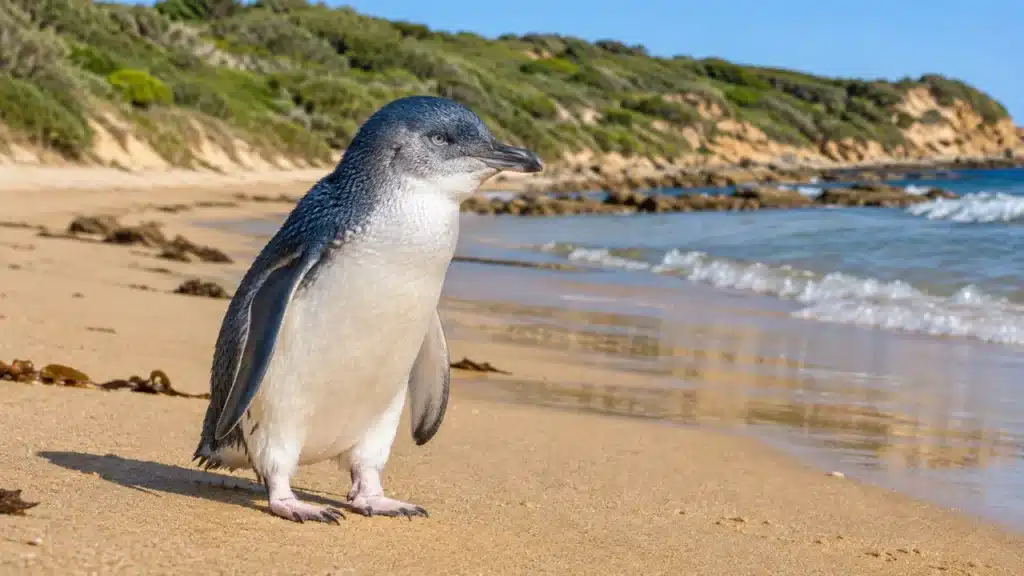
Little penguins are roughly 30cm tall and weigh about 1kg, which is why the old common name “fairy penguin” stuck for so long even though it’s fallen out of favour. They’re the smallest of all the world’s penguin species. Nothing about their body is built for ice. Their feathers, their fat layer, their breeding calendar and their whole foraging strategy are tuned to Bass Strait and Port Phillip Bay conditions, not the Southern Ocean pack ice. Confusing the two isn’t a small error, it actually leads people to misjudge basic things about the colony, like assuming winter is a dangerous time for the birds when in fact it lines up nicely with prime viewing conditions, as we’ve covered in our guide to the best time of year to see the St Kilda penguins.
Where the temperate penguins actually live
Little penguins breed around the coastlines of southern Australia and the North and South Islands of New Zealand. That’s the entire range. There’s no population anywhere near Antarctica, sub-Antarctic islands, or pack ice of any kind. Museums Victoria’s research collections document the species’ distribution clearly, and BirdLife Australia’s species accounts are worth a read if you want the full picture beyond what we can cover here.
Other temperate species follow a similar pattern. African penguins nest on the coasts of South Africa and Namibia, in rocky burrows not far from Cape Town, and they’ll happily tolerate warm days that would be lethal to an emperor. Galápagos penguins live practically on the equator, cooled only by the Humboldt Current. Yellow-eyed penguins and several crested species stick to New Zealand’s cooler southern coasts without ever going near true polar ice. The genus Spheniscus, which includes the African, Humboldt and Magellanic penguins, is sometimes called the “banded penguins” and every one of them is a temperate or subtropical bird.
What all of this tells you is that “penguin” describes a huge span of adaptations, not one climate niche. Antarctic species are the extreme end of the spectrum, not the default.
A breeding calendar built for Melbourne, not the ice shelf
The Cullen research that’s underpinned understanding of this colony since 1986 mapped out a breeding calendar that would make no sense for a polar bird. Courtship and nest re-forming happen from late July through October, eggs go down from August into early November, and chicks hatch across September to December, fed on whole fish brought back from the bay. That’s spring breeding tuned to when Port Phillip Bay’s food supply and daylight hours suit raising chicks, nothing to do with Antarctic ice cycles at all.
Compare that to an emperor penguin, which lays its single egg in the depth of the Antarctic autumn and incubates through the coldest, darkest months of the year purely because its chick needs to be ready to fledge when the pack ice conditions are right the following summer. Two entirely different calendars, driven by two entirely different environments. Even the moult follows a local rhythm here – St Kilda’s adults come ashore for about two weeks each summer and fast on stored fat while they replace their waterproof plumage, a detail we go into more in our post on moulting time and the more recent moult is here update.
Why this matters for how you watch them
Watch from behind the boardwalk railings on a winter evening and you might half expect the birds to look cold, hunched, waiting out bad weather. They don’t. They come ashore briskly after dark, call to their partners, duck into their cavities and get on with things, because this is simply their climate, not an ordeal they’re enduring. Little penguins forage at sea all day and only return to the breakwater after dusk, under cover of darkness, which is exactly why public viewing here happens at night rather than during the day – see our notes on how the nightly viewing sessions work if you haven’t been down before.
Because they’re a temperate species rather than a polar one, the real threats to this colony look nothing like what you’d read about for Antarctic penguins. Nobody here is worried about pack ice melting under a nesting site. The pressures are urban and coastal: off-leash dogs along the foreshore, fishing line and marine plastic, boat strike in a working harbour, and artificial light along the foreshore confusing birds trying to find their way home after dark. We’ve written separately about how foreshore light disrupts penguins coming home at dusk and about the predation risk foxes and cats still pose to a mainland colony like this one. None of that is a polar-penguin problem. It’s a temperate, urban-coastal one, and it needs a completely different kind of protection.
The size difference changes everything about behaviour
It’s easy to skip past the size stat, but a 1kg bird and a 30-plus kilogram bird are playing an entirely different survival game. Little penguins can’t store the fat reserves an emperor uses to fast for months, so they need consistent daily access to prey, mostly small schooling fish and squid, within a manageable swimming distance of the colony. That’s part of why sea temperature and weather conditions matter so much to how far St Kilda’s penguins have to travel to feed, something we’ve detailed in our piece on weather, sea temperature and penguin foraging trips. An emperor penguin can afford a bad week. A little penguin really can’t, and that vulnerability is a direct consequence of being built small and temperate rather than large and polar.
Their small size also explains the burrows. Little penguins nest in natural cavities, burrows they dig themselves in soft coastal soil, or in this colony’s case the gaps between the 1955 rubble-stone blocks of the breakwater, which formed by accident when the structure was built as part of the St Kilda Pier upgrade. Emperor penguins don’t burrow at all; there’s nothing to dig into on an ice shelf, and their strategy of huddling in the open in enormous colonies is a completely different answer to a completely different problem.
An honest gripe about how penguins get talked about
We reckon a lot of the “all penguins live on ice” confusion comes down to documentary framing more than any genuine gap in public knowledge, wildlife films skew hard towards the dramatic Antarctic footage because it photographs well, and species like the little penguin get comparatively little screen time despite being far more accessible to most people. You don’t need an expedition ship to see Eudyptula minor. You need a booked ticket, a jacket, a bit of patience at dusk, and to leave the flash off your phone, which we cover properly in our guide to why flash photography and torches genuinely harm the colony. That accessibility is arguably the more remarkable story, not less: a wild seabird colony persisting seven kilometres from Melbourne’s CBD, inside a human-built structure, entirely on its own terms.
What to actually expect if you visit
If the Antarctic image is stuck in your head, recalibrate before you come down. You won’t see snow, ice, or huddling. Viewing happens from the 150-metre elevated boardwalk at the end of St Kilda Pier, during free but ticketed one-hour sessions run each night by Phillip Island Nature Parks — two each evening, 150 people per session, times moving with sunset, and bookings essential, as we set out in our penguin viewing page. From behind the railings you’ll see small dark shapes porpoising in through the shallows after dusk, hauling out onto the rocks, and working their way into gaps in the breakwater while calling to their mates, a sound loud enough to surprise most first-time visitors, which we explain in why the breakwater gets so noisy after dark. Guides are on hand during the sessions to answer exactly this kind of question, and honestly, it’s one of the best-value things to do in Melbourne after dark that most locals have never bothered with. Bring warm layers regardless of the season; even a temperate-climate penguin colony gets a stiff wind off the bay once the sun’s down.