
A fur seal took a little penguin off Phillip Island in broad daylight a few seasons back, filmed by a tour boat and passed around the volunteer network for weeks afterwards. Nobody at St Kilda has documented anything quite that dramatic on the breakwater itself, and that’s worth sitting with for a second, because it tells you something important: the predator pressure on this particular colony looks nothing like the textbook version of “what eats a penguin.”
Little penguin predators split cleanly into two worlds, sea and land, and the St Kilda colony’s whole survival story is really about which of those worlds it managed to mostly escape by nesting inside a pile of rubble stone seven kilometres from the CBD.
At sea: the predators little penguins can’t outswim
Eudyptula minor is fast in the water for its size, but it’s still a one-kilogram bird competing with animals built specifically to hunt in open water. Australian fur seals are the standout marine predator across the species’ range, and New Zealand fur seals take their share too. Sharks, particularly larger coastal species, will also take penguins opportunistically, as will some large fish. None of this is exotic or surprising if you’ve spent time around any southern Australian rookery; it’s the standard cost of foraging offshore every single day.
What’s genuinely different about St Kilda is exposure. Phillip Island’s colony forages out into open Bass Strait water where fur seal haul-outs and known shark movement corridors overlap with penguin foraging grounds. Port Phillip Bay is a more enclosed, more trafficked, generally calmer body of water. Our volunteers haven’t recorded the kind of seal-strike incidents that occasionally make news at other Victorian colonies. That’s not a guarantee of anything, sea conditions shift and predator movements shift with them, but it is a meaningful structural difference in where these particular birds feed. If you want the detail on how conditions out in the bay affect what the colony eats day to day, we’ve covered that in our piece on Port Phillip Bay’s water quality and penguin foraging.
Boat strike sits in an odd category, not quite predation but a genuine at-sea threat unique to a colony operating inside a working harbour. A propeller doesn’t care whether a penguin is diving for pilchards or crossing a shipping lane on its way home. It’s arguably as relevant to St Kilda’s risk profile as any natural predator, simply because there’s so much recreational and commercial vessel traffic moving through the same water these birds use every evening.
On land: why the usual suspects barely apply here
Most little penguin colonies around southern Australia deal with introduced land predators as their single biggest ongoing threat. Foxes are the big one nationally, and cats, both feral and unrestrained domestic ones, run a close second. On islands without that predator load, like Phillip Island or Granite Island, colonies can grow to sizes that would be unthinkable on the mainland. That contrast is basically the whole reason island colonies get protected the way they do, and it’s the reason St Kilda’s situation is so unusual: this is a mainland colony, sitting inside a major city, with no water barrier keeping foxes or cats off the rock wall.
And yet the predation pressure from foxes and cats at St Kilda has historically been lower than you’d expect for a mainland site, mostly because the breakwater itself is an awkward target. It’s a narrow rubble-stone structure jutting into the bay, disconnected from dense fox habitat by open water and a busy foreshore, and the cavities the penguins nest in are tight rock gaps rather than open burrows. That doesn’t mean the risk is zero. Foxes have reached other mainland penguin colonies before, and an unrestrained or feral cat wandering onto the rocks at the wrong moment is a real danger to eggs, chicks and moulting adults who can’t easily flee. We go into this properly in our article on why foxes and cats still threaten the St Kilda penguin colony, and it remains one of the reasons volunteers keep such a close eye on the wall after dark.
Native land predators matter too, if less dramatically. Birds of prey and large gulls will take eggs or very young chicks if a nest is left exposed, though the tight rock cavities the colony uses make this harder than it would be for a ground-nesting bird on open sand.
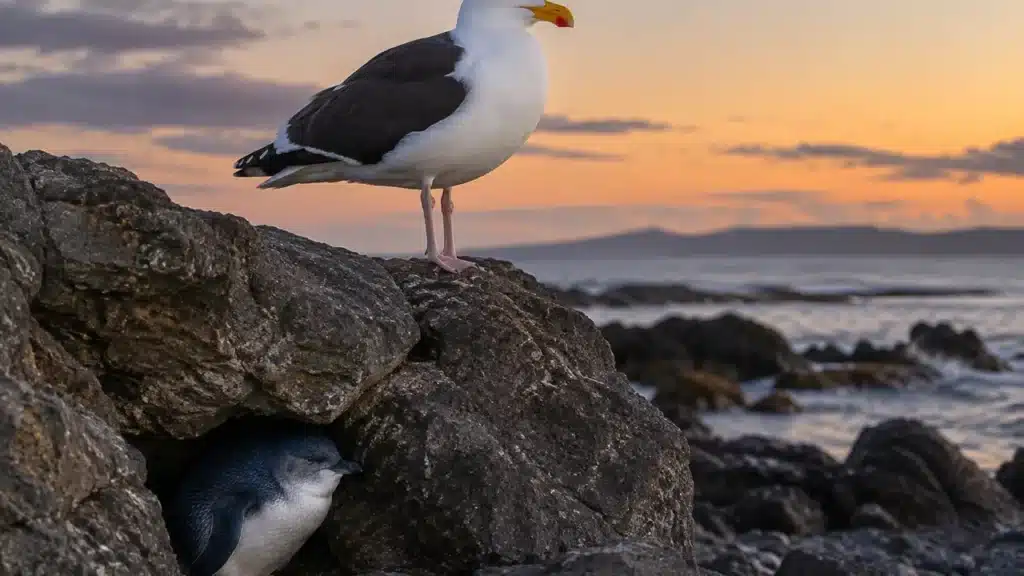
The predator that isn’t a predator: dogs
I’ll be blunt about this one because it’s the thing our volunteers talk about more than any actual predator. An off-leash dog on the breakwater isn’t hunting in the ecological sense, it’s playing, chasing, being a dog, but the outcome for a penguin caught on the rocks is the same regardless of intent. Little penguins are slow and clumsy on land, built for swimming rather than sprinting, and a dog can reach a bird in seconds on a surface the penguin can’t easily escape across.
This is arguably the single most preventable risk in this entire list, which is exactly why it frustrates people who work with the colony. A fox is doing what foxes do. A dog off its lead near the breakwater at dusk is usually just an owner who didn’t realise, or didn’t think it mattered for five minutes. It matters.
Human-created risks that behave like predation without being predation
Marine plastic and discarded fishing line don’t hunt penguins, but the physical outcome, entanglement, drowning, injury, sits close enough to predation-level harm that it belongs in the same conversation. A penguin tangled in mono-filament near the breakwater faces a slower, more preventable version of the same fate a fur seal strike delivers instantly. We’ve documented specific cases and the mechanics of how this happens in how marine plastic and fishing line injure St Kilda’s penguins, and it remains one of the more depressing threads of monitoring work simply because it’s entirely a byproduct of how busy this stretch of water is.
Artificial light is a stranger case again. It’s not predation and it doesn’t injure a bird directly, but by disrupting the low-light conditions penguins rely on to return to the breakwater safely after dark, foreshore lighting can leave birds exposed on open ground for longer than they should be, which raises their vulnerability to everything else on this list. That’s covered in more detail in how foreshore light disrupts St Kilda penguins coming home at dusk, and it’s part of the broader reason little penguins only ever come ashore after dark in the first place, dusk cover is a genuine survival strategy, not just a scheduling quirk for tourists.
Why the breakwater’s predator profile is genuinely unusual
Put all of that together and you get a colony whose land-predator risk is lower than almost any other mainland Victorian site, whose marine-predator risk is probably lower than the more exposed Bass Strait colonies, but whose human-proximity risk, dogs, boats, light, litter, is about as high as it gets anywhere in the state. That’s the trade-off of being the only mainland little penguin colony sitting inside a major Australian city.
I reckon that trade-off gets undersold sometimes in how people talk about the colony. It’s easy to frame St Kilda as a lucky, low-threat site because the fox and cat numbers look better than expected. But swap “predator” for “hazard” and the picture flips, because nothing about a fur seal or a fox compares to the sheer volume of dogs, boats and artificial light this specific population has to contend with every single night, all year round.
What this means for anyone watching from the rocks
If you’re heading down for an evening viewing, the predator conversation isn’t really theoretical, because the same conditions that keep foxes off the wall are the same conditions that make responsible visitor behaviour matter more, not less. Volunteers stationed at the breakwater aren’t just there to point out where a bird is calling from; they’re managing the human side of a threat profile that’s arguably harder to control than a natural predator would be. Zoos Victoria’s published guidance on little penguin conservation makes a similar point about mainland colonies generally, that human behaviour management is now as central to survival outcomes as predator control ever was.
None of this is meant to alarm anyone planning a visit. The colony has persisted on that rock wall since the breakwater went in back in 1955, entirely uninvited, entirely on its own initiative, and it’s still there. But understanding what actually threatens these birds, and what doesn’t, makes the case for a dog on a lead and a torch left in the car a lot more concrete than a general “be respectful” sign ever could. If you want the fuller picture of what volunteer-guided viewing actually involves on a normal night, that’s laid out in how volunteer-guided viewing works at the St Kilda breakwater.