
Half past six on a Tuesday in late autumn, and the end of St Kilda Pier fills with people who’ve clearly done this before: sensible shoes, phone flashes switched off before anyone asks, a thermos, and a booking confirmation on the screen. That’s the version of a St Kilda penguins evening that works. The version that doesn’t work is turning up on spec at 5pm expecting penguins, waiting forty minutes staring at rocks, and leaving disappointed before the birds have even left the water. Viewing here now runs as free but ticketed one-hour sessions, two each evening, and getting both the booking and the timing right is most of the job.
A question we’re asked a lot is how to “fit the penguins in” around a night out in St Kilda, as though the colony is a support act to dinner. It’s really the other way around. Little penguins (Eudyptula minor) come ashore after dusk, once it’s dark enough that returning to the rocks doesn’t expose them to predators or disorientate them, so the whole evening should be built backwards from your session time, not forwards from when you fancy a glass of wine.
Why the st kilda penguins evening has to start with dusk, not dinner
The colony forages at sea all day, sometimes many kilometres out into Port Phillip Bay, and only returns to the breakwater’s rubble-stone cavities under cover of darkness. That’s not a scheduling quirk for tourists’ convenience, it’s an anti-predator behaviour that’s kept this colony going since the wall was built in 1955. Turn up at 4pm on a summer’s day and you’ll see gulls, maybe a rakali if you’re lucky, but no penguins. That’s exactly why the public sessions are held at dusk and after dark rather than during the day.
Sunset times swing by hours across the year in Melbourne, so “dusk” in December is a very different clock time to dusk in June, and the session times move with it. If you only take one thing from this article, take this: book first and check the times for the date you’re visiting, because every other booking in your evening should slot around that, not the other way round. Sessions are run by Phillip Island Nature Parks, each one is capped, and bookings are essential – our penguin viewing page explains how it works. Our guide to the best time of year to visit goes into which months give the easiest viewing.
Anchoring dinner around the pier precinct
St Kilda’s foreshore strip does a lot of the heavy lifting here, because you don’t need to choose between a proper dinner and a good penguin viewing. The trick is sequencing. Eat first, walk after. If you’re coming from the city and you’ve booked an early-evening session, a table for 6 or 6:30pm along the Esplanade or on Acland Street gives you a relaxed meal with enough time to stroll down to the pier afterwards without rushing. We’ve got a rundown of options in our piece on the best restaurants in St Kilda, and if you’d rather finish the night with a drink after viewing than before it, the best bars in St Kilda guide covers places that don’t mind a slightly salt-and-wind-blown crowd wandering in later on.
It’s easy to overplan the food part of this and underplan the viewing part. You don’t need a two-hour degustation to make the night feel complete. A solid hour at a casual spot, then twenty minutes ambling down St Kilda Pier proper towards the viewing boardwalk, works better than a long lingering dinner that eats into your session time and leaves you jogging down the pier to make it before your session starts.
The walk down St Kilda Pier itself
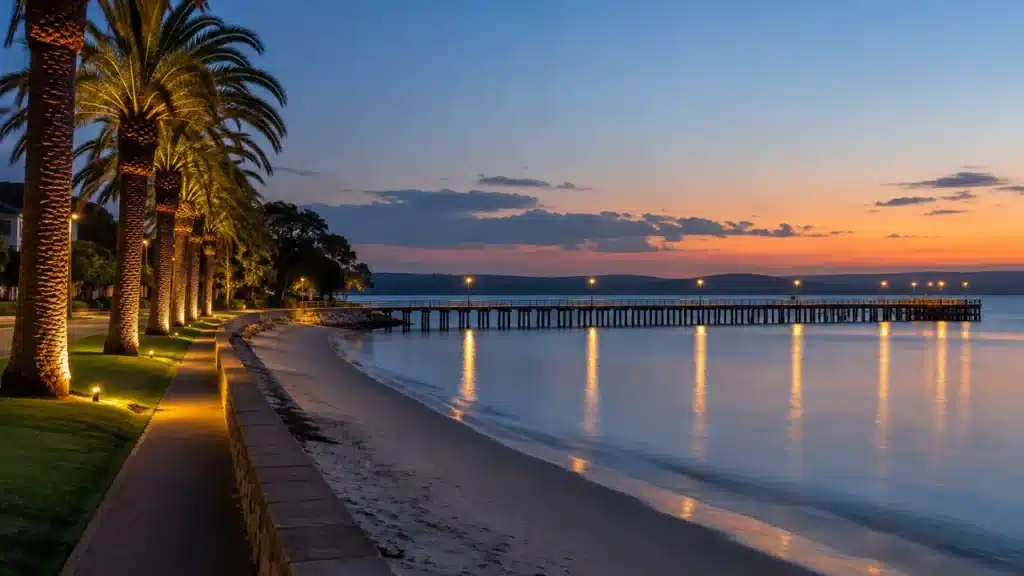
St Kilda Pier reopened to the public after its redevelopment, and the walk out along it is genuinely one of the better free things to do on the bay side of Melbourne regardless of the penguins – you get the kiosk, the yacht club lights coming on, container ships queued in the bay if the timing’s right. It’s roughly a 10-15 minute walk from the pier entrance out to the end, longer if you stop to look at the view, which most people do. If you haven’t been down since the works finished, our earlier piece on the pier redevelopment covers what changed, and there’s a shorter update in St Kilda Pier reopens.
The breakwater itself is a separate structure from the pier deck, a rubble-stone wall running off to one side, and nobody in the public walks on it. Viewing happens from a 150-metre elevated boardwalk at the end of the pier, which uses wildlife-friendly lighting and closes each night once the sessions have finished. Phillip Island Nature Parks runs the sessions and its guides are there on the night; Parks Victoria manages the pier and the breakwater. It’s worth reading up beforehand on how guided viewing at the breakwater works so you know what to expect when you arrive and aren’t surprised that nobody’s shining anything bright at the rocks.
What actually disturbs the birds, and what doesn’t
This is the part people get wrong most often, not out of malice but because it’s not obvious. A phone flash, even a single accidental one, affects a penguin’s night vision at exactly the moment it needs it to navigate wet rock in the dark. Dogs are worse: they’re a genuine and ongoing threat to this colony, and it doesn’t take an aggressive dog, just a loose one near a nest cavity, to cause a bird to abandon its return for the night. Dogs are allowed on St Kilda Pier on a lead, but they’re banned from the breakwater at all times, along with cats and fishing. Foot traffic on the rocks crushes the exact cavities the penguins nest and hide in, which is a large part of why the wall is off limits and everyone watches from the boardwalk.
None of this requires much sacrifice from a visitor. Stay on the boardwalk and watch quietly from behind the railings, keep any dog on a lead and well back from the rocks, leave the flash off, and don’t bring a torch or any bright light to the viewing area – if you want one for the walk back to the car or tram afterwards, keep it in your pocket until you’re clear of the colony. We’ve written a longer piece specifically on why flash photography and torches genuinely harm St Kilda’s penguins if you want the detail, and it’s worth a read before your first visit, not after.
If you’re coming with children, the etiquette is much the same but harder to enforce in the moment – kids get excited, voices go up, phones come out. Our guide to visiting with kids without disturbing them has some practical tips that make this genuinely easier rather than just telling you to hush your five-year-old at 8pm, which, as any parent knows, is a big ask.
Weather, wind, and why some nights are simply better than others
Not every dusk delivers. Wind direction and sea state change how many birds come ashore and when, and rough conditions can push the return later or thin the numbers on a given night. We cover this properly in how wind and rough seas change what you’ll see, but the short version for planning an evening out is: check the Bureau of Meteorology’s Port Phillip forecast in the afternoon before you commit to a night out, particularly in winter when southerly changes can come through fast. A calm, mild evening after a still day tends to be more reliable than a blustery one, though there’s no guarantee either way – this is a wild colony, not a scheduled parade, and that’s rather the point of it.
Water quality and food availability in the bay also shape foraging trips and, indirectly, how the birds behave when they get back. If you’re curious about that side of things, why Port Phillip Bay’s water quality decides what St Kilda penguins eat is a good rabbit hole for later, though it’s not something you need to think about on the night itself.
Getting there, parking, and what to actually bring
Trams 12, 16 and 96 run from the Melbourne CBD and stop at St Kilda Pier, getting you there in about 20-25 minutes, which honestly beats hunting for parking on a Friday night in season. If you’re driving, the limited paid parking next to the St Kilda Sea Baths and along the main roads fills quickly on clear evenings from spring through autumn, so arriving with your dinner-then-walk sequence in mind, rather than turning up right on your session time hunting for a park, saves a lot of stress.
Bring a jacket even on a mild evening, because the bay throws a different wind at you once the sun’s gone than the one you felt at dinner. We’ve got a dedicated rundown in what to wear and bring for a night visit, but the essentials are warm layers, flat comfortable shoes for the walk out along the pier, and patience rather than gear. You genuinely don’t need binoculars or a zoom lens; some of the best views happen close by in the dark once your eyes adjust. If mobility is a consideration for anyone in your group, it’s worth reading accessibility on the breakwater before you go, since it covers the long walk out along the pier deck as well as the viewing area itself.
Putting the whole night together
A sequence that works well for a lot of visitors: book the session first, then a dinner table for 6pm on the Esplanade or Fitzroy Street, a wander down to the pier with time in hand, an hour on the boardwalk as the light properly fades, then back up to a bar for a nightcap once the birds have settled in. In summer that whole sequence shifts two or three hours later because sunset’s so much further out, so check the session time for the date you’re going rather than assuming last month’s schedule still applies.
What you’re rewarded with, if the weather plays along, isn’t a show in the theatrical sense. It’s a handful of small dark shapes waddling up wet rock below the boardwalk in near-silence, occasionally breaking into that odd braying call the colony’s known for after dark – there’s a whole piece on why the breakwater gets so noisy after dark if the noise catches you off guard the first time. It’s an unglamorous, slightly damp, genuinely wild little moment happening seven kilometres from the CBD, which is most of why people keep coming back for it.