
Stand at the railing of the viewing boardwalk at the end of St Kilda Pier on a winter evening and you’ll be watching wild little penguins come home to a rock wall in the middle of a capital city, on a free ticket you booked before you left home. Drive two hours south-east to Phillip Island and you’ll pay for your seat, sit in tiered seating, and watch a much bigger parade of penguins come ashore under managed lighting. Both are watching the same species do the same thing. The experiences could hardly be more different, and honestly, that’s the interesting part.
People often ask which one is “better”. Wrong question. They’re answering different needs, and the reasons behind that difference say a lot about how each colony came to exist in the first place.
An accident of engineering versus a purpose-built attraction
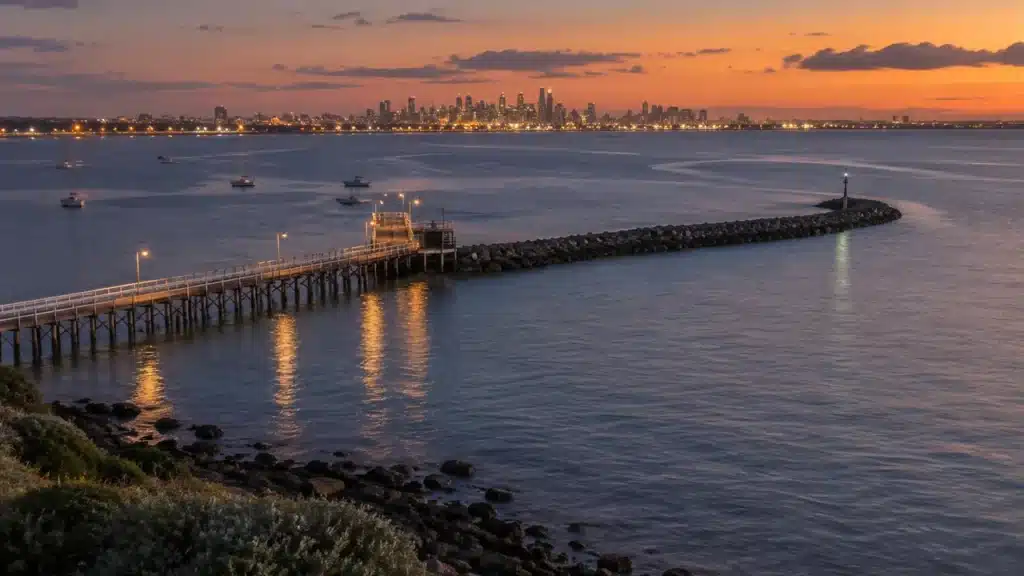
The St Kilda colony was never meant to happen. The breakwater itself is a rubble-stone rock wall built in 1955 as part of an upgrade to St Kilda Pier, and little penguins simply moved into the cavities between the rocks sometime after. No one designed nesting boxes, no one selected the site for tourism, and no committee signed off on a colony forming 7km from the Melbourne CBD. It’s the only mainland breeding colony of little penguins in Victoria sitting inside a major city, and it got there by accident of geology and opportunism from a small, adaptable seabird. Parks Victoria manages the pier and the breakwater today.
Phillip Island’s Summerland Beach colony has a completely different history and a much longer institutional relationship with visitors, going back decades before organised tourism infrastructure existed there in its current form. Over time that site was built out with boardwalks, viewing stands, and a visitor centre precisely because of the scale of the nightly parade and the volume of visitors it draws. Once you’re managing tens of thousands of people a year on a fragile dune system, ticketing and infrastructure aren’t greed, they’re the only way the site survives contact with that many boots.
Scale and setting, not ticket price
People sometimes assume the difference comes down to a deliberate choice, one operator wanting to charge and another choosing not to. We’d push back on that a bit. Both sites are ticketed. Phillip Island Nature Parks runs the public viewing at St Kilda as well, and since 29 October 2025 the St Kilda colony has been watched from a 150-metre elevated viewing boardwalk during nightly one-hour sessions that are free but ticketed: two each evening, one at sunset and one after dark, each capped at 150 people, with bookings essential and session times moving with sunset.
What actually differs is scale and setting. Phillip Island’s parade draws big-enough crowds that unmanaged access would flatten the dune vegetation and stress the colony within a season, and ticket revenue there funds boardwalk maintenance, ranger presence, and research. At St Kilda the site is a working harbour breakwater in the middle of a city, and the session caps and wildlife-friendly lighting do the protective work instead of a turnstile and a price. The boardwalk closes each night once the sessions finish, so the birds have the wall back to themselves.
What you actually see is different too
This matters more than people expect. Phillip Island’s Summerland Beach parade can involve very large numbers of birds crossing open sand in a concentrated window, which is precisely why it lends itself to stadium-style seating; you’re watching a genuine spectacle with hundreds of animals visible at once under low-level lighting designed not to disorient them.
St Kilda is nothing like that. You’re standing quietly at a boardwalk railing above an uneven rock wall after dusk, listening for the raspy calls of penguins already home in their cavities, and if you’re patient you might see a handful of birds haul out of the water and pick their way over the rocks in the dark. Visitors don’t walk on the breakwater or stand among the rocks, and that’s the point: you’re a spectator above a wild colony, not a guest in it. It’s intimate rather than dramatic. Fewer penguins, no floodlighting, much more silence. If you want the big showy spectacle, Phillip Island does that better than St Kilda ever will or should try to. If you want to watch a wild seabird colony that has no business existing in a capital city but does anyway, St Kilda gives you something Phillip Island can’t replicate at its scale.
The St Kilda sessions run to a completely different rhythm as a result, with more explained in how guided viewing works at the St Kilda breakwater and on our penguin viewing page, both worth a read before you go if you’re expecting Phillip Island’s format and pacing.
Why the volunteer effort matters as much as ticket revenue
Both sites rely on people protecting penguins from bad visitor behaviour, but the funding model behind that protection differs enormously. Phillip Island’s ticket revenue pays wages, funds boardwalk replacement, and bankrolls a research programme most conservation groups would envy. At St Kilda, guides are present during the public sessions to keep things calm, watch for off-leash dogs on the pier, and step in when someone reaches for a flash camera or a torch. It’s the same protective function, delivered on a much smaller footprint.
Volunteer effort extends well past the viewing sessions themselves. Population counts, weighing, and banding continue year-round, building on monitoring that goes back to 1986, when Professor Mike Cullen of Monash University began a long-term study of the colony after a harbour redevelopment proposal put it at risk. He ran fortnightly night trips until his death in 2001, with Neil Blake of St Kilda Council assisting him, and that data set is one of the more continuous urban penguin monitoring records in the country. You can read more about how that work continues today at Inside the volunteer monitoring and banding work at St Kilda.
The threats are similar, but the exposure isn’t
Both colonies deal with recognisable, well-documented threats: marine plastic and fishing-line entanglement, boat strike, and the disruption artificial light causes to birds trying to find their way home after dark. Phillip Island manages predator exclusion and habitat restoration on a much bigger land area. St Kilda’s version of that fight is smaller in scope but no less real, foxes and cats remain a genuine mainland predation risk even on a rock wall surrounded by water, which we’ve covered in detail at why foxes and cats still threaten the St Kilda penguin colony. Dogs are welcome on St Kilda Pier on a lead, but they’re banned from the breakwater at all times, along with cats and fishing.
Light pollution is arguably a sharper problem at St Kilda precisely because of its city-fringe location. A colony next to a working harbour and a lit foreshore faces constant, low-grade interference with the natural dusk return that Phillip Island’s more isolated dune system doesn’t experience in the same way. There’s more on that in how foreshore light disrupts St Kilda penguins coming home at dusk. Being a free night out doesn’t mean being lower-stakes. In a city setting, with a colony this small, what each visitor does with a phone screen, a torch or a lead matters more per person, not less.
Choosing between them isn’t really the point
Visitors planning a weekend in Melbourne often want to know which trip to book, and the honest answer is: do both if you can, for different reasons. Phillip Island if you want scale, a near-guaranteed sighting of large numbers of birds, and infrastructure built for exactly that experience. St Kilda if you want something closer to encountering the colony on its own terms, in a city, on a free ticket, in a small capped group with no guarantee of how many birds turn up.
One observation worth passing on: arriving expecting a Phillip Island-style parade at St Kilda is the single most common way people leave disappointed. Reset the expectation before you go and it becomes one of the better free things to do in Melbourne, not a lesser version of somewhere else.
Timing matters at St Kilda too, since the session times shift with sunset rather than sitting at a fixed hour all year. Check why winter dusk is the best time to see St Kilda penguins before you book, and have a look at what to wear and bring for a night visit to the St Kilda penguins since the wind off the bay catches people out more than they expect.
For background on the species itself, and why neither colony has anything to do with the cold climates people sometimes assume, Zoos Victoria’s little penguin research pages and the Victorian Government’s environment department both carry good baseline information on Eudyptula minor as a temperate, southern-Australian species, not a polar one.