Ask anyone over fifty what the little penguins at the St Kilda breakwater used to be called, and most will say “fairy penguins” without missing a beat. Ask anyone under twenty-five and you’ll often get a blank look. That generational gap isn’t an accident. It’s the result of a deliberate, fairly slow shift in Australian ornithology that’s now mostly complete, even if the older name still turns up on faded signage and in the memories of people who grew up visiting the breakwater with their parents.
We get asked about this a lot on guided viewing nights. Someone will point at the rocks and say “there’s a fairy penguin,” and one of our volunteers will gently correct them to “little penguin” – not to be pedantic, but because the name genuinely changed, for reasons that are worth understanding if you’re going to spend an evening watching this colony do what it’s done since the breakwater was built in 1955.
Where “fairy penguin” actually came from
The name wasn’t a marketing invention. It’s an old colloquial English name that predates most formal Australian bird-naming conventions, likely a reference to the bird’s small size, pale blue-grey plumage and slightly ethereal appearance when it moves at dusk. Early naturalists and coastal communities across southern Australia used “fairy penguin” more or less interchangeably with “little penguin” for well over a century. You’ll still find it in old field guides, in newspaper archives, and stamped into the concrete of older interpretive signs along parts of the Victorian coast.
It’s a nice name, honestly. There’s nothing wrong with it as description – a little penguin surfacing in the shallows off the breakwater at last light does have something faintly magical about it. But “nice” and “scientifically useful” aren’t the same thing, and that’s where the trouble started.
The scientific push behind the fairy penguin name change
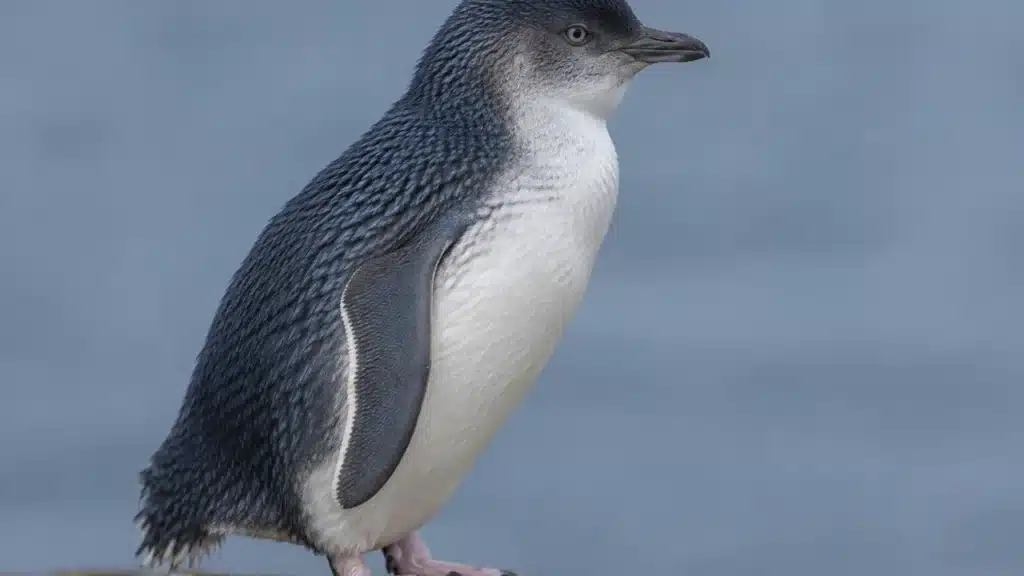
The species itself is Eudyptula minor, described in the nineteenth century and long recognised as the smallest of the world’s 17-18 penguin species – around 30cm tall, about a kilogram in weight, nothing like the larger Antarctic and subantarctic species most people picture when they hear the word “penguin”. That confusion is actually central to why the naming shifted.
Ornithological bodies in Australia, including BirdLife Australia, moved over recent decades toward standardising common names so they map more directly onto the scientific genus and species name. “Little penguin” is a literal translation of minor – small, and ties the common name directly to the taxonomy, which matters enormously for field guides, conservation reporting, government listings and cross-referencing between Australian and New Zealand research, since Eudyptula minor also breeds on the New Zealand coast. “Fairy” doesn’t tell you anything about the bird’s biology, size class or relationship to other species. “Little” does, immediately.
There’s also a subtler problem the fairy name created: it fed the public’s mental picture of penguins as whimsical Antarctic-adjacent creatures, when little penguins are the opposite of that. They’re a temperate-zone species, native to the coastlines of southern Australia and New Zealand, and they’ve never had anything to do with ice or polar conditions. We’ve written more on that distinction on the page about why St Kilda’s penguins have nothing to do with Antarctica, because it’s one of the most persistent misunderstandings we deal with on viewing nights. A name like “fairy” doesn’t help correct that; if anything it adds to the sense that these are storybook creatures rather than a genuine, monitored, at-times-vulnerable urban wildlife population living in a rock wall a few hundred metres off Marine Parade.
When the switch actually happened
There isn’t one clean date you can point to and say “that’s when fairy penguin died.” It was gradual, running through the 1990s and 2000s as field guides, museum collections and government fauna lists progressively adopted “little penguin” as the standard. Institutions like Museums Victoria and Zoos Victoria shifted their public-facing material over this period, and the Australian Museum’s own species records reflect the same move toward the standardised name. By the time volunteer monitoring of the St Kilda colony had built up a solid multi-decade dataset – work that traces back to Professor Mike Cullen’s studies from Monash University starting in 1986 – “little penguin” was already the term researchers were using in their notes and reports, even if the public was slower to catch up.
Signage is often the last thing to change, which is why you can still find “fairy penguin” printed on older interpretive boards around Victoria. It’s not wrong exactly, just out of date, a bit like calling a wombat a “badger” because that’s what early colonists mistakenly called it. Language lags behind taxonomy, always has.
Does the name actually matter for the birds?
Here’s my honestly slightly contrarian take: I don’t think the name change altered how anyone treats the colony day to day, and I reckon some of the energy spent correcting people at viewing nights would be better spent on the things that actually threaten these birds – the dogs, the fishing line, the lights along the foreshore. Names matter for consistency in scientific literature and government reporting, absolutely. But a visitor who calls a little penguin a “fairy penguin” while quietly watching from the boardwalk, keeping their torch off and their dog on a lead, is doing more for the colony than someone who gets the terminology perfect and then climbs the rocks for a photo.
That said, precision earns its keep. When a threat is reported, when a bird is banded, when population figures from St Kilda are compared against records from other Victorian colonies, everyone needs to be talking about the same species with the same name – otherwise data gets messy fast. Our page comparing St Kilda and Phillip Island colony size and monitoring relies on decades of consistent terminology to make sense of long-term counts, and that consistency only works because “little penguin” became the agreed standard rather than staying a mix of “fairy,” “little” and various local nicknames.
What the name tells you about the bird itself
It’s worth sitting with what “little” actually communicates, because it’s doing real descriptive work. At around a kilogram and 30cm tall, Eudyptula minor is dramatically smaller than the Antarctic and subantarctic penguins that dominate wildlife documentaries – emperor penguins can stand over a metre tall. The scale difference is enormous, and calling this species “little” keeps that front and centre for anyone encountering the name for the first time, whether in a school project, a government fauna database or a sign at the breakwater.
The name also nudges people toward asking the right follow-up question: if this is the little penguin, what’s it little compared to, and where does it actually live? That’s a much better entry point into understanding the species’ real ecology – its temperate range, its burrow and rock-cavity nesting habits, its reliance on Port Phillip Bay’s fish stocks – than “fairy,” which invites no such curiosity at all.
Seeing them for yourself, whatever you call them
Whatever term you grew up with, the birds themselves haven’t changed. They still forage out in the bay all day and come back to the breakwater’s rock cavities after dark, which is why viewing happens at dusk rather than during the day. They still pair up for a breeding season that runs from late winter courtship through to summer moult, still raise chicks in the same cavities they’ve used for years, and still face the same very real threats – off-leash dogs, marine plastic, boat strike, artificial light disrupting their night return – regardless of whether you call them fairy penguins or little penguins.
If you’re planning a visit, our volunteers guide public viewing most evenings and can talk you through both the history of the name and the biology behind it while you wait for the first birds to come ashore. It’s genuinely one of the more interesting small facts about this colony: a hundred-plus years of common usage overturned not by a marketing decision but by taxonomists quietly deciding that “little” was simply more useful than “fairy.” For a species this small, living on a rock wall this improbable, a bit of useful precision doesn’t seem like too much to ask.