
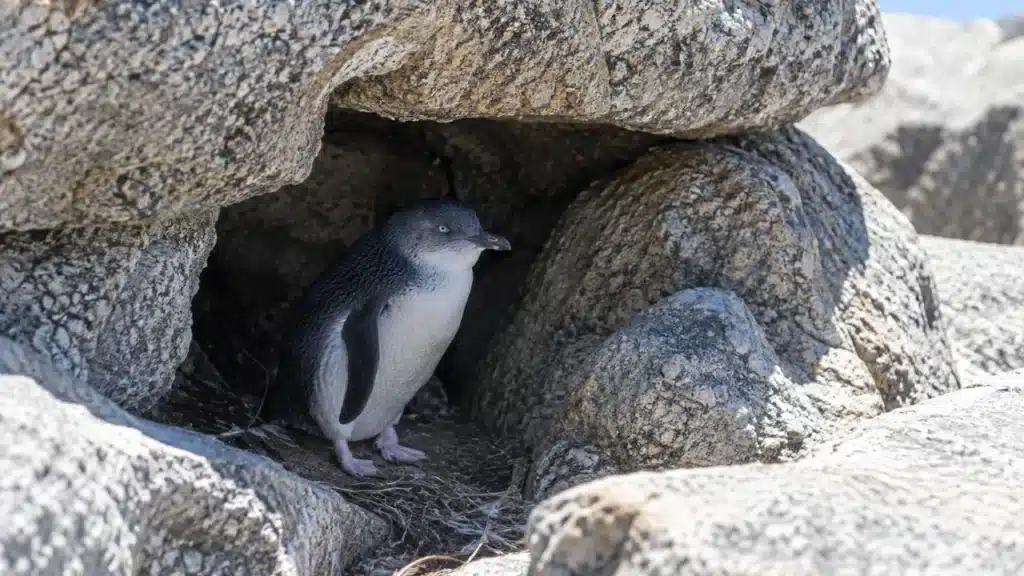
Forty degrees in the city, a northerly that feels like a hair dryer, and somewhere inside the rubble of the St Kilda breakwater a little penguin is doing precisely nothing. Sitting tight, panting slightly, waiting for the sun to drop. That’s not laziness. On the worst days of a Melbourne summer, sitting still in a rock cavity is the single most useful thing a one-kilogram seabird can do.
On the nastier heatwave evenings the contrast out at the end of the pier is stark. The esplanade empties out, the heat pushes people off the sand, and yet under the breakwater’s rock jumble it’s a good several degrees cooler than the open air. That gap between what the thermometer says at head height and what’s actually happening inside a stone crevice is, more or less, the whole story of how this colony survives its hottest days.
Why little penguins are so heat-vulnerable in the first place
It sounds odd to worry about penguins overheating, given the word “penguin” drags a mental image of ice and snow behind it. But Eudyptula minor isn’t built for that story at all. Little penguins are native to the temperate coastlines of southern Australia and New Zealand, not the Antarctic, and their whole physiology is tuned for cool, wet, wind-exposed environments rather than baking rock in January. If you want the fuller myth-busting version of that point, we’ve covered it separately in why St Kilda’s penguins have nothing to do with Antarctica.
The insulation that makes them so effective underwater, dense waterproof feathers over a layer of fat, works against them on land in extreme heat. They have no sweat glands. Their main way of shedding heat is panting and holding their flippers slightly away from the body to let air pass across less-insulated skin, the same trick you’ll see in a dog on a hot afternoon, just with flippers instead of a tongue. It’s a workable system for a mild Victorian day. It’s under real strain at 40-plus.
The rock cavities are doing more work than people realise
This is where the accident of the breakwater’s design turns out to matter enormously. Built in 1955 as part of the upgrade to St Kilda Pier, the wall was never meant to house wildlife, it’s rubble stone, stacked for a harbour engineering purpose, and the colony that formed inside its gaps and hollows did so entirely on its own. Nobody designed penguin housing here.
And yet those cavities behave almost like a thermal mass building. Stone absorbs heat slowly and releases it slowly too, so the deep pockets inside the wall lag well behind the air temperature outside. On a 40-degree day, a bird tucked two or three rocks in is likely sitting in conditions closer to the mid-20s than the mid-40s. It’s not comfortable, exactly, but it’s survivable, and it’s the main reason the colony hasn’t needed the kind of engineered nest-box cooling that some artificial colonies elsewhere rely on.
Compare that with a colony on open sand dunes and the advantage becomes obvious. We’ve written before about how the breakwater colony differs from other Victorian sites in St Kilda vs Phillip Island: comparing colony size and monitoring, and shelter type is a genuine part of that comparison, not just headcount.
Timing is everything: why heatwaves and the breeding calendar collide
Victoria’s nastiest heat generally lands in January and February, which sits right in the guts of the breeding season here. Courtship and nest re-forming run from roughly late July through October, eggs go down from August into early November, and chicks are still hatching as late as December. By the height of summer you can have half-grown chicks in the nest, not yet waterproofed and not yet able to regulate their own body heat properly, stuck in a cavity while the adult tries to manage both its own heat load and theirs.
That’s a genuinely tense combination, and it’s the point in the calendar where volunteers pay closest attention. A chick can’t get up and walk to shade the way an adult sometimes can. If you’re curious about the mechanics of how chicks are raised through to fledging, including what happens if conditions turn against a brood, that’s covered properly in how St Kilda’s penguin chicks are fed, and when they finally leave.
Adults undergoing their annual catastrophic moult face a related problem. During the roughly two-week moult each summer, a penguin can’t go to sea at all, it loses waterproofing and has to sit it out on land living off stored fat. A bird mid-moult during a heatwave has no option to retreat to the water to cool off, which is normally an escape valve available to any healthy adult. For more on the condition birds need to be in heading into that stretch, see what a healthy pre-moult weight looks like for St Kilda’s penguins.
The sea is the real cooling system
For any adult that isn’t mid-moult, the ocean is by far the best heat-management tool available, and it’s one reason the foraging pattern matters so much in summer. Little penguins already spend their days out at sea hunting small fish and returning to the breakwater only after dusk, a pattern driven mainly by predator avoidance, which we’ve detailed in why little penguins only ever come ashore after dark. On a heatwave day that same routine doubles as thermal relief. Port Phillip Bay’s water temperature barely shifts compared to the air above it, so a bird that’s spent the whole day at sea comes ashore in the evening already cooled down, well before it has to deal with whatever residual heat is still radiating off the rocks.
This is part of why volunteers get uneasy about anything that keeps a bird out of the cavities longer than necessary after it comes ashore. A disoriented bird wasting energy on the exposed rock face at the top of a hot evening is in a worse spot than one that gets straight into shelter. Bright torchlight or camera flash right at that moment isn’t just an annoyance, it can genuinely cost a heat-stressed bird time it doesn’t have to spare, which is one of several reasons torches and flashes are not permitted at the viewing area, as we explain in why flash photography and torches genuinely harm St Kilda’s penguins.
What volunteers actually watch for on extreme days
Trained volunteers who monitor the colony don’t wait for a heatwave to start caring. There’s an established rhythm of population counts, weighing and banding that runs across the season regardless of weather, described in more detail in inside the volunteer monitoring and banding work at St Kilda, and that baseline data is exactly what lets anyone notice a bird in genuine distress rather than just guessing.
The signs volunteers are alert to on a severe heat day are fairly intuitive once you know them: a bird panting heavily and refusing to move, one sitting fully exposed on open rock in the middle of the day rather than tucked into a cavity, or noticeably laboured movement. None of this is published as alarmist material, because most birds handle even a rough day perfectly well by doing exactly what they’d do anyway, staying still and staying hidden. The wall does most of the work; the watching is mainly there to catch the exceptions.
Our honest view, offered as an aside rather than site doctrine, is that the bigger long-term heat risk to this colony isn’t a single scorching afternoon at all. It’s the slow creep of more frequent hot nights that don’t cool the rock down properly before the next hot day arrives. One 42-degree Tuesday is a stress test the colony has clearly weathered for decades. A run of hot nights back-to-back, night after night with no proper cool-down, is a different and less visible kind of pressure, and it’s the sort of thing you’d only pick up by tracking condition and weight over seasons rather than watching any single evening.
Heat is one pressure among several, not the main event
It’s worth keeping heat in proportion against everything else this colony deals with. Off-leash dogs, marine plastic and fishing line, boat strike in a working harbour, artificial light disrupting the night return, and the ever-present risk from foxes and cats are the threats that do the most measurable damage across a typical year, and we go through them properly in what actually preys on St Kilda’s little penguins. An extreme heat day is dramatic to watch from the outside, all that empty, shimmering pier, but the colony has genuine architecture, in the literal rock-pile sense, built into its survival against it.
The Bureau of Meteorology’s long-term Melbourne climate data shows heatwave frequency has been trending upward, and CSIRO’s climate projections for southern Australia point the same direction for coming decades. Neither organisation is in the business of penguin welfare specifically, but the numbers they publish are the honest backdrop against which a colony like this one has to keep functioning.
None of that changes what you can actually do if you’re visiting on a stinking hot evening. Watch quietly from behind the railings of the elevated boardwalk at the end of the pier, which is where the free but ticketed nightly viewing sessions run by Phillip Island Nature Parks are held, so book ahead rather than turning up on spec; our guide to how penguin viewing at St Kilda works covers the details. Don’t go looking for penguins in daylight when they’re not there anyway, leave torches and flashes off, and understand that if the birds seem quieter or slower to emerge than usual, they might simply be conserving what energy the day cost them. If you want a general sense of when to time a visit outside of heatwave conditions altogether, why winter dusk is the best time to see St Kilda penguins lays out the calendar logic in full.
The stone wall built for a 1955 pier upgrade was never meant to be climate infrastructure for a seabird colony. It’s doing that job anyway, and on the worst days of an Australian summer, that’s about the best compliment you can pay a pile of rubble.