
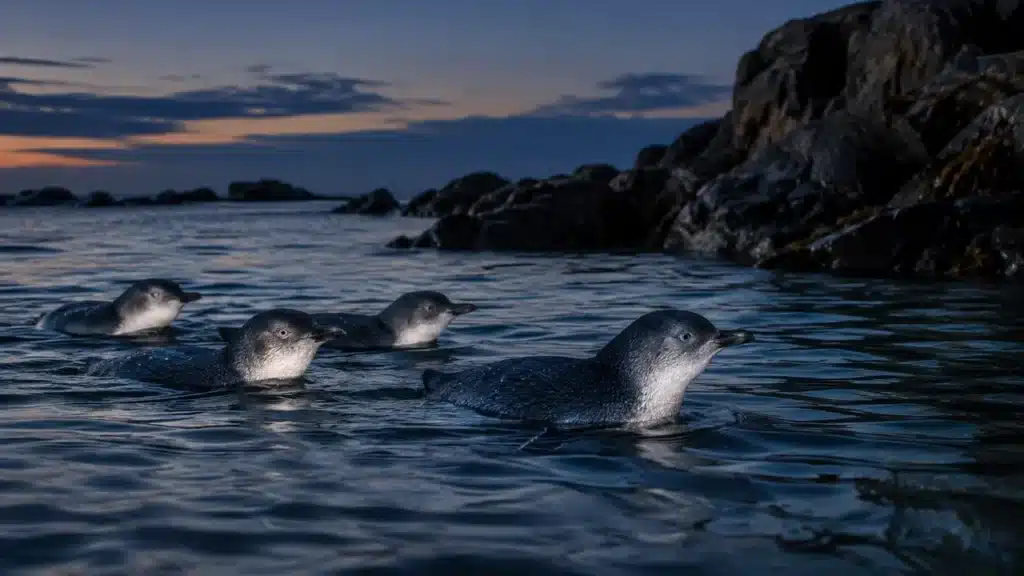
Look out over the St Kilda breakwater at 6pm in January and you’ll see nothing but rocks, gulls and the odd fisher packing up on the pier. Come back at 9.15pm and the same rocks are full of little penguins, calling, shuffling into cavities, feeding chicks. Nothing about the rock wall changed in those three hours. What changed is the light. Little penguins come ashore after dark for reasons that have nothing to do with timidity and everything to do with staying alive long enough to breed again next season.
Regular visitors come to know the pattern by feel rather than by watch. The gulls thin out, the wind usually drops a notch, and somewhere around civil twilight the first dark shapes start porpoising through the chop off the breakwater’s tip. It’s not a slow trickle. It’s more like a decision the whole raft makes at once.
The daily rhythm behind why little penguins come ashore after dark
Little penguins spend the entire day at sea. They leave the breakwater before first light and forage across Port Phillip Bay for small schooling fish, squid and krill, sometimes travelling considerable distances and diving repeatedly for hours on end. By the time dusk arrives they’re full, or as full as the day’s fishing allowed, and it’s time to get back to the nest, relieve a partner sitting on eggs or chicks, or simply rest before doing it all again tomorrow.
Coming ashore in daylight would be the easy option logistically. It isn’t the safe one. A little penguin standing 30cm tall and weighing about a kilogram is, in daylight, an easy target for aerial predators like gulls and birds of prey, and an exposed, slow-moving animal on an open rock wall next to a working harbour. Darkness is cover. It’s the only real defence a bird this size has once it leaves the water, and it’s a strategy little penguins share with other burrow and crevice-nesting seabirds worldwide, not something unique to Eudyptula minor, but it matters more here because this colony sits inside a major city rather than on some isolated island.
Predator avoidance, not shyness
It’s tempting to describe penguins waiting offshore at dusk as “shy” or “cautious,” and that’s not wrong exactly, but it undersells what’s actually going on. This is calculated risk management honed over a very long evolutionary history. Little penguins raft up in groups just off the breakwater before making a run for shore, and researchers who’ve watched this for years generally read it as a form of safety in numbers – more eyes for predators, and any single bird’s odds of being picked off are diluted across the group.
On the mainland this predator pressure is real and not hypothetical. Foxes and cats pose a genuine risk to little penguin colonies on the Australian mainland, and the St Kilda breakwater’s proximity to urban Melbourne doesn’t remove that risk, it just changes its shape. Darkness lowers the odds of an encounter with a fox patrolling the rocks. It doesn’t eliminate it. We’ve written before about exactly how foxes and cats still threaten the St Kilda penguin colony, and dusk arrival is one of the few tools the birds have against that pressure that doesn’t rely on us doing anything at all.
Why artificial light complicates a system that evolved for true darkness
Here’s the problem: little penguins evolved this after-dark strategy against a backdrop of natural darkness, not against the sodium and LED glow of a foreshore car park or a pier light left blazing all night. Artificial light along the shoreline can disrupt the cues birds use to judge when it’s safe to land, and can cause disorientation or delay right at the point in their day when they’re most exposed and most tired. A bird that’s spent twelve hours diving for fish doesn’t have unlimited reserves to sit offshore waiting out a confusing light source.
This is one of the more fixable pressures on the colony, precisely because it isn’t really about the penguins changing their behaviour, it’s about the humans around them managing torches, camera flashes and foreshore lighting sensibly. The viewing boardwalk itself uses wildlife-friendly lighting for that reason. We’ve gone into this in more depth in how foreshore light disrupts St Kilda penguins coming home at dusk, and honestly it’s the single behaviour change visitors can make that costs them nothing and helps the most.
Flash photography deserves its own mention here because it comes up at the viewing area almost every night. A camera flash at close range on a bird that’s navigating by faint ambient light isn’t a minor inconvenience, it can startle a penguin back into the water or delay it from reaching its chicks. Flashes, torches and bright lights aren’t permitted at the viewing area at all. If you want the fuller picture on this, why flash photography and torches genuinely harm St Kilda’s penguins spells out exactly what happens and why guides ask visitors so consistently to leave the flash off.
How the noise at dusk fits into the picture
If you’ve been down to the breakwater after dark you’ll know it’s not a quiet experience. As birds come ashore and reunite with partners or chicks, the calling ramps up quickly, a mix of braying, growling and softer contact calls that carry surprisingly far across the rocks. This isn’t random noise. It’s partly how paired birds relocate each other in the dark among dozens of identical-looking rock cavities, and partly territorial signalling to neighbours in adjacent crevices. We’ve covered the mechanics of this properly in why the St Kilda breakwater gets so noisy after dark, but it’s worth flagging here because the noise and the darkness are two sides of the same behaviour. Sound does a lot of the work that sight can’t, once the sun’s down.
Seasonal timing matters as much as the time of night
The exact time penguins start coming ashore shifts across the year, tracking sunset rather than the clock. In midsummer that might mean waiting until well past 9pm; in winter it can be closer to 6pm. This is why the nightly viewing sessions don’t run to fixed clock times and instead move with sunset through the season. Winter dusk, in particular, tends to deliver both an earlier and often more reliable viewing window, which is part of why we’ve argued elsewhere that winter dusk is the best time to see St Kilda penguins. Fewer daylight hours, cooler foraging conditions and a colony deep into the breeding calendar all line up nicely for anyone planning a visit.
Weather plays its part too. Wind direction and sea state off the bay can change how easily birds can body-surf onto the rocks, and a rough night sometimes pushes the main arrival later or spreads it out. Our piece on how wind and rough seas change what you’ll see at the breakwater is worth a read before you head down if the forecast looks average.
What this means for anyone planning a visit
The practical upshot of all this biology is straightforward: you cannot see St Kilda’s penguins during the day, because they are, quite sensibly, out at sea avoiding exactly the kind of daylight exposure that would get them killed. Turning up at 2pm expecting a wildlife encounter is a bit like turning up to the Prince of Wales expecting a quiet Tuesday lunch – wrong hours entirely. Viewing is built around dusk for that reason: Phillip Island Nature Parks runs one-hour sessions every night on the elevated 150-metre boardwalk at the end of St Kilda Pier, two each evening, one at sunset and one after dark. They’re free but ticketed, each capped at 150 people, so bookings are essential. You watch quietly from behind the boardwalk railings rather than from among the rocks, which keeps the pressure off the nest cavities. If you haven’t been before, how guided dusk viewing works at the St Kilda breakwater covers what to expect on the night, and our penguin viewing guide runs through the current arrangements.
Bring warm layers regardless of the season; the wind off Port Phillip Bay after sunset is no joke even in summer, and our what to wear and bring for a night visit to the St Kilda penguins guide runs through the practicalities in more detail than we can fit into a paragraph here.
None of this after-dark strategy is unique to St Kilda’s birds, and it’s not some quirk that evolved because of the city or the harbour. It’s the same behaviour little penguins show on Phillip Island, on Kangaroo Island, right along the temperate southern coastlines they call home, because these are birds native to southern Australia and New Zealand, not the Antarctic species people sometimes assume when they picture any penguin. What makes St Kilda unusual isn’t the behaviour, it’s the backdrop: a rubble breakwater built for a pier upgrade in 1955, seven kilometres from a capital city CBD, where wild seabirds have been running this exact dusk routine for decades regardless of what’s happening onshore.
Museums Victoria’s research collections and Zoos Victoria’s conservation programmes both document this nocturnal return pattern as consistent across little penguin colonies statewide, which tells you it’s core biology rather than a local adaptation. What’s local is the challenge of running that ancient behaviour metres from a bike path, a pier full of tourists and a foreshore lit for pedestrians rather than penguins. That tension, more than anything, is what the volunteers, guides and land managers looking after this colony are working around most nights of the year.