
Fifty penguins, one microphone and a lot of one-minute counts. Between May and September 2004, two researchers from Victoria University of Technology set up a portable workstation on the St Kilda breakwater and counted every call each bird made while it was being handled. Their study of little penguin vocalisations, by Bernice Romijn and Carol Scarpaci, sat on our old website for years as a slide deck saved to PDF. We’ve rewritten it here as a proper page, in plain language.
A quick note on scope. If you want to know why the rocks erupt into braying and growling after sunset, our piece on why the St Kilda breakwater gets so noisy after dark covers the natural chorus. This page is about the research: what the team asked, how they counted, what turned up, and what it means for anyone listening from the viewing platform.
The questions behind the 2004 breakwater study
The presentation sets out two aims. The first was to test whether the rate at which a penguin calls depends on three things: its sex, its capture experience (whether it had been caught before) and its body weight. The second was more ambitious. Romijn and Scarpaci wanted to know whether recording little penguin vocalisations was practical enough to build what they called a “signature key”, a reference library of individual voices.
Both questions have a practical edge. How often a bird calls while it is held is a rough window into how it is coping, which matters to anyone who weighs, measures or microchips wild animals. And if every adult has a voice that can be told apart from its neighbours, a recorder might one day stand in for a pair of hands.
Scarpaci, named on the title slide as the author for correspondence, is a marine mammal tourism scientist whose long-term research focused on bottlenose dolphins in Port Phillip Bay, so the choice of a penguin colony deserves a word. The slides give three logistical reasons for working at St Kilda. The colony already had years of monitoring data behind it; it has been the subject of a conservation study since 1986, according to the little penguin entry on Wikipedia. The researchers could also work alongside volunteers who were already catching birds for the volunteer monitoring and banding work, which kept extra disturbance to a minimum. And the breakwater was easy to get to.
How the calls were recorded on the breakwater
One slide lays out the field routine as a flow chart, and it is tidier than you might expect for night work on wet rocks.
- A penguin was caught at random and carried to a mobile workstation.
- Recording began, with the microphone placed close to the bird.
- At the same time the bird was weighed, sexed and checked for an existing tag or microchip. Tag numbers were noted; untagged birds were microchipped by a vet and the new number recorded.
- Calls were counted in one-minute blocks, for up to four minutes.
- The team noted whether this was the bird’s first capture, logged when handling finished, and let it go.
Only one penguin was at the workstation at any time, which is what made a per-bird count possible. Two checks kept the tally honest. The microphone sat close enough that recorded calls could only have come from the study animal, and the researchers could see the beak move with each call. If you’re curious about the tags and microchips, we explain how researchers tell individual penguins apart in a separate guide.
Turning a short last minute into a fair rate
Handling rarely ended on a neat minute mark, so the final block of recording was often cut short. Rather than waste those seconds, the team standardised what the slides call “whistling rates” with a formula they named the Penguin Probability Vocalization Index, or PPVI: the number of calls, multiplied by 60, divided by the length of the scan in seconds.
Their worked example: two calls in a 48-second scan gives 2 × 60 ÷ 48, or 2.5 calls a minute. Any scan under 30 seconds was dropped. It’s a grand name for simple arithmetic, honestly, but it’s the right arithmetic, and that 30-second floor stops one stray squawk in a ten-second scrap of tape from making a calm bird look frantic.
What the little penguin vocalisations revealed
Over the five months the team caught 50 penguins: 29 females and 21 males. Across eight field trips they averaged 6.25 birds a trip, with a best haul of 12 and at least one trip that produced none. Each bird was handled for an average of 149.5 seconds, just under two and a half minutes, though individual sessions ran anywhere from 73 to 333 seconds.
Males called more, but not convincingly
On the slide’s bar chart, males averaged a little over five calls per capture and females about three and a half. That looks like a gap. Statistically it isn’t one. The comparison returned p = 0.23, well short of the usual 0.05 threshold, and the spread within each group was wide, with standard deviations of 6.7 calls for males and 4.3 for females.
We’d file this under “not proven” rather than “no difference”. Fifty birds with that much scatter can’t settle the question either way, and the presenters themselves put a bigger sample at the top of their future research list.
Weight: the question without an answer
Body weight was the third factor in the aims, and every bird was weighed. Yet no weight result appears anywhere in the 16 slides. It may have been covered in the spoken talk. We simply don’t know, so we won’t guess.
Penguins caught for the first time called far more
This is the result that stands out. Of the 50 birds, 10 were on their first capture and 40 had been caught before. In the first minute of handling, first-timers averaged 10.2 calls against 4.2 for the experienced birds, a difference with p = 0.015. The second minute told the same story: 7.4 calls against 3.5 (p = 0.042).
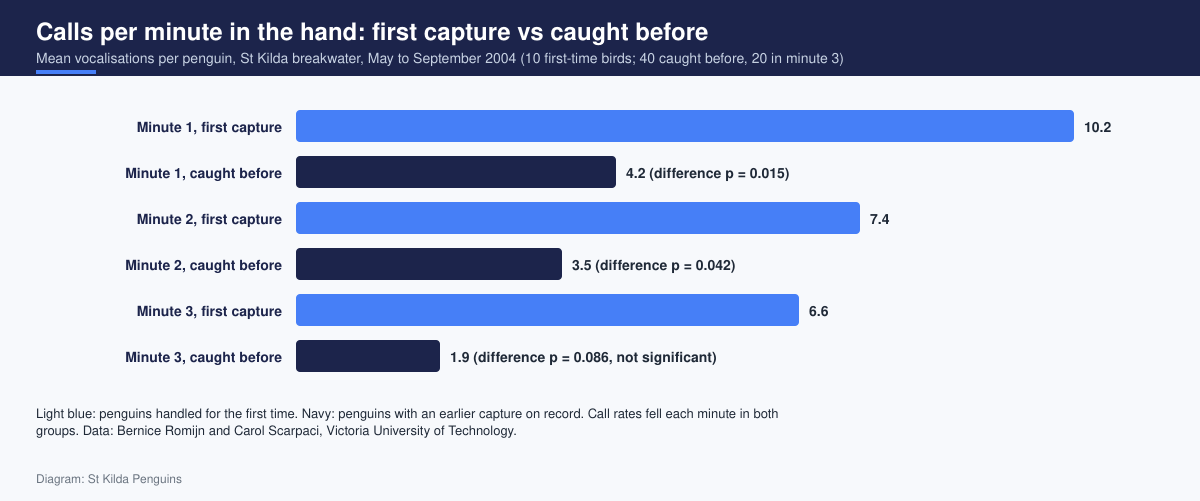
By the third minute the gap was still there, 6.6 calls against 1.9, but only 20 of the experienced birds were still being recorded by then, and the difference fell just outside statistical significance (p = 0.086). In both groups, calling eased off minute by minute.
The slides don’t spell out why. The obvious reading is that a penguin which has been handled before finds it less alarming the next time, or at least less worth protesting about. That fits the numbers. But with only ten first-time birds, and big differences between individuals (a standard deviation of 11 calls in that first minute), it is a pointer for further work rather than a closed case.
For a colony that is handled regularly for monitoring, it is still a handy finding. Call rate gives handlers a simple, non-invasive signal of how a bird is taking things, and it hints that the first encounter is the one to keep as quick and calm as possible.
Signature calls: could you count penguins by voice?
The last content slide points to where the work could go next: a larger sample, and using “signature calls to estimate population size”. The idea is appealing. If each adult’s call is distinctive enough to identify, recordings made at dusk could tell you which birds are home, and how many, without anyone lifting a penguin off the rocks.
The slides don’t show whether a signature key was ever built, and we haven’t found a published follow-up from the St Kilda project. Other researchers have since tested the premise, though. A study of four South Australian colonies by Diane Colombelli-Négrel and Rachel Smale, published in The Auk in 2018, found that both advertising and agonistic calls differed between individuals and between the sexes. That individual variation is exactly the raw material a signature key would need.
The penguins themselves seem to use those differences. In playback experiments by Masamine Miyazaki and Joseph Waas, reported in the Journal of Ethology in 2005, female little penguins approached their own partner’s call more closely than a stranger’s, whatever the stranger’s pitch. The question also has roots closer to home: in 1991 Janey Burger Fadely completed a master’s thesis at San Jose State University on vocal recognition by little penguins on Phillip Island. An answering call from a partner is one of the cues in our guide to how a penguin finds its own nest cavity in the dark.
What to listen for from the viewing platform
Here’s the catch for visitors: the calls Romijn and Scarpaci counted came from birds in the hand. You won’t hear those at dusk, and that’s exactly how it should be. What you will hear is the everyday range of little penguin vocalisations. Colombelli-Négrel and Smale list six recognised little penguin calls: quacks, advertising calls (the loud “bray”), agonistic calls (a lower “growl”), aggressive barks, hisses and cheeps.
The bray is the one that carries. It is a high-intensity call given mainly by males, both to warn off intruders and to court females. The growl is quieter, used before and after a pair’s mutual displays and as a threat when a bird is on the defensive. In that South Australian study, spontaneous calls were recorded in the first two hours after sundown, which lines up neatly with viewing hours at St Kilda.
Viewing is now run by Phillip Island Nature Parks as free, ticketed sessions on a dedicated platform at the end of St Kilda Pier. According to the Phillip Island Nature Parks St Kilda page, one session starts about 30 minutes after sunset and another about 90 minutes after. Our guide to how penguin viewing works at the breakwater covers the practical side.
The handling results are a reminder that these birds respond audibly when they are stressed. Camera flash must be off and torches are banned on the platform, for reasons we set out in why flash photography and torches harm the penguins. Keep your voice down too. A quiet crowd hears more of the colony anyway.
Frequently asked questions
Who carried out the St Kilda penguin call study?
Bernice Romijn and Carol Scarpaci of Victoria University of Technology, which was renamed Victoria University in 2005. The fieldwork ran from May to September 2004 alongside the volunteer monitoring team, and the presentation file we hold was saved in March 2007.
Why did penguins caught for the first time call more?
The slides report the pattern without explaining it. The likeliest reason is that birds with earlier handling experience find it less alarming, but with only ten first-time birds in the sample, treat that as a reasonable hunch rather than a proven mechanism.
Can little penguins recognise each other by voice?
Playback experiments suggest they can. Female little penguins in the 2005 study approached their own partner’s recorded call more closely than a stranger’s, which is part of why researchers think calls could one day help identify individual birds without handling them.