
Plenty of visitors arrive at St Kilda having only ever seen the Penguin Parade, and their first question is usually some version of “wait, where do we sit?” There’s no amphitheatre here, no floodlit sand, no grandstand. What there is instead is a 150-metre elevated viewing boardwalk at the end of St Kilda Pier, a rubble rock wall below it, a bay lapping on both sides, and a guide quietly explaining why we don’t point torches at the water. That’s the honest answer to what changes when you’ve only known Phillip Island: almost everything except the bird itself.
Both places host the same species, Eudyptula minor, the little penguin, the smallest penguin on earth at around 30cm and a kilogram of bodyweight. That’s where the similarity mostly ends.
St Kilda after Phillip Island isn’t a smaller version of the same show
It’s tempting to think of St Kilda as the “budget” option, a knock-off of the main event down at Phillip Island. We’d push back on that framing. Phillip Island’s Penguin Parade is a managed visitor attraction built around a large colony on a purpose-designed beach, with viewing stands, staff, and infrastructure that’s been developed over decades specifically for tourism at scale. St Kilda is something else entirely: a colony that formed by accident inside the cavities of a rubble-stone breakwater built in 1955 as part of the old St Kilda Pier upgrade. Nobody planned it. No one designed the wall for penguins. The penguins just moved in, and the city grew up around them.
That means St Kilda is free to attend, though you still need to book a ticket, and it’s unpredictable in ways Phillip Island isn’t. If you’ve read our other piece comparing colony size and monitoring at the two sites, you’ll know the numbers aren’t in the same league. Phillip Island’s colony is vastly larger. St Kilda is a genuinely small, urban outpost, and that’s precisely why it matters: it’s the only mainland breeding colony of little penguins in Victoria sitting inside a major city, about 7km from the CBD.
No stadium and no beach, just a boardwalk over a rock wall
At Phillip Island you buy a ticket, take a seat in the stands, and watch penguins waddle up a managed beach under low lighting designed not to disturb them. It’s a genuinely well-run wildlife tourism operation, and we’ve got no complaints about how it’s done.
At St Kilda you book a free ticket too, then join one of two one-hour sessions each evening, one at sunset and one after dark, run by Phillip Island Nature Parks and limited to 150 people each. You watch from behind the boardwalk railings, the lighting is wildlife-friendly and low, and nobody walks on the breakwater rocks themselves; those belong to the penguins. There’s no guaranteed sightline, though. Some nights penguins pop up within twenty minutes of each other, tucking into gaps in the rubble below you. Other nights you stand in the wind for much of the session before the first shape appears in the water. This isn’t a flaw in the experience, it’s the nature of a wild colony rather than a managed one. We’ve written before about why patience matters more than timing here, and it’s the single biggest mental adjustment for anyone coming from Phillip Island’s more predictable format. Session times move with sunset through the year, so check the current times and book before you travel; our penguin viewing guide covers the practicalities.
Dusk, darkness, and why torches aren’t allowed at either site, but the reasons hit different
Penguins forage at sea all day and only return to shore after dusk, under cover of darkness, and this is true at both colonies. It’s why viewing happens in the evening rather than the day, full stop, no exceptions. But at Phillip Island the lighting is centrally controlled, calibrated by staff, and the whole audience experience is engineered around it. At St Kilda, the boardwalk’s wildlife-friendly lighting does part of the job and the rest falls to the people on it: guides ask visitors not to use flash photography or torches, because artificial light can disrupt a penguin’s return to its nest. We go into more detail on this in our piece on why flash photography and torches genuinely harm St Kilda’s penguins, and honestly it’s the rule people break most often without meaning to, usually because their phone’s camera flash fires automatically in low light.
If you’re coming from Phillip Island, where the lighting is done for you, you need to mentally switch into “I am now responsible for my own light discipline” mode. Phone on airplane mode or torch function locked off is the simplest fix.
The setting itself is a different kind of interesting
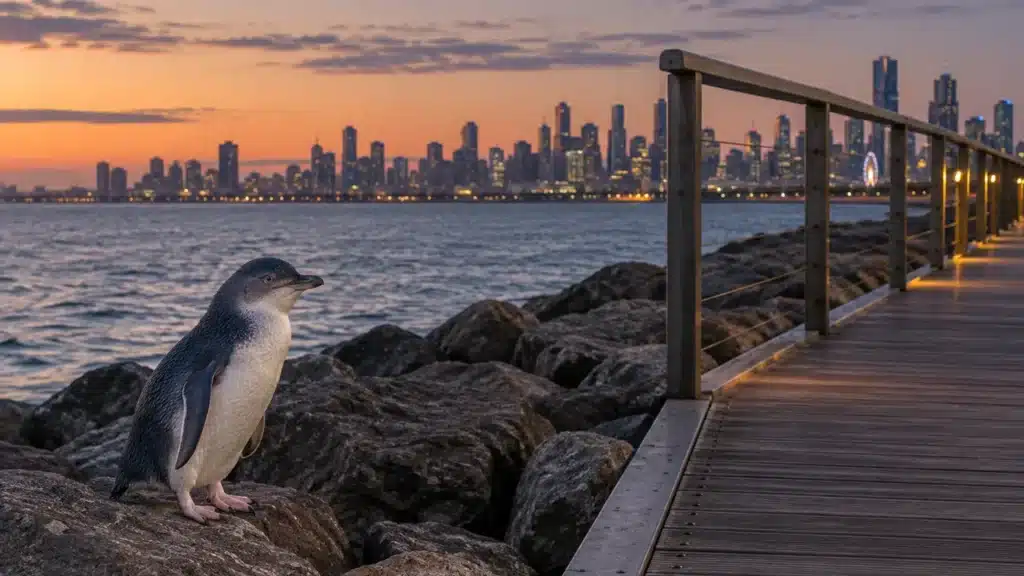
Phillip Island’s Penguin Parade beach is remote, dark, coastal, a proper nature reserve feel about two hours from Melbourne. St Kilda is a working breakwater at the end of St Kilda Pier, with the lights of the city glowing behind you and the Melbourne skyline visible across the bay on a clear night. With a session booked, you can genuinely go from a flat white at a café near Jacka Boulevard to the end of the pier, watching a wild seabird colony, inside about fifteen minutes. That contrast is, in our view, the more compelling story: not “look how remote and pristine this is” but “look how a wild colony has held on right next to a capital city.” It’s the throughline of a lot of what we write here, and it’s genuinely the reason this colony has been studied continuously since Professor Mike Cullen of Monash University began fortnightly night trips in 1986, following a harbour redevelopment proposal, with Neil Blake from St Kilda Council assisting him. Cullen kept those trips going until his death in 2001, and volunteer monitoring has carried on since: approaching four decades of observation on a rock wall nobody built for penguins in the first place.
If you want to make a proper evening of it rather than just ducking down for the session, our guide to the pier and foreshore covers how to combine the visit with dinner or a drink beforehand, and St Kilda’s restaurant strip gives plenty of options if you’re coming straight from the city.
What you won’t get at St Kilda (and why that’s sort of the point)
Be upfront with yourself about this before you go: there’s no guaranteed close-up wildlife photography moment, no gift shop, and no staff member narrating numbers into a microphone. Reaching the viewing boardwalk means a walk out along the pier, and if mobility is a concern for anyone in your group it’s worth reading our accessibility guide before you book. What you do get is a quiet, close view over the railings, with a guide a few steps away pointing out a penguin surfacing between waves, rather than an usher directing a crowd toward bleacher seats.
Numbers here are much smaller and there’s no promise of any sightings at all on a given night, which is worth setting expectations around rather than treating St Kilda as a like-for-like substitute. It genuinely isn’t. Weather changes things too; a rough southerly can push the swell right up over sections of the breakwater and change what you’ll see entirely, which we’ve covered in our piece on wind and rough seas.
The volunteers do a different job here
At Phillip Island, staff manage a large paying audience and infrastructure. At St Kilda, the picture is closer to guardianship: guides are present during the nightly sessions, keeping voices down and lights off, while trained volunteers carry out the less visible work of population counts, weighing and banding that keeps the fortnightly-to-decades-long monitoring record going. Off-leash dogs remain a real and ongoing risk to a ground-nesting seabird colony on an exposed rock wall; dogs are welcome on St Kilda Pier on a lead, but dogs, cats and fishing are prohibited on the breakwater itself at all times. If that side of things interests you, our piece on the volunteer monitoring and banding programme is a good next read, and there’s a separate guide if you’re wondering how to get involved yourself.
It’s worth remembering little penguins are not an Antarctic species, whatever penguin documentaries might have primed you to expect visually. These are temperate-coastline birds native to southern Australia and New Zealand, and the low, dark, wind-scoured rock wall at St Kilda is a far more accurate penguin habitat, ecologically speaking, than any ice floe. If that surprises you, have a look at our explainer on why St Kilda’s penguins have nothing to do with Antarctica.
So which one should you actually go to?
Both, if you can. They’re not really competing experiences once you stop expecting St Kilda to behave like a smaller Phillip Island. Go to Phillip Island for scale, reliability and a big-format wildlife show that’s genuinely well produced. Come to St Kilda for something quieter and stranger: a colony that was never supposed to exist, thriving in the gaps of a breakwater a fifteen-minute tram ride from Flinders Street, monitored for the better part of forty years by volunteers rather than paid staff. According to Zoos Victoria’s own conservation information on the species, little penguins face genuine pressure from habitat disturbance and predation across their mainland range, and a colony surviving in a CBD-adjacent, human-built structure is, frankly, a bit of a fluke worth protecting rather than taking for granted. The Victorian Government’s DEECA environment pages carry similar notes on coastal seabird pressures more broadly.
Bring warm layers regardless of which colony you choose, keep your phone dark, and book your St Kilda session before you set out, since times shift with sunset. If you want the practical packing list for a St Kilda evening specifically, we’ve got a rundown in what to wear and bring for a night visit. Turn up expecting less production and more coincidence, and St Kilda tends to deliver something Phillip Island, for all its polish, simply isn’t built to.