
No grandstand, no floodlit beach. Just a rock wall, a 150-metre elevated boardwalk at the end of St Kilda Pier, and an hour of watching the sky go from orange to grey. Since 29 October 2025 the colony has been viewed from that boardwalk during nightly one-hour sessions run by Phillip Island Nature Parks: free, but ticketed, with two sessions each evening capped at 150 people, so bookings are essential. You can read how it all works in our guide to penguin viewing at St Kilda. Compare that with Phillip Island, where you’ll queue at a visitor centre, pay an entry fee, and watch several hundred penguins cross a floodlit beach in front of tiered seating, and you start to see why people ask us constantly which one is “better.” Wrong question, honestly. They’re different animals – not the birds, the experiences.
Because both sites are now ticketed, the real differences are scale and setting, and that’s the part that gets oversimplified in most of what’s written about them. So let’s actually pull it apart.
Two colonies, two very different scales
Phillip Island’s Summerland Beach colony is the famous one, the one in the tourism brochures, and for good reason: it’s large, well-studied, and the “parade” of penguins coming ashore en masse after dark is a genuinely striking piece of natural theatre. St Kilda’s colony is much smaller and lives inside the cavities of a rubble-stone breakwater built in 1955 as part of the pier upgrade – nobody planned it, the little penguins just moved in over time and never left. That accident of history is worth sitting with for a second. This is the only mainland breeding colony of little penguins in Victoria sitting inside a major city, about 7km from the CBD, wedged between a working harbour and a beach full of swimmers and dog walkers.
We’ve got a full breakdown of the numbers and the monitoring differences over at our colony-size comparison, but the short version is: Phillip Island counts its birds in the thousands across a protected reserve; St Kilda’s population is a fraction of that, on a structure never built for wildlife, right next to a marina.
Booking, cost and what each one buys you
The St Kilda sessions cost nothing, but you still need to book a ticket, and numbers each night are capped. Phillip Island charges an entry fee that funds a large conservation and visitor operation, including the boardwalks, viewing platforms and ranger presence that protect its much bigger colony from tourist pressure. Neither model is wrong. We’ve laid out the fuller cost-and-experience case in St Kilda vs Phillip Island: how the two penguin experiences compare, but the practical upshot for a visitor is this: at Phillip Island you’re buying infrastructure and near-guaranteed sightings of a big group event. At St Kilda you’re getting a quieter, much smaller-scale encounter from behind the boardwalk railings, with guides on hand during the session and no guarantee of how many birds will come in.
Worth saying plainly: if what you want is a reliable, big-scale wildlife spectacle for a group or family, Phillip Island’s model does that job better. St Kilda was never built to do that job, and pretending otherwise does the colony a disservice.
The setting: nature reserve versus inner-city breakwater
Phillip Island’s parade happens on an open beach within a dedicated nature park, away from city lights and traffic. St Kilda’s colony returns to a rock wall that sits beside a marina, a popular swimming beach, and a foreshore lit up by streetlights and passing traffic. That’s part of what makes it remarkable – a wild seabird colony persisting that close to a capital city, but it also means the threats are different and more immediate. Artificial light disrupting the penguins’ night return is a real, documented problem here in a way it simply isn’t at a more isolated reserve, which is why the boardwalk itself uses wildlife-friendly lighting and closes each night once the sessions finish; we’ve written about how that plays out in how foreshore light disrupts penguins coming home at dusk. Boat traffic and propeller strike are a live risk near the breakwater too, something we cover in more detail in our piece on boat strike risk, and it’s not really a concern the Phillip Island parade beach has to contend with at the same scale.
Little penguins, whichever colony you’re watching, forage at sea all day and only come ashore after dusk, under cover of darkness – that’s a fixed behavioural trait of the species, not a show scheduled for tourists. Both sites are simply built around that same biological fact.
What you’ll actually see, and when
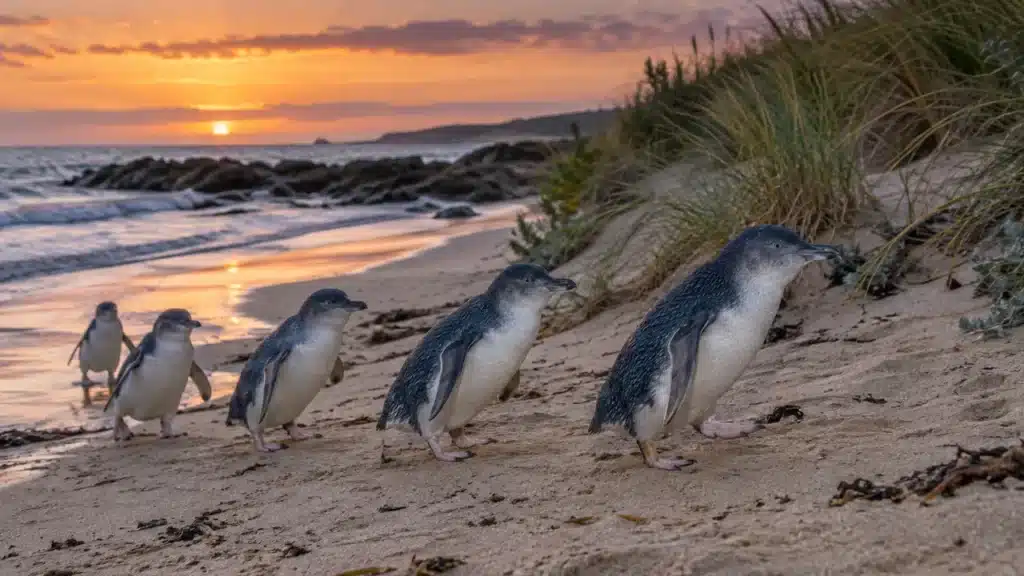
At Phillip Island, the parade is genuinely a parade: a concentrated, predictable wave of birds crossing open sand not long after sunset, viewed from fixed seating. At St Kilda, you’re watching (and often hearing, well before seeing) penguins slip into gaps in the rock wall in ones and twos, scattered along the length of the breakwater below the boardwalk. Some nights you’ll see a dozen birds. Some nights, especially in rough weather, you’ll see very few and hear plenty of calling from inside the rocks instead. We always tell first-timers that patience matters more than timing here, because session times shift with sunset and nothing about a wild colony comes with a guarantee.
Weather changes this more than people expect too. Wind and swell affect where and when the St Kilda birds come in, something we go into in how wind and rough seas change what you’ll see at the breakwater. Phillip Island’s more sheltered beach setting smooths a lot of that variability out for visitors; St Kilda doesn’t have that luxury, which is part of its appeal if you like your wildlife encounters a bit less curated.
Rules, supervision and why volunteers matter at both
Neither site leaves visitors to their own devices, and neither should. At Phillip Island, staff and infrastructure manage crowd behaviour largely through the built environment: boardwalks, barriers, timed entry. St Kilda now works in a broadly similar way on a smaller footprint – you watch from the elevated boardwalk, behind the railings, with guides present through the session, and nobody walks on or stands among the breakwater rocks. Volunteers also carry out the population counts, weighing and banding that keep track of how the colony is faring. The rules are simple and they matter: no flash photography, no torches or bright lights, don’t touch, feed or approach the birds, keep your voice down, and take your rubbish home with you. You can read more about the monitoring and guiding side of things in how guided viewing and volunteer monitoring work at the St Kilda breakwater.
This matters more than it sounds. Off-leash dogs are consistently one of the most serious threats to the St Kilda colony, precisely because the breakwater sits so close to a popular dog-walking beach. Dogs are welcome on St Kilda Pier itself on a lead, but dogs, cats and fishing are prohibited on the breakwater at all times – a pressure Phillip Island’s more isolated reserve doesn’t face in the same way. If you’re bringing a dog anywhere near the St Kilda foreshore at dusk, it needs to be leashed and kept well away from the rocks; we’ve covered why in why dogs must stay leashed and off the rocks.
If you’ve done Phillip Island first
Plenty of visitors come to St Kilda already having done the Phillip Island parade, often years earlier on a family trip, and turn up expecting something similar in miniature. It isn’t, and resetting that expectation early makes for a much better evening. There’s no announcer and no wave of birds crossing open sand, and you might spend a good part of the hour in near-darkness before you hear that first, slightly eerie call from inside the rocks. We wrote a whole piece for exactly this audience: first time at St Kilda after Phillip Island? Here’s what changes. The short of it is: come for a genuinely wild, unscripted encounter with a species that’s chosen to live alongside a city rather than away from it, not for a repeat performance of the parade.
Getting there is straightforward regardless – trams 12, 16 and 96 run from the Melbourne CBD and stop at St Kilda Pier, with limited paid parking next to the Sea Baths and along the main roads, covered in our guide to getting to St Kilda Pier. Dress warmer than you think you need to; the boardwalk catches the wind straight off the bay even on mild nights.
Which one should you actually go to
Both, if you can. They’re not really competing for the same evening. Phillip Island gives you scale, certainty and a purpose-built conservation operation funded by its ticketing, and researchers have published extensively on little penguin biology more broadly if you want the deeper science behind what you’re watching at either site. St Kilda gives you something rarer in a practical sense: proof that a wild seabird colony can hang on inside the cavities of a 1955 rock wall a few kilometres from Flinders Street, if enough people watch quietly from the boardwalk and leave it alone after dark. Which one you find more affecting is a personal call, not a knock on the other.